How the Claude Code Agent Loop, Tools, Context, and Sessions Work
Understand Claude Code's gather-act-verify loop, built-in tools, session lifecycle, checkpoints, context limits, and recovery techniques.
How the Claude Code Agent Loop, Tools, Context, and Sessions Work
Quick answer
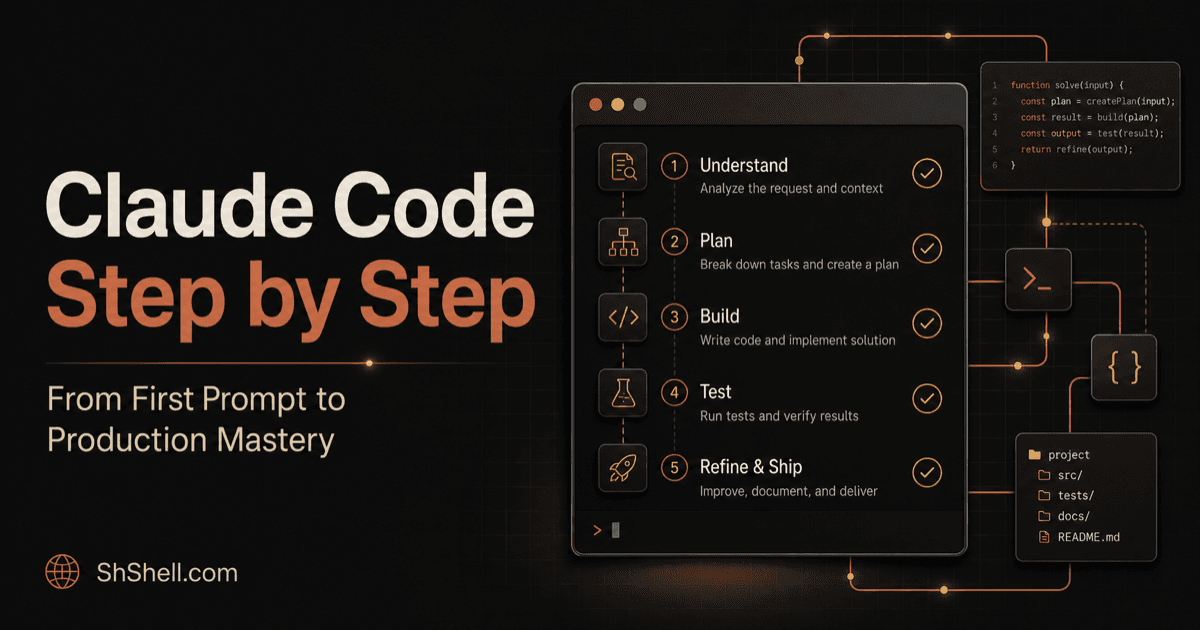
Claude Code repeats three blended phases: gather context, take action, verify results. The model reasons, tools read and change the environment, and every tool result becomes new context for the next decision. You improve outcomes by giving it a precise goal, useful constraints, and a testable finish line—not by prescribing every keystroke.
Anthropic's How Claude Code works guide is the primary reference for this mental model.
The loop in practice
Suppose a checkout endpoint sometimes returns duplicate orders. A weak workflow jumps to editing. A strong loop looks like this:
- Gather: reproduce the failure, read the route, trace the service and database transaction.
- Act: add a failing concurrency test, then make the smallest safe change.
- Verify: rerun the focused test, related tests, static checks, and inspect the diff.
- Repeat: if evidence contradicts the hypothesis, revise it rather than defending the first patch.
Prompt it explicitly:
Investigate duplicate orders in checkout. Reproduce first. State the leading
hypothesis and evidence. Add a regression test that fails before the fix. Make
the smallest safe change, run focused and related tests, then summarize residual risk.
Tools turn text into agency
Claude can use file operations, search, shell execution, web research, code intelligence, configured MCP tools, and orchestration tools. A tool result is observation, not truth. A test may be misconfigured; a search may miss generated code; an external document may be stale.
Use verification diversity:
- Behavior: a regression or end-to-end test.
- Structure: type checking, linting, or compilation.
- Change quality:
git diff --checkand focused review. - Scope:
git status --shortto catch unexpected files. - Requirements: a checklist mapped to observable evidence.
Sessions are durable, context is finite
Claude Code saves local session history and supports resuming and forking. Useful commands include:
claude -c          # continue the most recent conversation in this directory
claude -r          # choose a session to resume
claude -p "task"  # non-interactive one-off task
Inside a session, /clear starts fresh context. A new context window is often better than dragging a long, confused history into a new task. Persistent project knowledge belongs in CLAUDE.md or a focused skill, not in the hope that an old conversation remains available.
Prevent context pollution
Context quality matters more than context volume. Avoid pasting entire logs or repositories. Ask Claude to search narrowly, summarize findings, and cite relevant paths. Use subagents when a task requires reading many files but the main thread only needs conclusions.
Bad:
Read everything and fix authentication.
Better:
Map the authentication flow from middleware to session validation. Read only
the files needed to establish the flow. Return a path-and-symbol evidence map,
then wait before proposing changes.
Interrupt, steer, and recover
You are part of the loop. Interrupt when Claude pursues the wrong layer, expands scope, or repeats an ineffective action. Give corrective evidence:
Stop. The failing request never reaches the controller; the gateway log shows
a 413. Investigate request-size handling before changing application validation.
If a change goes wrong, inspect the diff and use Claude Code's checkpoint/rewind capabilities or version control. Do not use destructive Git recovery unless you understand which uncommitted changes belong to you.
Mastery exercise
Choose a small defect. Before Claude edits, require it to produce:
- a reproduction command;
- an evidence-backed hypothesis;
- the smallest affected surface;
- a verification plan with at least two independent signals.
Afterward, compare the planned and actual evidence. Note where the loop changed course and why.
FAQ
Is Claude Code just a chatbot with shell access?
No. The harness manages tools, permissions, project context, sessions, checkpoints, and extension points around the model.
When should I start a new session?
Start fresh when the objective changes materially, the context contains obsolete assumptions, or repeated corrections indicate the current thread is anchored on the wrong model.
Why does Claude sometimes repeat work?
The verification signal may be weak or context may be noisy. Give a concrete oracle, narrow the task, and point out already-established facts.