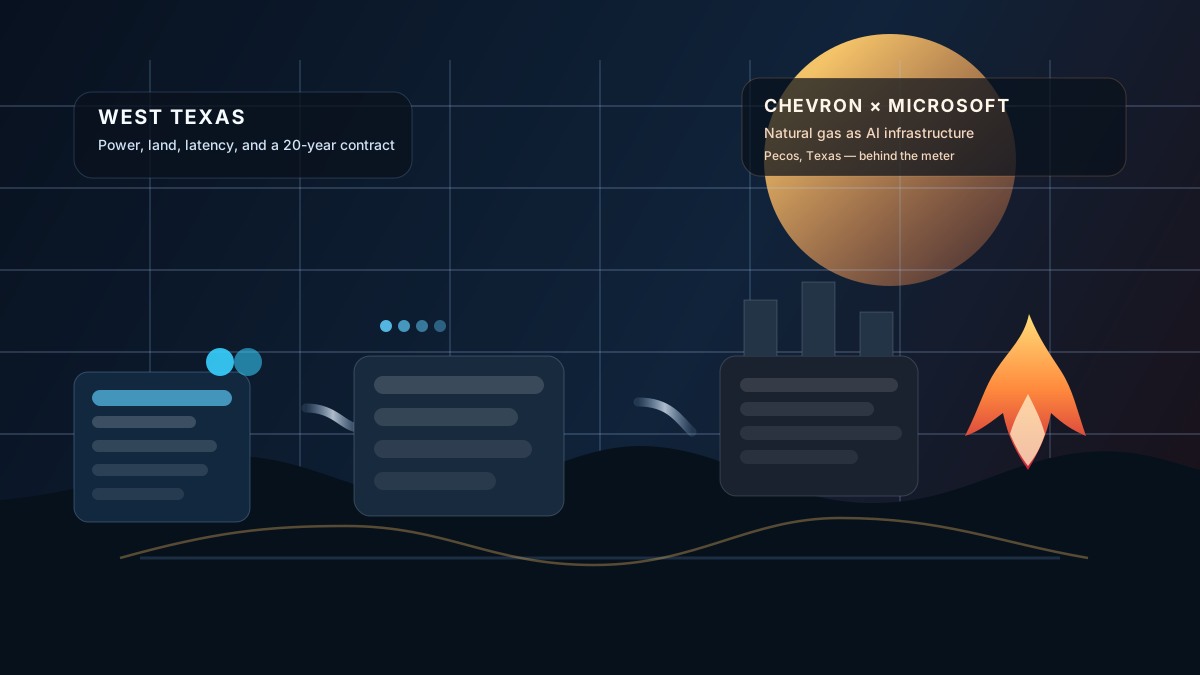
Chevron’s 20-Year Gas Deal With Microsoft Is Really a Bet on AI’s Power Scarcity
Chevron’s 20-year pact to supply natural gas power for Microsoft’s West Texas data center is less a fuel contract than a wager on AI’s grid-constrained future.
The cleanest way to understand Chevron’s deal with Microsoft is to stop calling it a fuel contract. It is a capacity contract, a timing contract, and a political contract. The gas matters, but mostly because it is the fastest way to turn land in West Texas into reliable electricity for a data center that cannot afford to wait for the grid to catch up.
That is why the announcement lands differently from the usual parade of AI partnerships. According to Reuters, Chevron signed a 20-year power supply deal with Microsoft for a Texas data center. Chevron’s own statement framed the arrangement as an exclusivity agreement with Microsoft and Engine No. 1. Microsoft’s blog, meanwhile, pointed to a new datacenter in Pecos, West Texas. Put those pieces together and the real story becomes obvious: the AI boom is no longer only a software race. It is a site-selection race, a fuel-procurement race, and a race to secure industrial infrastructure on a timeline that the public grid was never designed to satisfy.
West Texas is not just a place where a company can put a building and plug it in. It is a place where the economics of power, land, and cooling can be reassembled around a single high-value customer. That matters because data centers have crossed a threshold. They are no longer warehouses for servers in the old sense. They are power conversion plants whose output happens to be inference, storage, and cloud services. The hardware is digital; the constraints are physical. Whoever gets the physical layer right gets to sell the digital layer.
Pecos is not a backdrop; it is the business model
Pecos sounds like geography. In this story it is strategy.
West Texas offers a convergence of advantages that make sense only when the load is enormous and the timeline is tight. There is land. There is a long history of industrial development. There is proximity to gas production and energy expertise. There is enough space to build around the plant instead of on top of it. And there is a political culture in Texas that tends to welcome big infrastructure bets if they come wrapped in jobs, tax base, and local pride.
That combination makes the site attractive for Microsoft, which wants more than just more machines. It wants a dependable location to absorb growing AI demand without spending years waiting on transmission queues, interconnection studies, and grid upgrades. It makes Chevron attractive too, because Chevron is not being asked to pretend it is a utility in the narrow regulatory sense. It is being asked to do what it already knows how to do: lock up a resource, structure a long-term deal, and manage a capital-intensive project for a known buyer.
The key fact is that Microsoft is not buying electricity the way a household does. It is buying the ability to operate at scale without uncertainty becoming a bottleneck. A 20-year term is a clue. Nobody signs for two decades because they are searching for a temporary work-around. They sign for two decades because the asset they are building has a life measured in depreciation schedules, software refresh cycles, and product generations.
The longer the time horizon, the more the arrangement begins to look like infrastructure finance rather than procurement. That is one reason the deal matters so much. It is a financial instrument disguised as an energy story.
What a 20-year contract actually buys
A power agreement of this length does several things at once.
First, it reduces price uncertainty. Gas prices swing, power prices swing, and data center economics hate swings. Even a platform as large as Microsoft would rather lock in a structure that it can model than expose a massive new campus to market volatility every quarter. Long-term contracting turns a floating problem into a spreadsheet problem, and companies prefer spreadsheet problems because they can be financed.
Second, it makes a capital project bankable. Chevron is not building behind-the-meter gas infrastructure for applause. It is doing it because a 20-year offtake style arrangement helps justify the spend. In the same way an LNG terminal or pipeline project needs credible demand, a power plant for a data center needs a buyer that can anchor the economics from day one. Microsoft supplies that anchor.
Third, it cuts time-to-capacity. This is probably the most important part. In a world where AI demand is compounding faster than the grid can expand, the scarce resource is not natural gas itself. It is completed infrastructure. Gas turbines, substations, switchgear, transformers, and interconnects take time. If the service area cannot move quickly enough, a behind-the-meter arrangement becomes a way to bypass the queue.
Fourth, it shifts operational risk. The customer buys reliability; the developer absorbs more of the project complexity. That includes engineering, compliance, fuel logistics, maintenance, and the long tail of operating costs. Microsoft is not eliminating risk. It is moving risk into a container it can negotiate around.
Here is the more pointed way to say it: Microsoft is paying for optionality. Chevron is being paid to make that optionality real.
| Question | Traditional grid approach | Chevron-style behind-the-meter deal |
|---|---|---|
| How fast can capacity come online? | Often constrained by interconnection queues and transmission buildout | Faster if land, fuel, and generation are co-developed |
| Who bears price volatility? | Shared with the utility system and wholesale market | More directly managed through a long contract |
| What matters most? | Delivered kilowatt-hours | Reliable, schedulable megawatts on command |
| Main bottleneck | Grid congestion and permitting | Capital discipline and execution |
| Strategic value | Commodity electricity | Infrastructure with a customer attached |
That table explains why this announcement is more interesting than the headline suggests. The unit of analysis is not electricity. It is dependable load.
Behind the meter is the new moat
For years, the phrase “behind the meter” sounded like something only energy nerds cared about. In 2026 it is one of the most consequential phrases in the AI economy.
Why? Because the AI buildout has become more like industrial manufacturing than software deployment. A model may be born in a research lab, but it lives or dies on the strength of the power system underneath it. If a company cannot secure energy, it cannot secure compute. If it cannot secure compute, it cannot serve the products it hopes will define the next decade.
A behind-the-meter setup can be faster because it reduces dependence on the public grid for the core load. That does not mean the grid disappears. It means the data center gets its own architecture for handling the first-order problem of power delivery. In a place like West Texas, where industrial load and energy supply already coexist, that can be a very rational answer to a very modern problem.
The point is not that grids are obsolete. The point is that grid timelines and AI timelines have diverged. Utilities plan in years. Hyperscalers plan in product cycles. The mismatch is now visible enough that companies are building their own physical bridges over it.
flowchart LR
    A[AI demand growth] --> B[Need for new compute capacity]
    B --> C[Data center site search]
    C --> D[Power availability becomes the constraint]
    D --> E[Behind-the-meter gas generation]
    E --> F[Microsoft campus in Pecos]
    F --> G[More training and inference capacity]
    G --> A

    H[Gas supply] --> E
    I[Land and permits] --> E
    J[Cooling and water strategy] --> F
    K[Long-term contract] --> E
The diagram matters because it shows the loop. Power is no longer merely an input to AI. It is the gatekeeper for growth. When power is the gatekeeper, the companies that control access to it become part of the AI stack whether they call themselves tech companies or not.
The economics of capacity, not electricity
A conventional conversation about power asks how many megawatt-hours will be consumed. That is the wrong question for this phase of AI.
The better question is: how much would you pay to avoid delay?
Data center economics are unusually sensitive to delay because demand is not waiting politely in a queue. It is arriving from many directions at once: enterprise copilots, search products, developer tooling, consumer assistants, video generation, recommendation systems, and the internal automation layers every large company is now trying to bolt onto existing software. If the servers are not there, revenue is deferred. If the servers are there but the power is shaky, uptime erodes. If uptime erodes, customer trust erodes with it.
That is why long-term power agreements can look expensive on a narrow fuel basis and still be rational on a total-economics basis. Microsoft is not buying cheap gas. It is buying predictability in a market where predictability has become expensive.
The same logic has already reshaped other parts of the AI stack. Chip orders are locked in years ahead. Foundry capacity is reserved. Data centers are built where land and power can be secured, not simply where the cheapest square foot happens to be. The Chevron-Microsoft deal is the latest proof that AI infrastructure has become a contract-first industry.
If you want a simple way to think about the money, think of it this way: downtime is the most expensive fuel of all. If a data center cannot support the workloads that Microsoft expects to monetize, then the cheap route is the expensive route. A more expensive energy structure that actually works can produce a lower all-in cost than a cheaper structure that stalls deployment.
That is particularly true in Texas, where power demand is rising fast and the industrial system is already straining to keep up with new load. A customer with Microsoft’s balance sheet can turn that stress into leverage. A supplier like Chevron can turn that leverage into a twenty-year business line.
Chevron is not becoming a utility. It is becoming something else.
Chevron has spent most of its modern life as a company that lives upstream, downstream, and everywhere in between. The Microsoft deal suggests a new role: not utility operator, not pure commodity seller, but infrastructure orchestrator.
That distinction matters.
A utility is regulated to deliver electrons broadly and reliably to a defined service territory. Chevron is not doing that. It is using its balance sheet, project experience, gas relationships, and capital discipline to package power for a specific customer. That is a different business. It resembles the way industrial developers, private power firms, and large-scale infrastructure sponsors think about project finance.
It also fits the strategic moment for oil and gas companies. The easiest mistake to make is to assume that the energy transition leaves them with only one choice: decline. In practice, a company like Chevron can adapt by moving closer to the demand centers that still need hydrocarbons, especially where natural gas is presented not as a moral compromise but as a practical load-balancing tool.
That is partly why the activist-investor-to-power-developer angle matters. Engine No. 1’s presence in the broader arrangement signals that the market is searching for ways to make legacy energy assets legible to AI-era demand. This is not about greenwashing, though that risk exists. It is about using existing hydrocarbon expertise to serve a new kind of industrial customer.
Chevron also gains a hedge against a different risk: irrelevance. If the company can prove that gas is still essential in high-value digital infrastructure, it strengthens the argument that hydrocarbons remain economically relevant even as energy systems diversify. That does not erase climate pressure. It changes the negotiation.
Microsoft is buying time, not nostalgia
Microsoft’s interest is easier to explain but harder to appreciate fully.
The company is in the middle of a race for capacity. That race is not just about competing with Amazon, Google, and the rest of the hyperscalers. It is also about making sure that its own product ambitions do not outrun its physical footprint. Every major AI product line creates load. Every load source creates a new dependency. The winning company is the one that can turn dependencies into controllable contracts instead of fatal bottlenecks.
The Pecos deal gives Microsoft something that is often more valuable than idealized sustainability language: confidence that capacity will exist when it is needed. It also gives Microsoft a foothold in Texas, where the economics of enterprise infrastructure remain unusually attractive for exactly the reasons the industry now cares about most: land, power, interconnection, and scale.
There is a broader strategic layer here too. Microsoft has spent years building a cloud business around trust in reliability. AI complicates that promise because the workloads are heavier, the demand curves are steeper, and the public scrutiny is harsher. If customers want Copilot, models, and enterprise AI features, Microsoft has to keep the machine fed. A long-term power deal is the sort of boring decision that makes a flashy AI product possible.
It is also a sign that the company has accepted a harder truth: the cloud is becoming partially industrial. Software companies used to outsource physical complexity so thoroughly that the abstraction itself became part of the product. AI has broken that habit. The physical layer is now visible again, and Microsoft is choosing to manage it rather than pretend it can be ignored.
The climate argument will be fought on the balance sheet
This is the part of the story that will produce the loudest arguments and the least satisfying slogans.
Natural gas is cleaner than coal, but it is still a fossil fuel. A deal that locks in gas-fired power for two decades will attract criticism from environmental groups, climate policymakers, and anyone who believes the AI industry is accelerating fossil-fuel dependence under the cover of progress. Those critics are not wrong to worry about lock-in.
At the same time, the climate debate cannot be reduced to a binary moral position. The real question is whether a gas-backed data center is a transitional bridge, a permanent workaround, or a justification for delaying better grid solutions. The answer depends on what comes next. If the same firms use the contract to accelerate lower-carbon generation, transmission upgrades, storage, demand response, and eventual fuel substitution, then the deal can be framed as a bridge. If it simply creates a comfortable excuse to keep burning gas, it becomes a dead end.
The emissions math will matter, but so will methane leakage, fuel sourcing, and the actual engineering of the plant. The climate cost of gas is not just combustion. It is the full lifecycle chain, including how fuel is produced, transported, and burned.
Data center operators know this. So do investors. That is why sustainability claims around AI infrastructure now need to be audited at the same level as uptime claims. A green label is not the same thing as a credible emissions plan.
Texas complicates the picture. The state’s energy system has long been pragmatic, market-driven, and willing to absorb large industrial loads. That flexibility can support innovation. It can also externalize environmental costs if the growth of digital infrastructure outpaces the environmental governance around it.
The honest read is that this deal will likely make both sides more powerful and more exposed. Microsoft gains capacity. Chevron gains relevance. Regulators, local communities, and climate advocates gain a new target for scrutiny.
Texas gets jobs; Texas also gets a grid experiment
Every megaproject arrives wrapped in promises about investment, employment, and competitiveness. This one is no different. There will be construction jobs, operations jobs, engineering jobs, and service contracts. There may be tax revenue and supporting infrastructure. West Texas will get another reason to think of itself as more than extraction country.
But the more important outcome may be less visible. Texas is becoming a laboratory for the next phase of power-market design. As AI load grows, the state will have to reconcile three competing truths: industrial customers want fast capacity, the grid has physical limits, and the economics of expansion get ugly when demand arrives faster than transmission.
That is why a deal like this matters locally. It turns abstract national debates into concrete planning problems. How much water does cooling require? How much fuel security is needed? What happens if gas prices move sharply? What if the data center expands faster than expected? What does resilience mean when a campus is critical to a global platform company?
Those are not rhetorical questions. They are operating questions.
And they point to another reason the project is interesting: it makes the local consequences of AI visible. People like to imagine AI as software floating above the real world. The Pecos project says otherwise. It needs land and weather tolerance and fuel logistics and policy permission. It needs people who know how to build and maintain industrial systems. It needs Texas to be Texas in the oldest sense: a place where large-scale infrastructure can still be assembled quickly if the economics line up.
That is precisely why it will be watched closely. If it works, it becomes a template. If it stumbles, it becomes a cautionary tale about the limits of private power as a substitute for grid planning.
The signal for Silicon Valley is contractual, not technological
There is a temptation to read every AI headline as a model story. That habit is increasingly obsolete.
The true signal from the Chevron-Microsoft deal is that the next wave of AI competition will be decided partly by the quality of contracts. Which companies can lock in land before land becomes scarce? Which can secure power before the queue gets longer? Which can guarantee cooling and water at a scale that satisfies both operations teams and public scrutiny? Which can turn a decades-long asset into a repeatable deployment pattern?
In other words, the new advantage is not just technical superiority. It is infrastructure literacy.
That is bad news for firms that still think they can sprint ahead with software alone. It is good news for firms that understand how to finance, locate, and operate physical systems. It also helps explain why energy companies are suddenly appearing in AI news stories. They are not after the models. They are after the bottlenecks.
The bottleneck is where profit gathers.
If Microsoft can make a data center in Pecos function as a long-lived AI asset, it strengthens the case for more such structures. If Chevron can prove that gas can be packaged as reliable digital infrastructure, it opens a new line of business that sits between commodity energy and bespoke power development. That is a significant strategic change, even if the language around it sounds businesslike and restrained.
This is what industrial evolution looks like in 2026: a cloud company and an oil major signing a twenty-year deal because the world has run out of patience for pretending that compute can scale without power.
The future will not be announced in grand theory. It will be signed in contracts, priced in megawatts, and built in places like Pecos.
And once that happens, the real competition is no longer just for AI users. It is for the right to own the power plant that feeds them.