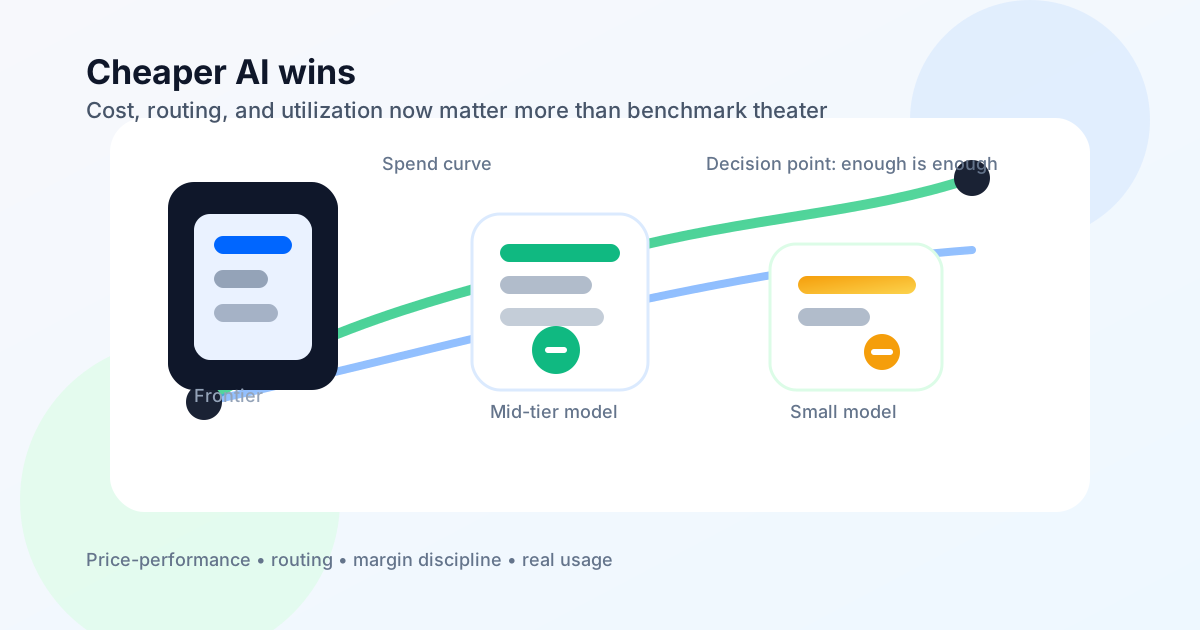
Cheaper AI Is Winning Because the Bill Has Finally Landed
Reuters' latest reporting on AI costs points to a bigger shift: businesses are no longer chasing the fanciest model, they're buying the cheapest model that still ships the job.
The AI market has spent years rewarding spectacle. Bigger models, louder launch events, cleaner benchmark charts, more dramatic claims about reasoning, memory, coding, and autonomy. But the latest Reuters reporting on how soaring AI bills are reshaping model choice says the market is finally colliding with the one thing that ends every abstract growth story: the invoice.
That is the real news. Not that companies want cheaper AI. They always wanted cheaper AI. The news is that cheaper AI is becoming the default strategy because the economics are now impossible to ignore. Enterprises are no longer treating frontier models as the automatic answer to every task. They are asking a more mature question: what is the smallest model, or the least expensive route, that still delivers the result we need?
Once that question becomes normal, the entire market changes shape.
The shift is bigger than token prices. It changes product design, procurement, vendor positioning, cloud strategy, and even how investors interpret the AI trade. It also changes how technical teams build systems. The old instinct was to route everything to the most capable model and optimize later. The new instinct is to route intelligently from the beginning because later may be too expensive.
What the reporting is really telling us
Reuters’ framing is useful because it captures the behavior change without dressing it up as a trend piece. Businesses are not asking whether AI is useful. They are asking which version of AI is worth the cost.
That distinction matters. A model can be technically impressive and commercially wrong. It can ace a benchmark and still be a bad choice for day-to-day use. It can perform brilliantly in a demo and still fail the procurement test once the company sees what recurring usage looks like at scale.
This is the moment the industry has been approaching for some time. The first phase of generative AI was driven by curiosity. The second phase was driven by experimentation. The third phase is being driven by budget discipline. That is why so much of the market is now split between two camps. One camp still talks about capability in the abstract. The other camp is trying to figure out how to get acceptable output for half the price.
In the early days, people assumed model quality would dominate everything else. The best model would win because it was smartest. The reality is messier. Most enterprises do not need the smartest possible model for every step. They need the right model for the right stage of the workflow. In many cases, a smaller model or a cheaper route is not a compromise. It is the rational choice.
The current coverage is all pointing at the same thing
The Reuters piece does not live alone. It sits inside a wider pattern of reporting that says AI is starting to behave like a cost-sensitive utility rather than an infinite software layer.
| Source | Signal | What it means |
|---|---|---|
| Reuters | Soaring AI bills are reshaping how businesses choose models | Cost is now a primary selection criterion |
| Reuters Market Talk | Doubts are creeping into the AI trade | The market is starting to price in realism |
| Reuters | Google limiting Meta’s Gemini usage | Capacity and rationing are part of the new normal |
| OpenAI / HP coverage | Enterprise partnerships are becoming managed layers | Distribution is moving closer to procurement |
| Reuters | Companies cutting jobs as investments shift toward AI | AI spend is forcing tradeoffs elsewhere in the business |
| Fortune | AI spending boom accelerates as Big Tech pours into infrastructure | The bill is not just at the app layer; it is at the infrastructure layer |
| Reuters | South Korea’s AI-chip drive | Nations are treating compute as industrial policy |
| NVIDIA / AWS coverage | Production-scale AI stack | Efficiency and throughput are now product features |
| OpenAI / Broadcom coverage | Custom silicon and cost control | The biggest AI firms are trying to lower their own unit economics |
| Microsoft and cloud reporting | AI concerns weigh on stocks | Investors are realizing growth stories depend on margin stories |
What is striking about this table is not that every outlet says the same thing. It is that each outlet is looking at a different part of the same machine. The signal is coherent: AI is no longer a novelty spend. It is a line item with consequences.
Why price-performance has become the only honest metric
Benchmark scores matter, but only up to a point.
A benchmark is a proxy. It tells you something about capability. It does not tell you whether the model is affordable, whether it can be routed efficiently, whether it can run at acceptable latency, whether the surrounding application will stay stable, or whether the monthly invoice will make the finance team nervous.
That is why price-performance has become the real metric. It incorporates what leaders actually care about: output quality, latency, reliability, throughput, and spend. If a model is twice as expensive but only marginally better on the task that matters, it is often the wrong model. If a smaller model is good enough for 80 percent of requests and the frontier model only needs to handle the hardest 20 percent, the economics improve dramatically.
This is the central lesson the market is learning in public. AI is not one model. It is a portfolio.
A mature AI stack does not route all traffic to the most expensive endpoint. It uses a routing strategy that matches task complexity to model cost. Simple classification can go to a cheap model. Summarization can go to a mid-tier model. Sensitive or difficult reasoning can go to a frontier model. Retrieval can happen before generation. Caching can remove duplicate work. Local or open models can handle internal tasks. The expensive model becomes a specialist, not a default.
That architecture is not just smarter. It is financially survivable.
The new model stack is a budget stack
If you want to know where AI is headed, stop looking at the model leaderboard and start looking at the procurement spreadsheet.
Enterprise buyers are increasingly thinking in tiers:
- What task absolutely requires the best model?
- What task can be handled by a cheaper hosted model?
- What task can be done locally or with open weights?
- What task can be preprocessed so the expensive model sees less work?
- What task should be abandoned because it is not worth automating yet?
That is a much more disciplined way to build. It also creates a very different market for vendors. The cheapest useful model is not glamorous, but it is sticky. Once a company discovers that a slightly smaller model does the job at a fraction of the cost, the procurement logic changes permanently.
This is why the AI market is entering a phase where small and mid-sized models matter more, not less. They are not stepping stones. They are the economics of reality.
The winners in this environment are vendors that can prove a few things at once: low cost, acceptable accuracy, easy deployment, predictable behavior, and a clean route to scale. That is a very different value proposition from the old frontier-model narrative, where the pitch was simply that more intelligence solved everything.
A practical way to think about routing
The best way to see the change is to imagine a company dividing workloads by value, risk, and cost.
graph TD
    A[User request] --> B{How hard is the task?}
    B -->|Simple| C[Cheap model]
    B -->|Moderate| D[Mid-tier model]
    B -->|Complex or risky| E[Frontier model]
    C --> F[Cache result if reusable]
    D --> F
    E --> G[Human review if needed]
    F --> H[Workflow output]
    G --> H
That flow chart is the market’s new common sense.
A company that does not build some version of it will overpay. It will send too much work to the most expensive model. It will also create unnecessary latency and more points of failure. A company that does build it will discover that AI becomes cheaper not because any one model suddenly got miraculous, but because the system around the model got smarter.
That is a huge difference. It moves the discussion away from model worship and toward system design. In other words, it turns AI from a product decision into an operations discipline.
Where the savings actually come from
The savings are not coming from one magic trick.
They come from a series of small, boring moves that compound.
The first move is routing. Not every prompt deserves a frontier model. Many tasks are straightforward enough for smaller systems.
The second move is retrieval. If the model does not need to reconstruct the world from scratch, it wastes fewer tokens and less reasoning effort.
The third move is caching. A surprising amount of enterprise traffic repeats. If the same question is asked a thousand times, there is no reason to pay the full price a thousand times.
The fourth move is structured prompts and narrower outputs. If a company asks the model to return only the fields it needs, the bill drops. If it asks the model to write an essay when it only needs a classification, the bill rises.
The fifth move is model specialization. Fine-tuned or task-specific systems often outperform generic frontier models on a narrow workflow, especially when the workflow is repetitive.
The sixth move is user behavior. Once employees understand that every AI action has a cost, they start using the tool more deliberately. This sounds minor. It is not. Human behavior changes when the tool stops feeling infinite.
These are the kinds of efficiencies that make CFOs happier and product teams less allergic to scale.
The operational shift is bigger than the technical one
One mistake analysts make is treating cheaper AI as a pure technology story. It is not.
It is a management story.
The moment a company starts caring about token spend, it starts caring about governance. The moment it starts routing requests by cost, it starts caring about observability. The moment it starts using smaller models for routine work, it starts caring about quality assurance and fallback paths. Once AI becomes a budget item, it also becomes a control item.
That has a very practical implication. Companies will need dashboards that show cost by use case, not just total usage. They will need routing policies that can be changed without rewriting the application. They will need approval processes for when a task should escalate to a more expensive model. They will need testing pipelines that compare outputs across model tiers so that savings do not quietly turn into bad decisions.
In other words, the companies that save money on AI will usually be the companies that build the best AI operations.
That is good news for the market, because it means optimization itself becomes a product category. It also means that the companies selling AI infrastructure, observability, orchestration, and governance are likely to do well even if the frontier-model halo fades a little.
The investor read is changing too
Investors are beginning to understand that growth in AI usage does not automatically mean margin expansion.
That is a crucial shift. A classic software business gets more profitable as usage grows because the marginal cost of serving another user is low. AI can behave differently. If a product scales on a very expensive model, growth can compress margin. If a company is careless about routing, it can become a victim of its own success.
This is why the current AI trade is becoming more discriminating. Investors are asking whether usage is efficient, whether gross margins are defensible, whether there is a model mix strategy, and whether the company has any control over its compute destiny.
That skepticism is healthy. It forces management teams to explain not just how much AI they are using, but how they are using it. It also rewards companies that have the discipline to say no to overkill.
That discipline often looks boring. It is not. It is how a market matures.
How the AI vendor landscape may split
If cheaper AI continues to win, the vendor landscape will probably split into four rough groups.
First, the frontier model companies that still win on hard tasks, brand prestige, and premium enterprise contracts.
Second, the efficient model companies that specialize in good-enough performance at much lower cost.
Third, the orchestration companies that route work intelligently across models and data sources.
Fourth, the infrastructure and tooling companies that help enterprises measure, control, and optimize the whole thing.
That split is important because it means the market is no longer winner-take-all. A company can do very well without being the smartest model on earth if it becomes the cheapest reliable path to a specific outcome.
This is why the phrase "cheaper AI" should not be read as a compromise. It should be read as a competitive strategy.
In many industries, the most successful product is not the most advanced one. It is the one that consistently solves the problem at the lowest total cost. AI is finally entering that stage. The novelty is wearing off. The economics are taking over.
The market’s emotional arc is visible in the headlines
The headlines tell a story of transition.
A year ago, the dominant narrative was that frontier models would replace a lot of work simply because they were powerful enough.
Now the headlines are about bills, debt, capacity, rationing, and corporate discipline. Reuters reports that cheaper AI is better. Reuters reports that doubts are creeping in to the AI trade. Reuters reports that Google has limited Meta’s access to Gemini. Reuters also reports that companies are shifting jobs and investment patterns as AI changes their budgets. On the infrastructure side, the spending boom keeps climbing, which only makes the need for discipline more urgent.
That is what a normalizing market looks like. The tone changes from wonder to accounting.
For builders, this is a blessing. It gives them permission to solve the actual system problem instead of chasing demos. For buyers, it is a warning not to equate sophistication with value. For vendors, it is a reminder that the best product may be the one that saves money without making users feel like they lost anything.
That is a very hard product to build, which is why it will be worth a lot.
A simple decision table for teams
| Use case | Best default | Why |
|---|---|---|
| High-stakes reasoning | Frontier model | Accuracy and robustness matter more than cost |
| Routine summarization | Mid-tier model | Enough quality at lower spend |
| Classification and tagging | Small model | Cheap, fast, and scalable |
| Repetitive internal queries | Cached response or small model | Reuse beats recomputation |
| Sensitive on-prem tasks | Local or open model | Data control and predictable cost |
| Hard exceptions | Escalate to frontier model | Reserve expensive capacity for edge cases |
That table is the business reality hiding behind the news.
The biggest takeaway is that AI value is no longer measured by whether the company can afford to use the best model everywhere. It is measured by whether the company has the discipline to use the right model where it matters most.
What product teams should change on Monday
The easiest mistake to make is to treat cheaper AI as something the finance team handles later. It is not a finance-only issue. It is a product design issue. If a team wants the bill to stay under control, the product has to be built with budget awareness from the start.
That means deciding where the expensive model is allowed to exist. It means documenting which requests can be satisfied by lower-cost models. It means designing fallback paths so that a model failure does not automatically escalate to the most expensive option. It also means measuring cost per task, not just cost per day.
A product team that does this well usually ends up with a better system, not just a cheaper one. The app gets faster. The UX gets clearer. The quality becomes more predictable. The architecture becomes easier to maintain because every request has an explicit place in the pipeline.
| Team choice | Bad habit | Better habit |
|---|---|---|
| Prompting | Asking the biggest model by default | Route based on task complexity |
| Retrieval | Letting the model guess from memory | Fetch context first, then generate |
| Outputs | Asking for long prose everywhere | Ask for the minimum useful structure |
| Monitoring | Watching only usage totals | Watch cost by workflow |
| Escalation | Sending every edge case to premium | Create a clear exception path |
The market is rewarding teams that internalize those habits because they make the AI system more durable. And durability is now the scarce thing.
What to watch next
There are a few signs that will tell us how far this shift goes.
If enterprise software vendors start advertising routing, caching, and cost controls as first-class features, the message is clear: optimization is now a selling point.
If CFOs begin asking for AI spend forecasts the way they ask for cloud forecasts, the market has normalized.
If more teams adopt hybrid stacks that mix frontier, mid-tier, open, and local models, the portfolio approach has won.
If investors keep punishing companies whose usage grows faster than their efficiency, the market will keep pushing everyone toward better economics.
And if the cheapest acceptable model keeps getting better, the pressure on the top end will intensify even more.
That is where this story is headed. The most expensive intelligence in the world still matters. But the market is learning that the smartest move is often the cheapest one that works.
Why customers should welcome the cost discipline
There is a temptation to treat cost discipline as a downgrade in user experience. In practice, it usually improves the product. When teams are forced to justify every expensive call, they become more deliberate about what the model is supposed to do. That leads to cleaner prompts, tighter workflows, fewer redundant requests, and less hallucinated overreach.
Customers benefit from that discipline because the system feels less random. The interface gets quicker. The answers get narrower and more relevant. The company can afford to keep the feature running instead of throttling it after a spike in usage. In other words, efficiency is not just a backend virtue. It is a product quality feature.
That is why the cheapest acceptable model often wins. It protects margin, but it also forces a better design conversation. The companies that understand this will build AI products that last. That will matter for years.