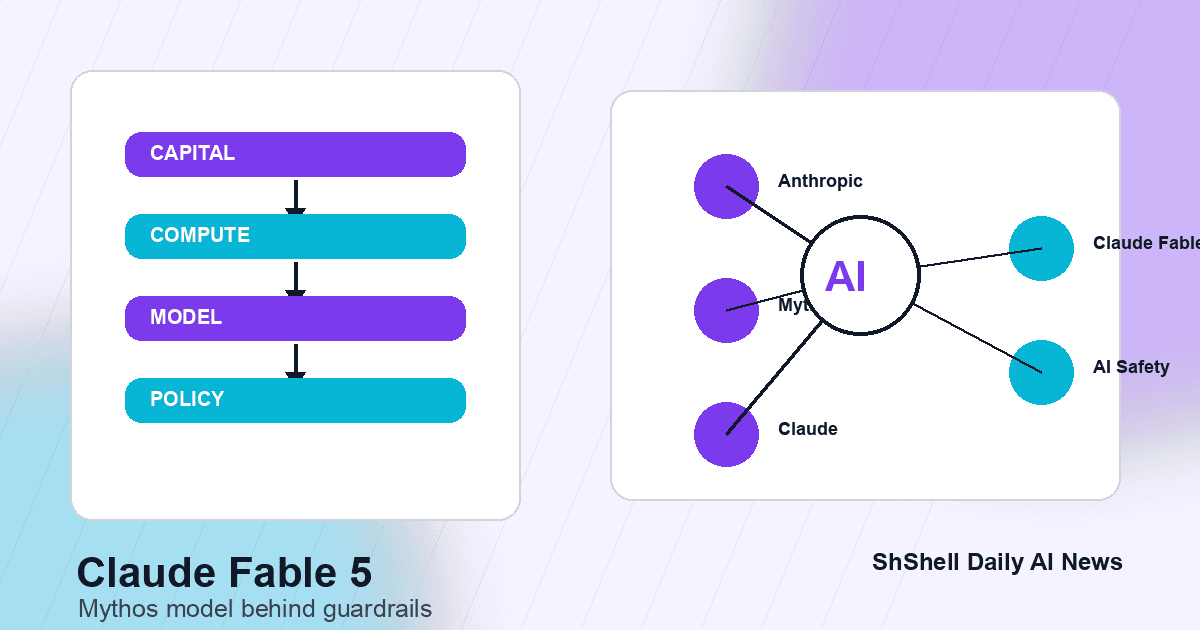
Claude Fable 5 Shows The New Tradeoff In Mythos-Class AI Access
Anthropic's Claude Fable 5 release tests whether Mythos-class models can be public, powerful, and constrained by visible guardrails.
Claude Fable 5 Shows The New Tradeoff In Mythos-Class AI Access
Claude Fable 5 Shows The New Tradeoff In Mythos-Class AI Access is today's most useful AI infrastructure and governance signal because it turns a fresh market event into a concrete operating question. The story is not simply that another model, workstation, funding round, or cloud venture appeared. The story is how the event changes what builders, buyers, researchers, and operators should verify before they commit money, data, or workflow authority to a new AI system.
Source trail
- Times of India — reported Claude Fable 5 as a public Mythos-class model with safeguards, Opus 4.8 fallback, less-than-5-percent average trigger rate, $10 input and $50 output per million token pricing, and 30-day retention.
- Axios — reported Anthropic's release of Fable 5 as a general-use Mythos-class model and described automatic rerouting of high-risk queries to lower-performing models.
- Business Insider — reported availability for Pro, Max, team, and enterprise subscribers and noted the model is a safeguarded version of Claude Mythos 5.
Ten facts that lock this story to the event
- Anthropic released Claude Fable 5 on June 9, 2026, as a public Mythos-class model.
- Fable 5 is based on the same core architecture as Claude Mythos 5 but with stronger safeguards.
- Times of India reported that sensitive queries can be routed to Claude Opus 4.8.
- Reported sensitive domains include cybersecurity, biology and chemistry, and distillation.
- Anthropic said conservative safeguards can catch harmless requests but trigger in less than 5 percent of sessions on average.
- Fable 5 and Mythos 5 were reported at $10 per million input tokens and $50 per million output tokens.
- Anthropic said Mythos-class traffic has a 30-day retention requirement for safety defense and jailbreak analysis.
- The company said it would not use that retained data to train new Claude models or for non-safety purposes.
- Fable 5 is positioned as strong in software engineering, research, advanced reasoning, and long-running work.
- Mythos 5 remains restricted to trusted partners and cybersecurity experts through controlled access.
Operating map for this AI News Today story
graph TD
    User_request[User request] --> Fable_5_classifiers[Fable 5 classifiers]
    Fable_5_classifiers[Fable 5 classifiers] --> Normal_Fable_response[Normal Fable response]
    Fable_5_classifiers[Fable 5 classifiers] --> Sensitive_domain_route[Sensitive domain route]
    Sensitive_domain_route[Sensitive domain route] --> Opus_4.8_fallback[Opus 4.8 fallback]
    Opus_4.8_fallback[Opus 4.8 fallback] --> User_notification[User notification]
    User_request[User request] --> 30_day_safety_retention[30 day safety retention]
Decision table for builders and buyers
| Layer | Reported detail | What to verify next |
|---|---|---|
| Public model | Claude Fable 5 | Broader access to Mythos-class capability |
| Restricted model | Claude Mythos 5 | Trusted partners and selected expert access |
| Guardrail route | Opus 4.8 fallback | Sensitive prompts may use a less capable model |
| Sensitive domains | Cybersecurity, biology, chemistry, distillation | Safety filters may create false positives |
| Data policy | 30-day retention for Mythos-class traffic | Enterprise buyers need legal review |
Anthropic Is Testing Public Power With Private-Class Controls
Claude Fable 5 is not just another model launch. It is Anthropic's attempt to make a Mythos-class system public without giving the public the full risk profile of Mythos 5. That distinction matters. The company is saying the core capability is strong enough to require special handling, but the market is demanding access now.
The model therefore arrives with a visible compromise: strong public capability, conservative classifiers, fallback routing, and a retention policy designed around safety monitoring. This is the new frontier-model tradeoff. Users want the most capable system. Governments and security teams worry about misuse. Enterprises want zero-retention guarantees. Labs want telemetry to detect novel attacks. Claude Fable 5 puts all of those demands into one product surface.
For Artificial Intelligence News readers, the release is a marker. The next phase of large language models will not be only about benchmark wins. It will be about differential access, domain-specific restrictions, safety telemetry, trusted user programs, and whether customers accept model behavior that changes depending on the sensitivity of the request.
For Claude Fable 5 Shows The New Tradeoff In Mythos-Class AI Access, this detail changes the practical read of the story: Anthropic released Claude Fable 5 on June 9, 2026, as a public Mythos-class model. That is not trivia; it is an operating constraint for teams following latest AI news and AI News Today. A builder sees integration work, an operator sees a runbook, a buyer sees a contract question, and a governance lead sees a control that must be written down. In this specific anthropic is testing public power with private-class controls context, the important move is to connect the reported fact to a decision: what gets tested, who owns the risk, which data can move, what the fallback path is, and how the team will know if the deployment is working. That discipline is what separates useful Artificial Intelligence News from a headline that disappears by tomorrow.
For Claude Fable 5 Shows The New Tradeoff In Mythos-Class AI Access, this detail changes the practical read of the story: Fable 5 is based on the same core architecture as Claude Mythos 5 but with stronger safeguards. That is not trivia; it is an operating constraint for teams following latest AI news and AI News Today. A builder sees integration work, an operator sees a runbook, a buyer sees a contract question, and a governance lead sees a control that must be written down. In this specific anthropic is testing public power with private-class controls context, the important move is to connect the reported fact to a decision: what gets tested, who owns the risk, which data can move, what the fallback path is, and how the team will know if the deployment is working. That discipline is what separates useful Artificial Intelligence News from a headline that disappears by tomorrow.
For Claude Fable 5 Shows The New Tradeoff In Mythos-Class AI Access, this detail changes the practical read of the story: Times of India reported that sensitive queries can be routed to Claude Opus 4.8. That is not trivia; it is an operating constraint for teams following latest AI news and AI News Today. A builder sees integration work, an operator sees a runbook, a buyer sees a contract question, and a governance lead sees a control that must be written down. In this specific anthropic is testing public power with private-class controls context, the important move is to connect the reported fact to a decision: what gets tested, who owns the risk, which data can move, what the fallback path is, and how the team will know if the deployment is working. That discipline is what separates useful Artificial Intelligence News from a headline that disappears by tomorrow.
For Claude Fable 5 Shows The New Tradeoff In Mythos-Class AI Access, this detail changes the practical read of the story: Reported sensitive domains include cybersecurity, biology and chemistry, and distillation. That is not trivia; it is an operating constraint for teams following latest AI news and AI News Today. A builder sees integration work, an operator sees a runbook, a buyer sees a contract question, and a governance lead sees a control that must be written down. In this specific anthropic is testing public power with private-class controls context, the important move is to connect the reported fact to a decision: what gets tested, who owns the risk, which data can move, what the fallback path is, and how the team will know if the deployment is working. That discipline is what separates useful Artificial Intelligence News from a headline that disappears by tomorrow.
The Opus 4.8 Fallback Is The Product Design Choice
The most interesting mechanism is not that Anthropic blocks risky content. Many labs block risky content. The notable choice is routing certain sensitive requests away from Fable 5 to Claude Opus 4.8. That turns safety into a model-selection problem. A request begins at the frontier model, passes through classifiers, and may receive an answer from a less capable system if it touches a flagged area.
That design has advantages. It can preserve everyday usefulness while reducing access to the most sensitive capability. It can also be explained to users more cleanly than a silent refusal, especially if the interface states when routing occurred. But it creates new questions. How accurate are the classifiers? Which harmless biology or cybersecurity questions are downgraded? Can attackers split a request across multiple turns to evade classification? How much capability is lost in the fallback?
The less-than-5-percent average trigger figure is useful but incomplete. Average trigger rates hide distribution. A software engineer working on secure infrastructure, a biology student, or a security researcher may see a much higher rate than a general user. Anthropic will need to measure false positives by user group, not only across the whole population.
For Claude Fable 5 Shows The New Tradeoff In Mythos-Class AI Access, this detail changes the practical read of the story: Anthropic released Claude Fable 5 on June 9, 2026, as a public Mythos-class model. That is not trivia; it is an operating constraint for teams following latest AI news and AI News Today. A builder sees integration work, an operator sees a runbook, a buyer sees a contract question, and a governance lead sees a control that must be written down. In this specific the opus 4.8 fallback is the product design choice context, the important move is to connect the reported fact to a decision: what gets tested, who owns the risk, which data can move, what the fallback path is, and how the team will know if the deployment is working. That discipline is what separates useful Artificial Intelligence News from a headline that disappears by tomorrow.
For Claude Fable 5 Shows The New Tradeoff In Mythos-Class AI Access, this detail changes the practical read of the story: Fable 5 is based on the same core architecture as Claude Mythos 5 but with stronger safeguards. That is not trivia; it is an operating constraint for teams following latest AI news and AI News Today. A builder sees integration work, an operator sees a runbook, a buyer sees a contract question, and a governance lead sees a control that must be written down. In this specific the opus 4.8 fallback is the product design choice context, the important move is to connect the reported fact to a decision: what gets tested, who owns the risk, which data can move, what the fallback path is, and how the team will know if the deployment is working. That discipline is what separates useful Artificial Intelligence News from a headline that disappears by tomorrow.
For Claude Fable 5 Shows The New Tradeoff In Mythos-Class AI Access, this detail changes the practical read of the story: Times of India reported that sensitive queries can be routed to Claude Opus 4.8. That is not trivia; it is an operating constraint for teams following latest AI news and AI News Today. A builder sees integration work, an operator sees a runbook, a buyer sees a contract question, and a governance lead sees a control that must be written down. In this specific the opus 4.8 fallback is the product design choice context, the important move is to connect the reported fact to a decision: what gets tested, who owns the risk, which data can move, what the fallback path is, and how the team will know if the deployment is working. That discipline is what separates useful Artificial Intelligence News from a headline that disappears by tomorrow.
For Claude Fable 5 Shows The New Tradeoff In Mythos-Class AI Access, this detail changes the practical read of the story: Reported sensitive domains include cybersecurity, biology and chemistry, and distillation. That is not trivia; it is an operating constraint for teams following latest AI news and AI News Today. A builder sees integration work, an operator sees a runbook, a buyer sees a contract question, and a governance lead sees a control that must be written down. In this specific the opus 4.8 fallback is the product design choice context, the important move is to connect the reported fact to a decision: what gets tested, who owns the risk, which data can move, what the fallback path is, and how the team will know if the deployment is working. That discipline is what separates useful Artificial Intelligence News from a headline that disappears by tomorrow.
Retention Turns Safety Into A Legal Review
The 30-day retention requirement is the other major product choice. Anthropic says the data helps defend against complex and novel attacks, including jailbreaks that unfold across many requests, and says it will not use the data to train new Claude models or for non-safety purposes. From a safety engineering perspective, that rationale is coherent. You cannot detect multi-turn abuse patterns if every trace disappears immediately.
From an enterprise perspective, the policy is not automatically acceptable. Some organizations have strict zero-data-retention requirements because their prompts may contain source code, customer records, regulated data, trade secrets, or legal material. A model can be technically better and still fail procurement if the data policy breaks internal rules.
That is the uncomfortable lesson for AI tools in 2026: safety telemetry and privacy guarantees can conflict. Labs want logs to defend the system. Customers want minimal retention to protect themselves. The best products will make those tradeoffs explicit and give administrators clear controls rather than hiding them inside vague trust language.
For Claude Fable 5 Shows The New Tradeoff In Mythos-Class AI Access, this detail changes the practical read of the story: Anthropic released Claude Fable 5 on June 9, 2026, as a public Mythos-class model. That is not trivia; it is an operating constraint for teams following latest AI news and AI News Today. A builder sees integration work, an operator sees a runbook, a buyer sees a contract question, and a governance lead sees a control that must be written down. In this specific retention turns safety into a legal review context, the important move is to connect the reported fact to a decision: what gets tested, who owns the risk, which data can move, what the fallback path is, and how the team will know if the deployment is working. That discipline is what separates useful Artificial Intelligence News from a headline that disappears by tomorrow.
For Claude Fable 5 Shows The New Tradeoff In Mythos-Class AI Access, this detail changes the practical read of the story: Fable 5 is based on the same core architecture as Claude Mythos 5 but with stronger safeguards. That is not trivia; it is an operating constraint for teams following latest AI news and AI News Today. A builder sees integration work, an operator sees a runbook, a buyer sees a contract question, and a governance lead sees a control that must be written down. In this specific retention turns safety into a legal review context, the important move is to connect the reported fact to a decision: what gets tested, who owns the risk, which data can move, what the fallback path is, and how the team will know if the deployment is working. That discipline is what separates useful Artificial Intelligence News from a headline that disappears by tomorrow.
For Claude Fable 5 Shows The New Tradeoff In Mythos-Class AI Access, this detail changes the practical read of the story: Times of India reported that sensitive queries can be routed to Claude Opus 4.8. That is not trivia; it is an operating constraint for teams following latest AI news and AI News Today. A builder sees integration work, an operator sees a runbook, a buyer sees a contract question, and a governance lead sees a control that must be written down. In this specific retention turns safety into a legal review context, the important move is to connect the reported fact to a decision: what gets tested, who owns the risk, which data can move, what the fallback path is, and how the team will know if the deployment is working. That discipline is what separates useful Artificial Intelligence News from a headline that disappears by tomorrow.
For Claude Fable 5 Shows The New Tradeoff In Mythos-Class AI Access, this detail changes the practical read of the story: Reported sensitive domains include cybersecurity, biology and chemistry, and distillation. That is not trivia; it is an operating constraint for teams following latest AI news and AI News Today. A builder sees integration work, an operator sees a runbook, a buyer sees a contract question, and a governance lead sees a control that must be written down. In this specific retention turns safety into a legal review context, the important move is to connect the reported fact to a decision: what gets tested, who owns the risk, which data can move, what the fallback path is, and how the team will know if the deployment is working. That discipline is what separates useful Artificial Intelligence News from a headline that disappears by tomorrow.
Why Mythos-Class Access Will Be Tiered
Anthropic's split between Fable 5 and Mythos 5 suggests a broader access pattern. Public users get a safeguarded version. Trusted partners and cybersecurity experts can receive more capable or less restricted access under additional controls. Vetted researchers may eventually get specialized access for domains where public restrictions are too blunt.
Tiered access is messy but likely. A model that is useful for defensive cyber research can also assist misuse. A model that can reason about biological systems can help legitimate science and raise biosecurity concerns. A single public policy cannot satisfy every use case. The alternative is either overblocking important work or exposing dangerous capability too broadly.
The operational challenge is legitimacy. Who qualifies as trusted? What audit rights exist? What happens if a trusted user misuses access? Are decisions appealable? Will small labs and independent researchers be locked out while large institutions receive privileged capability? Claude Fable 5 opens those questions because it makes tiering visible.
For Claude Fable 5 Shows The New Tradeoff In Mythos-Class AI Access, this detail changes the practical read of the story: Anthropic released Claude Fable 5 on June 9, 2026, as a public Mythos-class model. That is not trivia; it is an operating constraint for teams following latest AI news and AI News Today. A builder sees integration work, an operator sees a runbook, a buyer sees a contract question, and a governance lead sees a control that must be written down. In this specific why mythos-class access will be tiered context, the important move is to connect the reported fact to a decision: what gets tested, who owns the risk, which data can move, what the fallback path is, and how the team will know if the deployment is working. That discipline is what separates useful Artificial Intelligence News from a headline that disappears by tomorrow.
For Claude Fable 5 Shows The New Tradeoff In Mythos-Class AI Access, this detail changes the practical read of the story: Fable 5 is based on the same core architecture as Claude Mythos 5 but with stronger safeguards. That is not trivia; it is an operating constraint for teams following latest AI news and AI News Today. A builder sees integration work, an operator sees a runbook, a buyer sees a contract question, and a governance lead sees a control that must be written down. In this specific why mythos-class access will be tiered context, the important move is to connect the reported fact to a decision: what gets tested, who owns the risk, which data can move, what the fallback path is, and how the team will know if the deployment is working. That discipline is what separates useful Artificial Intelligence News from a headline that disappears by tomorrow.
For Claude Fable 5 Shows The New Tradeoff In Mythos-Class AI Access, this detail changes the practical read of the story: Times of India reported that sensitive queries can be routed to Claude Opus 4.8. That is not trivia; it is an operating constraint for teams following latest AI news and AI News Today. A builder sees integration work, an operator sees a runbook, a buyer sees a contract question, and a governance lead sees a control that must be written down. In this specific why mythos-class access will be tiered context, the important move is to connect the reported fact to a decision: what gets tested, who owns the risk, which data can move, what the fallback path is, and how the team will know if the deployment is working. That discipline is what separates useful Artificial Intelligence News from a headline that disappears by tomorrow.
For Claude Fable 5 Shows The New Tradeoff In Mythos-Class AI Access, this detail changes the practical read of the story: Reported sensitive domains include cybersecurity, biology and chemistry, and distillation. That is not trivia; it is an operating constraint for teams following latest AI news and AI News Today. A builder sees integration work, an operator sees a runbook, a buyer sees a contract question, and a governance lead sees a control that must be written down. In this specific why mythos-class access will be tiered context, the important move is to connect the reported fact to a decision: what gets tested, who owns the risk, which data can move, what the fallback path is, and how the team will know if the deployment is working. That discipline is what separates useful Artificial Intelligence News from a headline that disappears by tomorrow.
The Developer Experience Risk Is False Positives
Developers care about reliability. A model that sometimes routes to a different model can be hard to build around unless the API exposes the event clearly. If an agentic workflow expects Fable 5-level performance for a security analysis task and suddenly receives Opus 4.8 behavior, the workflow needs to know. Silent capability shifts can break evals, cost planning, and user expectations.
Anthropic reportedly designed Fable 5 for long-running and complex work, including software engineering and research. Those are exactly the domains where multi-step context matters. If a long coding session touches secure networking, dependency vulnerabilities, or system internals, the guardrail route may become part of normal developer experience. The model needs graceful degradation, not just refusal.
The practical recommendation for builders is to log model-routing events and include them in evaluations. Do not treat the model name as the only variable. The effective model may depend on content classification, safety policy, account tier, and time. That is now part of production AI engineering.
For Claude Fable 5 Shows The New Tradeoff In Mythos-Class AI Access, this detail changes the practical read of the story: Anthropic released Claude Fable 5 on June 9, 2026, as a public Mythos-class model. That is not trivia; it is an operating constraint for teams following latest AI news and AI News Today. A builder sees integration work, an operator sees a runbook, a buyer sees a contract question, and a governance lead sees a control that must be written down. In this specific the developer experience risk is false positives context, the important move is to connect the reported fact to a decision: what gets tested, who owns the risk, which data can move, what the fallback path is, and how the team will know if the deployment is working. That discipline is what separates useful Artificial Intelligence News from a headline that disappears by tomorrow.
For Claude Fable 5 Shows The New Tradeoff In Mythos-Class AI Access, this detail changes the practical read of the story: Fable 5 is based on the same core architecture as Claude Mythos 5 but with stronger safeguards. That is not trivia; it is an operating constraint for teams following latest AI news and AI News Today. A builder sees integration work, an operator sees a runbook, a buyer sees a contract question, and a governance lead sees a control that must be written down. In this specific the developer experience risk is false positives context, the important move is to connect the reported fact to a decision: what gets tested, who owns the risk, which data can move, what the fallback path is, and how the team will know if the deployment is working. That discipline is what separates useful Artificial Intelligence News from a headline that disappears by tomorrow.
For Claude Fable 5 Shows The New Tradeoff In Mythos-Class AI Access, this detail changes the practical read of the story: Times of India reported that sensitive queries can be routed to Claude Opus 4.8. That is not trivia; it is an operating constraint for teams following latest AI news and AI News Today. A builder sees integration work, an operator sees a runbook, a buyer sees a contract question, and a governance lead sees a control that must be written down. In this specific the developer experience risk is false positives context, the important move is to connect the reported fact to a decision: what gets tested, who owns the risk, which data can move, what the fallback path is, and how the team will know if the deployment is working. That discipline is what separates useful Artificial Intelligence News from a headline that disappears by tomorrow.
For Claude Fable 5 Shows The New Tradeoff In Mythos-Class AI Access, this detail changes the practical read of the story: Reported sensitive domains include cybersecurity, biology and chemistry, and distillation. That is not trivia; it is an operating constraint for teams following latest AI news and AI News Today. A builder sees integration work, an operator sees a runbook, a buyer sees a contract question, and a governance lead sees a control that must be written down. In this specific the developer experience risk is false positives context, the important move is to connect the reported fact to a decision: what gets tested, who owns the risk, which data can move, what the fallback path is, and how the team will know if the deployment is working. That discipline is what separates useful Artificial Intelligence News from a headline that disappears by tomorrow.
What Fable 5 Signals For Latest AI News
Claude Fable 5 is a window into how frontier labs will release powerful models under pressure. The lab does not want to wait forever. Customers do not want to wait. Regulators and security teams do not want uncontrolled capability. The resulting product is powerful, constrained, monitored, and politically loaded.
For buyers, the next step is concrete diligence: ask about retention, fallback routing, audit logs, sensitive-domain behavior, enterprise overrides, and incident response. For learners, this is a useful case study in why large language models are not just weights and benchmarks. They are policy systems, routing systems, safety systems, and data-governance systems.
The headline is not simply that Anthropic released a stronger Claude. The headline is that public frontier AI access now comes with visible circuit breakers, and those circuit breakers will shape how people build with the model.
For Claude Fable 5 Shows The New Tradeoff In Mythos-Class AI Access, this detail changes the practical read of the story: Anthropic released Claude Fable 5 on June 9, 2026, as a public Mythos-class model. That is not trivia; it is an operating constraint for teams following latest AI news and AI News Today. A builder sees integration work, an operator sees a runbook, a buyer sees a contract question, and a governance lead sees a control that must be written down. In this specific what fable 5 signals for latest ai news context, the important move is to connect the reported fact to a decision: what gets tested, who owns the risk, which data can move, what the fallback path is, and how the team will know if the deployment is working. That discipline is what separates useful Artificial Intelligence News from a headline that disappears by tomorrow.
For Claude Fable 5 Shows The New Tradeoff In Mythos-Class AI Access, this detail changes the practical read of the story: Fable 5 is based on the same core architecture as Claude Mythos 5 but with stronger safeguards. That is not trivia; it is an operating constraint for teams following latest AI news and AI News Today. A builder sees integration work, an operator sees a runbook, a buyer sees a contract question, and a governance lead sees a control that must be written down. In this specific what fable 5 signals for latest ai news context, the important move is to connect the reported fact to a decision: what gets tested, who owns the risk, which data can move, what the fallback path is, and how the team will know if the deployment is working. That discipline is what separates useful Artificial Intelligence News from a headline that disappears by tomorrow.
For Claude Fable 5 Shows The New Tradeoff In Mythos-Class AI Access, this detail changes the practical read of the story: Times of India reported that sensitive queries can be routed to Claude Opus 4.8. That is not trivia; it is an operating constraint for teams following latest AI news and AI News Today. A builder sees integration work, an operator sees a runbook, a buyer sees a contract question, and a governance lead sees a control that must be written down. In this specific what fable 5 signals for latest ai news context, the important move is to connect the reported fact to a decision: what gets tested, who owns the risk, which data can move, what the fallback path is, and how the team will know if the deployment is working. That discipline is what separates useful Artificial Intelligence News from a headline that disappears by tomorrow.
For Claude Fable 5 Shows The New Tradeoff In Mythos-Class AI Access, this detail changes the practical read of the story: Reported sensitive domains include cybersecurity, biology and chemistry, and distillation. That is not trivia; it is an operating constraint for teams following latest AI news and AI News Today. A builder sees integration work, an operator sees a runbook, a buyer sees a contract question, and a governance lead sees a control that must be written down. In this specific what fable 5 signals for latest ai news context, the important move is to connect the reported fact to a decision: what gets tested, who owns the risk, which data can move, what the fallback path is, and how the team will know if the deployment is working. That discipline is what separates useful Artificial Intelligence News from a headline that disappears by tomorrow.
What ShShell readers should watch next
The next signal for Claude Fable 5 Shows The New Tradeoff In Mythos-Class AI Access is whether the announcement becomes repeatable operating behavior. Watch for customer evidence, transparent pricing, clear model or hardware limits, published safety and retention terms, and examples that survive real workflows. For people trying to Learn AI, the lesson is not to memorize the headline. The lesson is to ask what changed in the system: compute access, model routing, data retention, developer ergonomics, capital structure, or human approval. That is where durable AI knowledge lives.
Sudeep Devkota writes ShShell's Daily AI News for readers who need practical signal from fast-moving model, infrastructure, agentic AI, and governance stories. The goal is simple: turn latest AI news into decisions that teams can test, document, and improve.