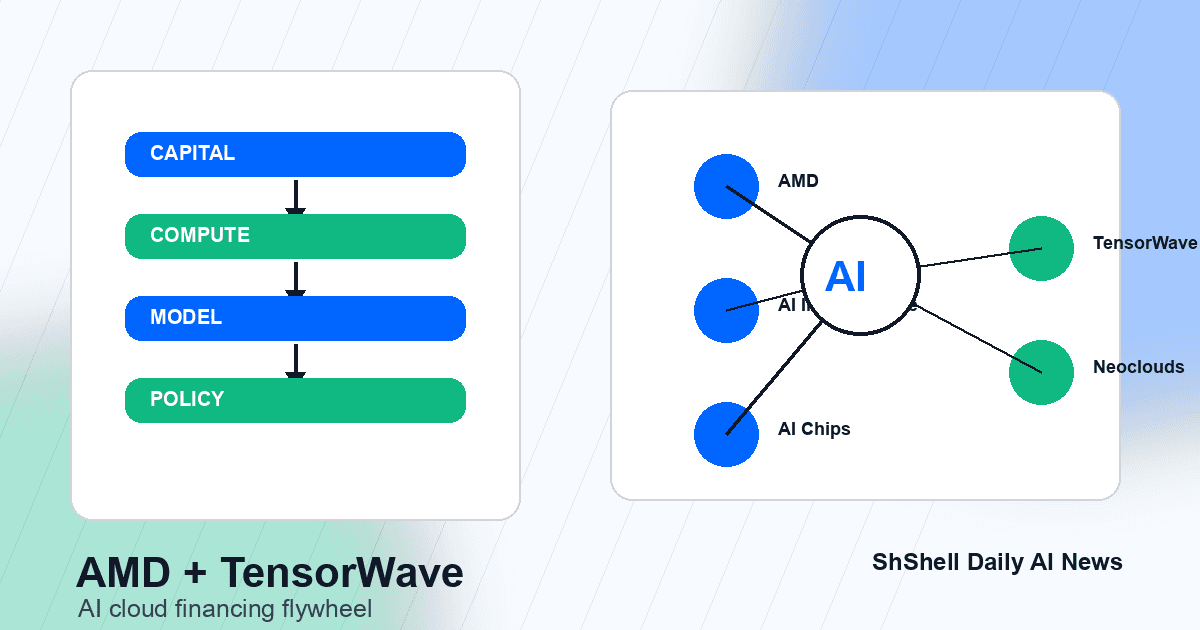
AMD's TensorWave Bet Turns AI Cloud Financing Into a Chip Strategy
AMD's TensorWave-led funding shows how AI cloud financing, Instinct GPUs, and neocloud capacity are becoming one strategy.
AMD's TensorWave Bet Turns AI Cloud Financing Into a Chip Strategy
AMD's TensorWave Bet Turns AI Cloud Financing Into a Chip Strategy is today's most useful AI infrastructure and governance signal because it turns a fresh market event into a concrete operating question. The story is not simply that another model, workstation, funding round, or cloud venture appeared. The story is how the event changes what builders, buyers, researchers, and operators should verify before they commit money, data, or workflow authority to a new AI system.
Source trail
- Wall Street Journal — reported TensorWave's $350 million Series B, $1.55 billion valuation, AMD and Magnetar leadership, AMD-only infrastructure, 10,000 GPUs, 14 megawatts operating capacity, and leases for 500 megawatts.
- Barron's — framed AMD's role as a smaller version of Nvidia-style neocloud financing and noted market concern about circular demand.
Ten facts that lock this story to the event
- TensorWave raised $350 million in a Series B round led by AMD and Magnetar Capital.
- The round valued the Las Vegas startup at $1.55 billion.
- TensorWave positions itself as an anti-Nvidia cloud by using AMD hardware and software rather than Nvidia GPUs.
- The company was reported to operate data centers in Pennsylvania, Arizona, and Florida.
- Its operating footprint was reported at 10,000 AMD GPUs across 14 megawatts of power capacity.
- TensorWave has secured leases for 500 megawatts of future capacity and has discussed a path toward 2 gigawatts.
- Barron's compared the strategy to Nvidia's investments in neoclouds that buy Nvidia hardware.
- AMD shares were reported down roughly 1.5 percent after the announcement, showing investors were not treating the deal as a clean catalyst.
- The practical software layer is ROCm, because buyers need the AMD stack to be easier to run, debug, and staff than it was in earlier cycles.
- The core market question is whether financing can accelerate an ecosystem before customer demand becomes self-sustaining.
Operating map for this AI News Today story
graph TD
    AMD_capital[AMD capital] --> TensorWave_cloud_buildout[TensorWave cloud buildout]
    TensorWave_cloud_buildout[TensorWave cloud buildout] --> Instinct_GPU_purchases[Instinct GPU purchases]
    Instinct_GPU_purchases[Instinct GPU purchases] --> ROCm_production_workloads[ROCm production workloads]
    ROCm_production_workloads[ROCm production workloads] --> Enterprise_AI_customers[Enterprise AI customers]
    Enterprise_AI_customers[Enterprise AI customers] --> Utilization_and_renewal_data[Utilization and renewal data]
    Utilization_and_renewal_data[Utilization and renewal data] --> AMD_capital[AMD capital]
Decision table for builders and buyers
| Layer | Reported detail | What to verify next |
|---|---|---|
| Financing layer | $350 million Series B | Watch whether demand comes from independent customers or vendor-backed commitments |
| Capacity layer | 10,000 AMD GPUs and 14 MW reported live | Capacity must convert into high utilization, not only installed megawatts |
| Expansion layer | 500 MW leased with 2 GW ambition | Power contracts are strategic assets but can become liabilities |
| Software layer | ROCm as the production interface | Developer experience decides whether the cloud is usable |
| Market layer | Alternative to Nvidia neoclouds | Differentiation needs reliability, price, and available supply |
Why AMD Is Funding Its Own Demand Channel
The AMD-TensorWave story is not only a venture funding item. It is a test of whether a chipmaker can use capital to shape the market around its silicon before the market naturally does it on its own. Nvidia has already shown the playbook: support cloud operators, help them secure capacity, and turn those operators into distribution channels for scarce accelerators. AMD is now trying a version of that pattern with TensorWave, but with a harder job because the software ecosystem has to prove itself alongside the hardware.
That is why the latest AI news matters to builders. If TensorWave succeeds, AMD Instinct capacity becomes easier to buy as a managed service, not just as hardware inside a procurement spreadsheet. If it fails, buyers will treat the deal as another reminder that AI infrastructure is not solved by chips alone. The cloud operator has to absorb hardware supply, power contracts, networking, scheduling, software images, support, and billing into something teams can actually use.
The phrase circular financing can sound accusatory, but the useful question is more precise. Vendor-backed financing becomes risky when the apparent customer demand is really the vendor funding purchases of its own product. It becomes strategic when the capital creates a durable ecosystem that customers keep using after the incentives fade. TensorWave sits exactly on that line, which is why the reported valuation, capacity, and AMD-only posture deserve close reading.
For AMD's TensorWave Bet Turns AI Cloud Financing Into a Chip Strategy, this detail changes the practical read of the story: TensorWave raised $350 million in a Series B round led by AMD and Magnetar Capital. That is not trivia; it is an operating constraint for teams following latest AI news and AI News Today. A builder sees integration work, an operator sees a runbook, a buyer sees a contract question, and a governance lead sees a control that must be written down. In this specific why amd is funding its own demand channel context, the important move is to connect the reported fact to a decision: what gets tested, who owns the risk, which data can move, what the fallback path is, and how the team will know if the deployment is working. That discipline is what separates useful Artificial Intelligence News from a headline that disappears by tomorrow.
For AMD's TensorWave Bet Turns AI Cloud Financing Into a Chip Strategy, this detail changes the practical read of the story: The round valued the Las Vegas startup at $1.55 billion. That is not trivia; it is an operating constraint for teams following latest AI news and AI News Today. A builder sees integration work, an operator sees a runbook, a buyer sees a contract question, and a governance lead sees a control that must be written down. In this specific why amd is funding its own demand channel context, the important move is to connect the reported fact to a decision: what gets tested, who owns the risk, which data can move, what the fallback path is, and how the team will know if the deployment is working. That discipline is what separates useful Artificial Intelligence News from a headline that disappears by tomorrow.
For AMD's TensorWave Bet Turns AI Cloud Financing Into a Chip Strategy, this detail changes the practical read of the story: TensorWave positions itself as an anti-Nvidia cloud by using AMD hardware and software rather than Nvidia GPUs. That is not trivia; it is an operating constraint for teams following latest AI news and AI News Today. A builder sees integration work, an operator sees a runbook, a buyer sees a contract question, and a governance lead sees a control that must be written down. In this specific why amd is funding its own demand channel context, the important move is to connect the reported fact to a decision: what gets tested, who owns the risk, which data can move, what the fallback path is, and how the team will know if the deployment is working. That discipline is what separates useful Artificial Intelligence News from a headline that disappears by tomorrow.
For AMD's TensorWave Bet Turns AI Cloud Financing Into a Chip Strategy, this detail changes the practical read of the story: The company was reported to operate data centers in Pennsylvania, Arizona, and Florida. That is not trivia; it is an operating constraint for teams following latest AI news and AI News Today. A builder sees integration work, an operator sees a runbook, a buyer sees a contract question, and a governance lead sees a control that must be written down. In this specific why amd is funding its own demand channel context, the important move is to connect the reported fact to a decision: what gets tested, who owns the risk, which data can move, what the fallback path is, and how the team will know if the deployment is working. That discipline is what separates useful Artificial Intelligence News from a headline that disappears by tomorrow.
TensorWave Is Selling More Than Cheap GPUs
The reported operating footprint gives the company enough substance to be more than a pitch deck. Ten thousand AMD GPUs across fourteen megawatts is still small beside the largest Nvidia-linked neoclouds, but it is enough to expose real operational problems: cluster availability, queue design, model serving latency, customer support, and the quality of ROCm images under production pressure. Those details matter more than the headline valuation because they determine whether an AI team can move a workload without losing weeks to platform friction.
TensorWave's anti-Nvidia positioning is commercially useful because many buyers want supply diversification. But supply diversification is not the same as workload portability. A training job tuned for CUDA kernels, Nvidia networking assumptions, and a specific observability stack does not magically become AMD-ready because a contract is cheaper. The buyer still has to test kernels, libraries, checkpoint behavior, inference serving, and failure recovery.
The best version of TensorWave is therefore not simply a cheaper GPU rental business. It is a managed translation layer for teams that want AMD economics without rebuilding the whole platform themselves. That means polished developer images, clear migration guides, stable Kubernetes integrations, useful support, and model-serving examples that do not require heroic internal engineering.
For AMD's TensorWave Bet Turns AI Cloud Financing Into a Chip Strategy, this detail changes the practical read of the story: TensorWave raised $350 million in a Series B round led by AMD and Magnetar Capital. That is not trivia; it is an operating constraint for teams following latest AI news and AI News Today. A builder sees integration work, an operator sees a runbook, a buyer sees a contract question, and a governance lead sees a control that must be written down. In this specific tensorwave is selling more than cheap gpus context, the important move is to connect the reported fact to a decision: what gets tested, who owns the risk, which data can move, what the fallback path is, and how the team will know if the deployment is working. That discipline is what separates useful Artificial Intelligence News from a headline that disappears by tomorrow.
For AMD's TensorWave Bet Turns AI Cloud Financing Into a Chip Strategy, this detail changes the practical read of the story: The round valued the Las Vegas startup at $1.55 billion. That is not trivia; it is an operating constraint for teams following latest AI news and AI News Today. A builder sees integration work, an operator sees a runbook, a buyer sees a contract question, and a governance lead sees a control that must be written down. In this specific tensorwave is selling more than cheap gpus context, the important move is to connect the reported fact to a decision: what gets tested, who owns the risk, which data can move, what the fallback path is, and how the team will know if the deployment is working. That discipline is what separates useful Artificial Intelligence News from a headline that disappears by tomorrow.
For AMD's TensorWave Bet Turns AI Cloud Financing Into a Chip Strategy, this detail changes the practical read of the story: TensorWave positions itself as an anti-Nvidia cloud by using AMD hardware and software rather than Nvidia GPUs. That is not trivia; it is an operating constraint for teams following latest AI news and AI News Today. A builder sees integration work, an operator sees a runbook, a buyer sees a contract question, and a governance lead sees a control that must be written down. In this specific tensorwave is selling more than cheap gpus context, the important move is to connect the reported fact to a decision: what gets tested, who owns the risk, which data can move, what the fallback path is, and how the team will know if the deployment is working. That discipline is what separates useful Artificial Intelligence News from a headline that disappears by tomorrow.
For AMD's TensorWave Bet Turns AI Cloud Financing Into a Chip Strategy, this detail changes the practical read of the story: The company was reported to operate data centers in Pennsylvania, Arizona, and Florida. That is not trivia; it is an operating constraint for teams following latest AI news and AI News Today. A builder sees integration work, an operator sees a runbook, a buyer sees a contract question, and a governance lead sees a control that must be written down. In this specific tensorwave is selling more than cheap gpus context, the important move is to connect the reported fact to a decision: what gets tested, who owns the risk, which data can move, what the fallback path is, and how the team will know if the deployment is working. That discipline is what separates useful Artificial Intelligence News from a headline that disappears by tomorrow.
The Neocloud Financing Flywheel Has A Weak Point
The flywheel looks attractive on paper. A chipmaker invests in a cloud provider. The cloud provider buys the chipmaker's hardware. The hardware deployment creates availability. Availability attracts developers and enterprises. Utilization data then justifies more financing. The weak point is utilization. If customers do not consume the compute at prices that support debt, power, facilities, depreciation, and support, the financing loop stops being a flywheel and starts looking like inventory support.
This is where AMD's smaller scale may help and hurt. A smaller TensorWave buildout is less systemically dramatic than the giant Nvidia-linked clouds, so it can focus on customers with a real reason to run AMD. But a smaller cloud also has less room for fragmentation. If too many customer environments need special handling, support costs rise and the promised price advantage erodes.
For operators, the lesson is direct: do not evaluate neoclouds only on dollars per GPU-hour. Evaluate sustained throughput per dollar, time-to-first-successful-run, incident response, storage performance, and how the provider handles model-serving spikes. The financing structure is interesting, but the workload either runs well or it does not.
For AMD's TensorWave Bet Turns AI Cloud Financing Into a Chip Strategy, this detail changes the practical read of the story: TensorWave raised $350 million in a Series B round led by AMD and Magnetar Capital. That is not trivia; it is an operating constraint for teams following latest AI news and AI News Today. A builder sees integration work, an operator sees a runbook, a buyer sees a contract question, and a governance lead sees a control that must be written down. In this specific the neocloud financing flywheel has a weak point context, the important move is to connect the reported fact to a decision: what gets tested, who owns the risk, which data can move, what the fallback path is, and how the team will know if the deployment is working. That discipline is what separates useful Artificial Intelligence News from a headline that disappears by tomorrow.
For AMD's TensorWave Bet Turns AI Cloud Financing Into a Chip Strategy, this detail changes the practical read of the story: The round valued the Las Vegas startup at $1.55 billion. That is not trivia; it is an operating constraint for teams following latest AI news and AI News Today. A builder sees integration work, an operator sees a runbook, a buyer sees a contract question, and a governance lead sees a control that must be written down. In this specific the neocloud financing flywheel has a weak point context, the important move is to connect the reported fact to a decision: what gets tested, who owns the risk, which data can move, what the fallback path is, and how the team will know if the deployment is working. That discipline is what separates useful Artificial Intelligence News from a headline that disappears by tomorrow.
For AMD's TensorWave Bet Turns AI Cloud Financing Into a Chip Strategy, this detail changes the practical read of the story: TensorWave positions itself as an anti-Nvidia cloud by using AMD hardware and software rather than Nvidia GPUs. That is not trivia; it is an operating constraint for teams following latest AI news and AI News Today. A builder sees integration work, an operator sees a runbook, a buyer sees a contract question, and a governance lead sees a control that must be written down. In this specific the neocloud financing flywheel has a weak point context, the important move is to connect the reported fact to a decision: what gets tested, who owns the risk, which data can move, what the fallback path is, and how the team will know if the deployment is working. That discipline is what separates useful Artificial Intelligence News from a headline that disappears by tomorrow.
For AMD's TensorWave Bet Turns AI Cloud Financing Into a Chip Strategy, this detail changes the practical read of the story: The company was reported to operate data centers in Pennsylvania, Arizona, and Florida. That is not trivia; it is an operating constraint for teams following latest AI news and AI News Today. A builder sees integration work, an operator sees a runbook, a buyer sees a contract question, and a governance lead sees a control that must be written down. In this specific the neocloud financing flywheel has a weak point context, the important move is to connect the reported fact to a decision: what gets tested, who owns the risk, which data can move, what the fallback path is, and how the team will know if the deployment is working. That discipline is what separates useful Artificial Intelligence News from a headline that disappears by tomorrow.
ROCm Is The Hidden Procurement Question
The AMD story always returns to software. ROCm has improved, but buyer trust is earned through boring reliability. The AI infrastructure market is filled with teams that will pay a premium to avoid debugging the lower layers. That is why Nvidia's moat is not only the GPU. It is CUDA, cuDNN, NCCL, mature containers, examples, community answers, vendor support, and a hiring market full of people who have already solved the same problems.
TensorWave can narrow that gap by packaging opinionated environments. A customer should be able to bring a Llama-family model, a diffusion workload, a retrieval reranker, or an internal fine-tuning job and see the exact supported path. If the answer is a long compatibility matrix with caveats, the platform will appeal only to the most cost-sensitive or infrastructure-savvy buyers.
This is also why AI courses and AI training should treat hardware choice as an applied systems topic. The decision is not AMD versus Nvidia in the abstract. It is model shape, sequence length, precision, batch strategy, networking, developer skill, observability, and migration cost. TensorWave's funding puts those questions in front of more teams.
For AMD's TensorWave Bet Turns AI Cloud Financing Into a Chip Strategy, this detail changes the practical read of the story: TensorWave raised $350 million in a Series B round led by AMD and Magnetar Capital. That is not trivia; it is an operating constraint for teams following latest AI news and AI News Today. A builder sees integration work, an operator sees a runbook, a buyer sees a contract question, and a governance lead sees a control that must be written down. In this specific rocm is the hidden procurement question context, the important move is to connect the reported fact to a decision: what gets tested, who owns the risk, which data can move, what the fallback path is, and how the team will know if the deployment is working. That discipline is what separates useful Artificial Intelligence News from a headline that disappears by tomorrow.
For AMD's TensorWave Bet Turns AI Cloud Financing Into a Chip Strategy, this detail changes the practical read of the story: The round valued the Las Vegas startup at $1.55 billion. That is not trivia; it is an operating constraint for teams following latest AI news and AI News Today. A builder sees integration work, an operator sees a runbook, a buyer sees a contract question, and a governance lead sees a control that must be written down. In this specific rocm is the hidden procurement question context, the important move is to connect the reported fact to a decision: what gets tested, who owns the risk, which data can move, what the fallback path is, and how the team will know if the deployment is working. That discipline is what separates useful Artificial Intelligence News from a headline that disappears by tomorrow.
For AMD's TensorWave Bet Turns AI Cloud Financing Into a Chip Strategy, this detail changes the practical read of the story: TensorWave positions itself as an anti-Nvidia cloud by using AMD hardware and software rather than Nvidia GPUs. That is not trivia; it is an operating constraint for teams following latest AI news and AI News Today. A builder sees integration work, an operator sees a runbook, a buyer sees a contract question, and a governance lead sees a control that must be written down. In this specific rocm is the hidden procurement question context, the important move is to connect the reported fact to a decision: what gets tested, who owns the risk, which data can move, what the fallback path is, and how the team will know if the deployment is working. That discipline is what separates useful Artificial Intelligence News from a headline that disappears by tomorrow.
For AMD's TensorWave Bet Turns AI Cloud Financing Into a Chip Strategy, this detail changes the practical read of the story: The company was reported to operate data centers in Pennsylvania, Arizona, and Florida. That is not trivia; it is an operating constraint for teams following latest AI news and AI News Today. A builder sees integration work, an operator sees a runbook, a buyer sees a contract question, and a governance lead sees a control that must be written down. In this specific rocm is the hidden procurement question context, the important move is to connect the reported fact to a decision: what gets tested, who owns the risk, which data can move, what the fallback path is, and how the team will know if the deployment is working. That discipline is what separates useful Artificial Intelligence News from a headline that disappears by tomorrow.
What Buyers Should Ask Before Moving Workloads
A finance-backed cloud can look compelling during capacity shortages. The right response is not cynicism; it is structured diligence. Ask for benchmark runs that match the actual workload, not generic FLOPS charts. Ask how the provider handles failed jobs, checkpoint restore, multi-node networking, and noisy neighbor problems. Ask what happens if a model depends on a library that works on CUDA today and only partially works on ROCm.
Procurement teams should also ask where the discount comes from. If the economics depend on vendor subsidies, customers need to understand renewal risk. A cheap pilot can become expensive when the subsidy changes, when capacity tightens, or when support tiers become mandatory. A strong vendor should be able to explain the long-term price path without hand-waving.
For AMD, the win condition is clear. TensorWave does not need to beat Nvidia everywhere. It needs to become credible enough that enterprises treat AMD cloud capacity as a normal option for inference, fine-tuning, and some training workloads. Normal is the milestone. Once a platform becomes normal, procurement pressure starts working in its favor.
For AMD's TensorWave Bet Turns AI Cloud Financing Into a Chip Strategy, this detail changes the practical read of the story: TensorWave raised $350 million in a Series B round led by AMD and Magnetar Capital. That is not trivia; it is an operating constraint for teams following latest AI news and AI News Today. A builder sees integration work, an operator sees a runbook, a buyer sees a contract question, and a governance lead sees a control that must be written down. In this specific what buyers should ask before moving workloads context, the important move is to connect the reported fact to a decision: what gets tested, who owns the risk, which data can move, what the fallback path is, and how the team will know if the deployment is working. That discipline is what separates useful Artificial Intelligence News from a headline that disappears by tomorrow.
For AMD's TensorWave Bet Turns AI Cloud Financing Into a Chip Strategy, this detail changes the practical read of the story: The round valued the Las Vegas startup at $1.55 billion. That is not trivia; it is an operating constraint for teams following latest AI news and AI News Today. A builder sees integration work, an operator sees a runbook, a buyer sees a contract question, and a governance lead sees a control that must be written down. In this specific what buyers should ask before moving workloads context, the important move is to connect the reported fact to a decision: what gets tested, who owns the risk, which data can move, what the fallback path is, and how the team will know if the deployment is working. That discipline is what separates useful Artificial Intelligence News from a headline that disappears by tomorrow.
For AMD's TensorWave Bet Turns AI Cloud Financing Into a Chip Strategy, this detail changes the practical read of the story: TensorWave positions itself as an anti-Nvidia cloud by using AMD hardware and software rather than Nvidia GPUs. That is not trivia; it is an operating constraint for teams following latest AI news and AI News Today. A builder sees integration work, an operator sees a runbook, a buyer sees a contract question, and a governance lead sees a control that must be written down. In this specific what buyers should ask before moving workloads context, the important move is to connect the reported fact to a decision: what gets tested, who owns the risk, which data can move, what the fallback path is, and how the team will know if the deployment is working. That discipline is what separates useful Artificial Intelligence News from a headline that disappears by tomorrow.
For AMD's TensorWave Bet Turns AI Cloud Financing Into a Chip Strategy, this detail changes the practical read of the story: The company was reported to operate data centers in Pennsylvania, Arizona, and Florida. That is not trivia; it is an operating constraint for teams following latest AI news and AI News Today. A builder sees integration work, an operator sees a runbook, a buyer sees a contract question, and a governance lead sees a control that must be written down. In this specific what buyers should ask before moving workloads context, the important move is to connect the reported fact to a decision: what gets tested, who owns the risk, which data can move, what the fallback path is, and how the team will know if the deployment is working. That discipline is what separates useful Artificial Intelligence News from a headline that disappears by tomorrow.
What This Changes In AI News Today
The bigger Artificial Intelligence News signal is that compute markets are becoming financial products. Power leases, GPU allocations, vendor investments, debt packages, and customer commitments now shape which models get trained and where AI agents run. That is a different world from simply choosing a cloud instance type.
Builders should watch TensorWave's customer logos, uptime claims, software templates, and benchmark transparency. Investors should watch utilization, not only contracted megawatts. Policy teams should watch whether vendor-backed financing concentrates hidden risk in the AI supply chain. And developers should keep testing portability before they are forced into emergency migration by price or capacity constraints.
AMD has bought a louder seat in the neocloud race. TensorWave now has to prove that the seat is attached to a production platform, not only a financing structure.
For AMD's TensorWave Bet Turns AI Cloud Financing Into a Chip Strategy, this detail changes the practical read of the story: TensorWave raised $350 million in a Series B round led by AMD and Magnetar Capital. That is not trivia; it is an operating constraint for teams following latest AI news and AI News Today. A builder sees integration work, an operator sees a runbook, a buyer sees a contract question, and a governance lead sees a control that must be written down. In this specific what this changes in ai news today context, the important move is to connect the reported fact to a decision: what gets tested, who owns the risk, which data can move, what the fallback path is, and how the team will know if the deployment is working. That discipline is what separates useful Artificial Intelligence News from a headline that disappears by tomorrow.
For AMD's TensorWave Bet Turns AI Cloud Financing Into a Chip Strategy, this detail changes the practical read of the story: The round valued the Las Vegas startup at $1.55 billion. That is not trivia; it is an operating constraint for teams following latest AI news and AI News Today. A builder sees integration work, an operator sees a runbook, a buyer sees a contract question, and a governance lead sees a control that must be written down. In this specific what this changes in ai news today context, the important move is to connect the reported fact to a decision: what gets tested, who owns the risk, which data can move, what the fallback path is, and how the team will know if the deployment is working. That discipline is what separates useful Artificial Intelligence News from a headline that disappears by tomorrow.
For AMD's TensorWave Bet Turns AI Cloud Financing Into a Chip Strategy, this detail changes the practical read of the story: TensorWave positions itself as an anti-Nvidia cloud by using AMD hardware and software rather than Nvidia GPUs. That is not trivia; it is an operating constraint for teams following latest AI news and AI News Today. A builder sees integration work, an operator sees a runbook, a buyer sees a contract question, and a governance lead sees a control that must be written down. In this specific what this changes in ai news today context, the important move is to connect the reported fact to a decision: what gets tested, who owns the risk, which data can move, what the fallback path is, and how the team will know if the deployment is working. That discipline is what separates useful Artificial Intelligence News from a headline that disappears by tomorrow.
For AMD's TensorWave Bet Turns AI Cloud Financing Into a Chip Strategy, this detail changes the practical read of the story: The company was reported to operate data centers in Pennsylvania, Arizona, and Florida. That is not trivia; it is an operating constraint for teams following latest AI news and AI News Today. A builder sees integration work, an operator sees a runbook, a buyer sees a contract question, and a governance lead sees a control that must be written down. In this specific what this changes in ai news today context, the important move is to connect the reported fact to a decision: what gets tested, who owns the risk, which data can move, what the fallback path is, and how the team will know if the deployment is working. That discipline is what separates useful Artificial Intelligence News from a headline that disappears by tomorrow.
What ShShell readers should watch next
The next signal for AMD's TensorWave Bet Turns AI Cloud Financing Into a Chip Strategy is whether the announcement becomes repeatable operating behavior. Watch for customer evidence, transparent pricing, clear model or hardware limits, published safety and retention terms, and examples that survive real workflows. For people trying to Learn AI, the lesson is not to memorize the headline. The lesson is to ask what changed in the system: compute access, model routing, data retention, developer ergonomics, capital structure, or human approval. That is where durable AI knowledge lives.
Sudeep Devkota writes ShShell's Daily AI News for readers who need practical signal from fast-moving model, infrastructure, agentic AI, and governance stories. The goal is simple: turn latest AI news into decisions that teams can test, document, and improve.