AirTrunk's $30B India Plan Shows AI Infrastructure Is Becoming Geography Strategy
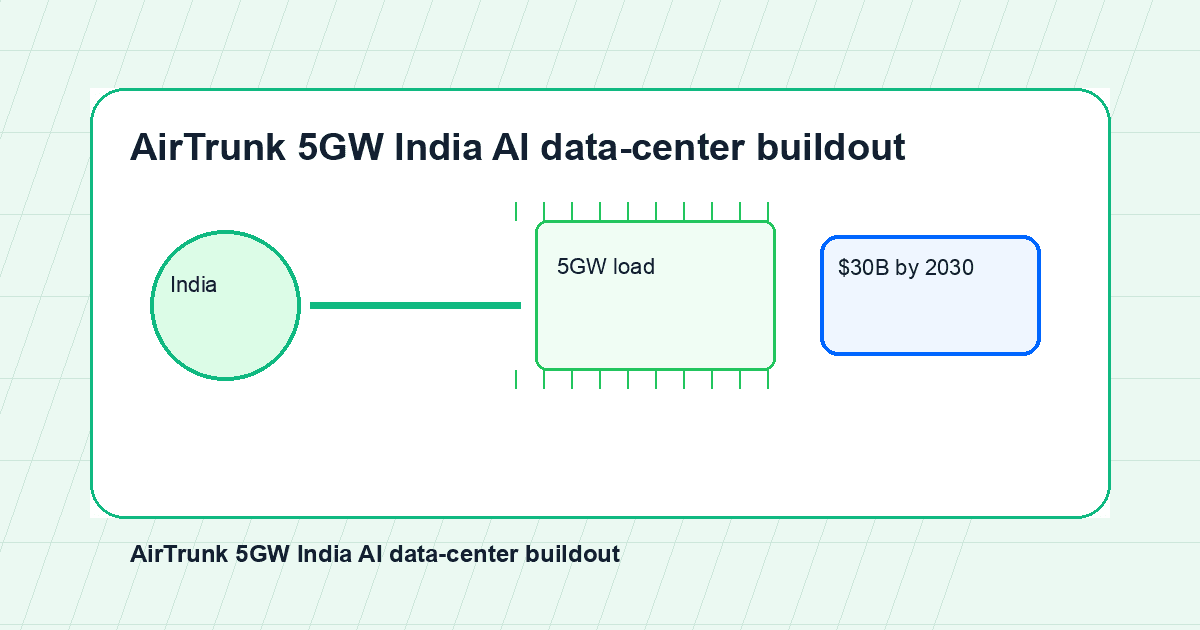
AirTrunk's 5GW India data-center commitment shows AI infrastructure is moving toward power, land, policy, and regional capacity.
AirTrunk's $30B India Plan Shows AI Infrastructure Is Becoming Geography Strategy
AirTrunk said on June 5, 2026 it would invest $30 billion in India by 2030. This is the kind of latest AI news that matters because it changes the operating layer around large language models, llms, ai agents, and generative ai systems rather than merely adding another feature announcement.
The Blackstone-backed data center operator plans to develop 5 gigawatts of new data center capacity in India. The specific question for builders and buyers is what this changes in practice: capacity, cost, governance, distribution, safety, or workflow reliability. ShShell readers should treat the story as a prompt to update deployment assumptions, not as a loose market signal.
Source trail
- TechCrunch report on AirTrunk India plan
- AirTrunk announcement on India investment
- India government cloud policy context cited in reporting
- Deloitte data-center power demand context
- Blackstone infrastructure context
This article uses those sources as the factual base and adds ShShell analysis for engineering, product, security, finance, and operations teams. Claims from reporting are framed as reporting; claims from company pages or filings are treated as primary-source claims.
Source-grounded operating read
- AirTrunk said on June 5, 2026 it would invest $30 billion in India by 2030.
- The Blackstone-backed data center operator plans to develop 5 gigawatts of new data center capacity in India.
- AirTrunk entered India earlier in 2026 through the acquisition of Lumina CloudInfra.
- TechCrunch reported India data center capacity could rise to as much as 8GW by 2030 from about 1.5GW today, citing Bernstein research through Economic Times reporting.
- New Delhi offered foreign cloud providers tax exemptions through 2047 on services sold overseas if workloads run from Indian data centers, according to TechCrunch reporting.
- Maharashtra Chief Minister Devendra Fadnavis said the state exchanged a letter of intent for land allotment at Raigad Pen Growth Center.
- The Raigad project is planned as a 3GW data center involving about ₹2 trillion, or around $21 billion, according to the post cited by TechCrunch.
- AirTrunk already has a development pipeline of about 600MW across Mumbai, Chennai, and Hyderabad.
- Prime Minister Narendra Modi publicly said the planned investment would strengthen India position as a global hub for cloud computing and artificial intelligence.
- Amazon, Google, Microsoft, OpenAI, and Uber have announced major cloud or AI infrastructure investments in India, according to TechCrunch.
- Reliance Industries, Adani Group, and TCS have also laid out data center expansion plans.
- Data centers create bottlenecks around power, water, land, grid access, and local approvals.
Decision table
| Decision point | Why it matters for this story | Practical check |
|---|---|---|
| What changed | AirTrunk said on June 5, 2026 it would invest $30 billion in India by 2030. | Confirm dates, named entities, and scope from primary sources |
| Who is exposed | Builders, buyers, operators, and finance teams affected by AirTrunk, India, AI Infrastructure | Identify the workflow, budget owner, and risk owner |
| What to measure | Cost, latency, quality, safety, adoption, and operational reliability | Compare against the current baseline before scaling |
| What can go wrong | Overcommitment, weak governance, vendor lock-in, poor observability, or misleading launch metrics | Require logs, versioning, review paths, and rollback |
AirTrunk's $30B India Plan: the architecture map
graph TD
    AirTrunk[AirTrunk India plan]
    Capital[30B investment by 2030]
    Capacity[5GW target capacity]
    Sites[Mumbai Chennai Hyderabad Raigad]
    Policy[India cloud and tax policy]
    Demand[AI and cloud demand]
    Constraints[Power water land grid]
    AirTrunk --> Capital
    Capital --> Capacity
    Capacity --> Sites
    Policy --> Sites
    Demand --> Capacity
    Sites --> Constraints
Why The AirTrunk India Commitment Matters
AirTrunk commitment is not simply another data center announcement. A 5GW target changes the scale of India role in the AI infrastructure map. The plan ties capital, geography, policy, power availability, and cloud demand into one story. For readers tracking latest AI news, this is the physical layer behind model progress: the servers, land, water, substations, tax policy, and regional connectivity that decide where AI workloads can run.
India Is Competing For The AI Workload Map
India has a large developer base, deep enterprise demand, and a government eager to position the country as a cloud and AI hub. The AirTrunk plan lands in that context. If foreign cloud providers can receive tax exemptions on overseas services run from Indian data centers, India becomes more attractive as an export base for compute. The country is not only consuming AI. It wants to host, train, serve, and monetize the workloads that power AI tools and enterprise agents across regions.
The Geography Of Capacity Is Now A Product Constraint
AI infrastructure is regional. A model served from the wrong region can create latency, data residency, compliance, and reliability problems. Companies building AI products in Asia, the Middle East, and Europe will care where capacity lives. A 5GW India buildout could support cloud workloads, inference endpoints, data residency commitments, and lower-latency access for regional customers. But capacity on a press release does not equal production capacity. The timeline, power contracts, network connectivity, and cooling design will decide what actually ships.
Power, Water, And Land Are The Hard Parts
The visible number is $30 billion. The harder number is 5GW. A gigawatt-scale data center plan requires grid access, backup power, cooling systems, land approvals, environmental review, and community acceptance. Data centers can create jobs and digital infrastructure, but they also compete for scarce resources. Water usage, power reliability, and land acquisition can become political issues quickly. AirTrunk thesis depends on renewable energy access and government support, but those are execution requirements, not slogans.
What Buyers Should Ask About India AI Infrastructure
Cloud and AI buyers should treat regional capacity as part of procurement. Ask which workloads can run in India, which compliance regimes apply, what latency looks like from major user populations, whether GPUs or TPUs are available, how failover works, and whether pricing reflects local power economics. Also ask whether a vendor can prove sustainability claims with power purchase agreements, water usage metrics, and grid-impact plans. Regional compute is valuable only when it is reliable, compliant, and measurable.
What To Watch By 2030
The next signals are land conversion, power agreements, grid upgrades, customer commitments, and whether the Raigad project becomes the anchor for most of the 5GW target. Watch how Amazon, Google, Microsoft, OpenAI, Reliance, Adani, and TCS respond. Also watch whether India can coordinate policy, infrastructure, and environmental constraints fast enough to turn announced AI capacity into actual model-serving capacity.
Builder checklist
- Track AI infrastructure by geography, not only by company or chip vendor.
- Capacity announcements need power, water, land, and grid verification.
- India is positioning itself as a regional AI compute hub, not only an end market.
- Buyers should include regional latency and data residency in AI platform decisions.
The practical read for ShShell readers
AirTrunk's $30B India Plan Shows AI Infrastructure Is Becoming Geography Strategy belongs in AI News Today because it shows how quickly artificial intelligence news has moved from model announcements into operating systems for money, infrastructure, governance, and distribution. The useful response is not to copy the headline into a roadmap. The useful response is to turn the headline into a local test. Identify the workflow affected by AirTrunk, define the baseline, then measure whether the new capability changes cost, speed, quality, risk, or reach.
For teams trying to Learn AI in a serious way, the story also explains why AI tools and ai agents cannot be judged only by demo quality. A model or assistant sits inside a stack: data, identity, context, compute, cost controls, user interface, policy, and evaluation. If the stack is weak, the model can look impressive and still fail in production. If the stack is strong, even a narrower model can create durable value because the workflow is measurable and reversible.
The next operational question is ownership. Someone has to own model selection, someone has to own spend, someone has to own security, and someone has to own user outcomes. In small teams, that may be the same person. In large enterprises, those responsibilities often live in different departments. AirTrunk's $30B India Plan Shows AI Infrastructure Is Becoming Geography Strategy matters because it makes those boundaries visible. It forces teams to ask whether procurement, engineering, security, product, and finance are aligned before the capability becomes business-critical.
The final lesson is pacing. Early adoption is valuable when it produces evidence. It is dangerous when it produces hidden dependency. Before expanding a workflow touched by India, teams should ask what happens if the provider changes pricing, if the model changes behavior, if the data boundary moves, or if the system fails during a high-pressure moment. The answer should be in architecture, not hope.
What to watch next
Watch item 1: Prime Minister Narendra Modi publicly said the planned investment would strengthen India position as a global hub for cloud computing and artificial intelligence. Track whether this becomes operating evidence rather than another market headline.
Watch item 2: Amazon, Google, Microsoft, OpenAI, and Uber have announced major cloud or AI infrastructure investments in India, according to TechCrunch. Track whether this becomes operating evidence rather than another market headline.
Watch item 3: Reliance Industries, Adani Group, and TCS have also laid out data center expansion plans. Track whether this becomes operating evidence rather than another market headline.
Watch item 4: Data centers create bottlenecks around power, water, land, grid access, and local approvals. Track whether this becomes operating evidence rather than another market headline.
The bottom line: AirTrunk's $30B India Plan Shows AI Infrastructure Is Becoming Geography Strategy is useful because it connects an external event to a concrete AI adoption decision. Readers should ask what workflow changes, what budget or infrastructure assumption changes, what governance control becomes mandatory, and what evidence would prove the story mattered after the news cycle moves on.
Why 5GW Changes The Scale Of The Conversation
A 5GW data-center commitment is not a normal real-estate plan. It is a national infrastructure program in commercial form. Many regional data-center markets are still measured in hundreds of megawatts, not gigawatts. A five-gigawatt target means power procurement, grid upgrades, cooling strategy, fiber routes, equipment supply chains, permitting, and workforce planning all have to move together. If any one of those parts lags, announced capacity turns into delayed capacity.
That matters for AI because model-serving demand is becoming less optional. Enterprises want local inference, governments want data sovereignty, and developers want low latency. India has the talent base and market demand, but AI infrastructure needs physical execution. The AirTrunk plan gives India a path to host more cloud and artificial intelligence workloads locally, but the value depends on how quickly the facilities become operational and how reliably they can serve high-density AI hardware.
Why Blackstone Backing Matters
AirTrunk is backed by Blackstone, which gives the announcement a different profile from a smaller speculative data-center plan. Large infrastructure investors can coordinate capital, land, customer commitments, and long project timelines. They can also absorb the early years when construction, power, and equipment costs arrive before full utilization. That is important because AI data centers have high upfront capital demands. The market wants capacity quickly, but the assets take time to permit and build.
Still, capital is only one input. India expansion will require state coordination, power-market planning, and local community acceptance. The Raigad Pen Growth Center letter of intent suggests Maharashtra could become a major anchor, but a 3GW site also concentrates risk. If the site faces power constraints, environmental opposition, or permitting delays, the national target becomes harder. Distributed pipelines across Mumbai, Chennai, and Hyderabad reduce some risk, but they also require consistent execution across regions.
The Sustainability Claim Needs Evidence
AirTrunk and policymakers can point to renewable energy as part of the investment thesis, but buyers should ask for specifics. Which power purchase agreements exist. How much load is matched by renewable generation on an hourly basis. What backup generation is planned. How water use will be managed. What heat rejection technology will be used in humid or water-stressed regions. What grid upgrades are required, and who pays for them. These questions are not anti-AI. They are how AI infrastructure becomes credible.
The Asia Pacific data-center buildout is expected to require large amounts of additional electricity by the end of the decade. If the region adds capacity faster than it adds clean, reliable power, data-center growth can collide with climate goals and local reliability needs. The strongest operators will win not by announcing the largest number but by proving they can deliver capacity with transparent energy, water, and community metrics.
What Indian AI Builders Can Do Now
Indian startups and enterprise teams should not wait until 2030 to change their architecture thinking. They can start by making deployment regions explicit in every AI product review. They can measure inference latency from Mumbai, Delhi, Bengaluru, Hyderabad, Chennai, Singapore, and the Middle East. They can ask cloud vendors which models are available in-region, which vector stores can stay in India, and which logs leave the country. They can also design applications so model endpoints can move without rewriting the product.
The practical architecture pattern is portability with proof. Keep prompts, retrieval pipelines, evaluation sets, and observability independent enough that workloads can move between regions or providers. Use the new capacity wave to improve resilience, not to create a single new dependency. If AirTrunk succeeds, India gets more AI infrastructure leverage. If timelines slip, teams with portable systems will still be able to route around the constraint.
The Procurement Question Hidden Inside The India Buildout
For enterprise buyers, the AirTrunk announcement should change how AI infrastructure is discussed in procurement meetings. The old question was usually vendor-centered: which cloud has the right model, the right GPU instance, the right managed service, or the right discount. The new question is location-centered: where can the workload run with acceptable latency, legal exposure, power reliability, and cost predictability. A 5GW India buildout does not automatically answer that question, but it gives buyers a reason to start asking it earlier.
The practical procurement model should separate three layers. First is facility capacity: does the region have enough power, cooling, rack density, network connectivity, and operational maturity to host AI workloads. Second is cloud and platform availability: are the needed models, vector databases, observability tools, key management systems, and identity controls available in that region. Third is business exposure: what happens to data residency, tax treatment, support coverage, and customer commitments if an AI workflow moves there. The AirTrunk plan sits mostly in the first layer, but the value will only be realized if the second and third layers arrive with it.
This matters for Indian companies that want to serve global customers from India. If the government incentive structure makes export-oriented cloud services more attractive, companies may be able to build regional AI products with better cost economics. But those economics depend on platform maturity. A startup cannot build a dependable agentic AI product on a region that lacks the model endpoints, logging controls, security certifications, or managed services it needs.
What The Raigad Anchor Could Mean
The Raigad Pen Growth Center detail is important because gigawatt-scale infrastructure needs an anchor. A 3GW project would concentrate a large share of the announced capacity in one state-level development path. That can accelerate execution if land, grid access, and permits are coordinated well. It can also create a bottleneck if local approvals, community concerns, or power delivery slow down.
For policy teams, the lesson is coordination. AI infrastructure policy cannot be handled only by technology ministries. It touches energy, water, land, telecommunications, tax, workforce development, and environmental review. A government can attract data-center capital with tax exemptions, but long-term credibility comes from predictable approvals and transparent resource planning. If India wants to become a global AI compute hub, the operating standard has to be boring in the best way: reliable power, clear permits, measurable sustainability, and fewer surprises.
For builders, Raigad is a reminder that cloud abstractions sit on geography. A model endpoint may look like a URL, but behind that URL are substations, fiber routes, diesel or battery backup, cooling loops, and on-site operations teams. When a region becomes strategically important, product teams should understand the physical dependency well enough to plan fallback routes.
The Developer Impact Is Latency And Availability
Developers will feel the AirTrunk story only if it changes what they can deploy. Lower-latency inference near Indian users could make voice agents, customer-support copilots, multimodal search, fraud detection, and coding tools feel more responsive. Local capacity could also reduce the pressure to send sensitive data across borders for model processing. For regulated sectors like banking, healthcare, insurance, and public services, that could unlock workflows that were previously hard to approve.
But availability matters as much as latency. If a provider offers a model in one region but rate-limits it aggressively, the product still fails. If a region supports basic inference but not long-context models, tool calling, batch processing, or fine-tuning, developers will split workloads across regions and reintroduce governance complexity. The promise of 5GW capacity is therefore not simply more servers. It is more complete regional capability.
The watch item for 2026 and 2027 is whether cloud vendors announce specific AI services tied to India capacity. New facilities alone are not enough. The market needs model availability, regional SLAs, customer references, energy disclosures, and production evidence.
The Risk Of Treating Capacity As Destiny
There is a tempting but weak reading of the AirTrunk news: India gets 5GW of AI data centers, therefore India becomes an AI hub. The stronger reading is more conditional. Capacity creates the possibility of a hub. Execution determines whether that possibility becomes durable advantage. A country can have buildings and still lack enough reliable power. It can have power and still lack the network routes or cloud services developers need. It can have services and still face procurement skepticism if buyers cannot verify sustainability, security, and uptime.
That is why the next twelve to twenty-four months matter. Watch whether AirTrunk and its partners disclose signed power agreements, anchor customers, construction milestones, and regional service commitments. Watch whether Indian enterprises begin moving production inference workloads into local regions rather than only running pilots. Watch whether startups can buy AI capacity without paying a premium that wipes out the latency advantage. The headline is capital. The proof will be workload migration.
For ShShell readers, the useful takeaway is to treat AI geography as an architecture input. When designing an agent, retrieval system, search product, or multimodal workflow, include deployment region in the first design review. The model choice matters. The prompt matters. The data pipeline matters. But where the workload runs will increasingly decide whether the system is fast, compliant, affordable, and resilient.