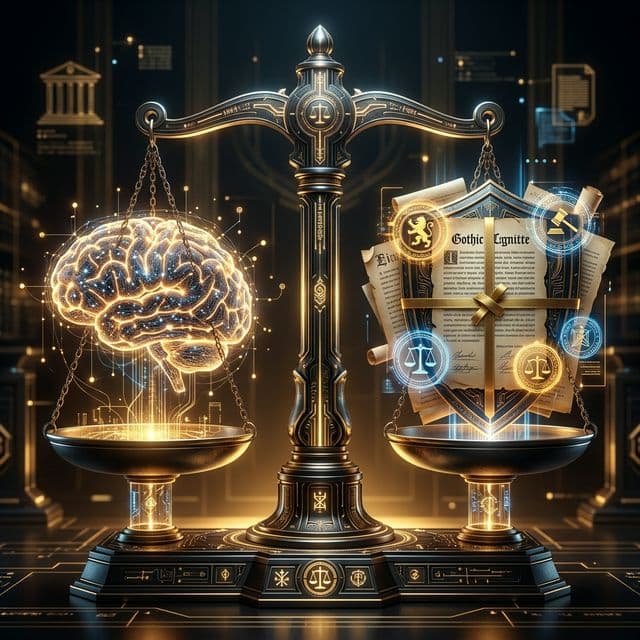
March Madness in the Marble Halls: The High Stakes of 2026 AI Regulation
From Brussels to Washington D.C., March 2026 is the month the rules of the internet were rewritten. As the EU AI Act enters its full enforcement phase and the US introduces the 'Sovereign Intelligence Order,' we analyze the collision of innovation and oversight.
The Great Governance Collision
If the tech world has its "March Madness" in the form of rapid model releases, the political world has its own version in the form of regulatory milestones. March 27, 2026, marks the day several key pieces of global legislation officially collided, creating the first unified (yet fractured) global framework for artificial intelligence.
We are no longer in the "Wait and See" era. For the 500 largest companies in the world, AI compliance is no longer a footnote—it is a $100M-per-year line item.
The EU AI Act Moves from "Text" to "Total Enforcement"
The European Union has achieved what many thought was impossible: they have codified the "Red Lines" of AI. As of March 2026, the Risk-Based Tiering System of the EU AI Act has entered its final compliance phase.
The "High-Risk" Checklist
For any model used in credit scoring, recruitment, or public infrastructure (like education), companies must now provide an "Interpretability Certificate." They must prove not just what the AI decided, but why. This has directly influenced the success of transparent models like Claude 4.6 (see Part 1 of this series).
| Tier | Example Use Case | Regulatory Burden | Status (March 2026) |
|---|---|---|---|
| Unacceptable Risk | Real-time social scoring | Total Ban | Enforcement Active |
| High Risk | Hiring, Mortgage Approval | Explicit Audit Required | Now Mandatory |
| Generative Tier | Marketing, Art | Transparency Disclosures | Enforcement Active |
The US Sovereign Intelligence Order (SIO)
While the EU focuses on "Risk," the United States has shifted its focus to "Sovereignty." The Sovereign Intelligence Order (SIO), signed by the President last month, mandates that any AI system performing critical infrastructure tasks for the US government must be "Hardware-Grounded" on domestic soil.
This has sparked a massive architectural shift in the cloud market. We are seeing the rise of "Gov-Clouds"—physically isolated data centers where AI models like GPT-4-Sovereign run on air-gapped servers.
graph TD
    A[Public Interest] --> B{Sovereignty Check}
    B -- Public --> C[Global Cloud Models]
    B -- Critical --> D[Sovereign US Infrastructure]
    D --> E[Air-Gapped Training]
    D --> F[Domestically-Owned Hardware]
    F --> G[End-to-End Verification]
    G --> H[Gov-Ops Ready]
    E --> H
    subgraph "The SIO Framework"
    D
    E
    F
    G
    end
The "Copyright Compromise" of March 2026
The third major pillar of March Madness is the Global Content Royalty Accord. After years of litigation, the world’s major news organizations and the "Big Three" AI labs reached a permanent settlement.
Under this accord, AI labs pay a "Residual Fractional Penny" (RFP) for every token generated that can be traced back to proprietary training data. This has fundamentally changed the economics of LLMs. Intelligence is no longer "Free to Scrape"—it is a licensed utility.
This is why we’ve seen the cost of some models rise slightly in March, while others (based on synthetic or open-weights data) have plummeted.
FAQ – Staying Compliant in 2026
Q: Does my small business need to worry about the EU AI Act? A: If you are using standard tools like ChatGPT or Claude for marketing, no. You just need to ensure your content is labeled as AI-generated where appropriate. If you are building high-risk tools for HR or Finance, yes. You need an audit.
Q: What is the "Red Team Mandate"? A: The SIO mandates that all models above a certain compute threshold ($10^$ FLOPS) must undergo a third-party "National Security Red-Team" before public release. This is why we are seeing fewer, but higher-quality, big model releases.
Q: Is "Prompt Injection" now a legal crime? A: There is a new federal law being debated that would classify the malicious subversion of an AI's safety protocols as a form of "Digital Trespassing." It hasn't passed yet, but the intent is clear.
Conclusion: The Era of "Regulated Innovation"
The "March Madness" of 2026 regulation was expected to slow down innovation. Paradoxically, it has done the opposite. By providing a clear set of rules, the biggest capital pools in the world finally feel safe enough to go "All-In" on AI.
We are entering the era of the Professional AI. The wild west is over, and while some will miss the chaos, the stability of this new framework is what will allow AI to finally scale into every corner of the global economy.
This is a special feature as part of our March AI News Series. Stay tuned for our final synthesis – AI & the Future of Human Meaning.