Atomic Intelligence: Why the Next Era of AI Clusters Will Be Powered by Nuclear Fusion
As energy scarcity threatens AI scaling, tech giants and energy firms are converging on a radical solution: integrated small modular reactors and fusion clusters.
Atomic Intelligence: Why the Next Era of AI Clusters Will Be Powered by Nuclear Fusion
The primary constraint of the Great Intelligence Race in 2026 is no longer memory bandwidth or GPU silicon—it is Tera-watts. As Large Language Models (LLMs) evolve into "Always-On" agentic systems, the power demand of global data centers has surged by 400% in just two years. On March 22, 2026, industry leaders from Microsoft, NVIDIA, and Helion Energy announced the Atomic Intelligence Consortium, a massive investment pivot towards nuclear-integrated AI clusters.
The message is clear: to power the mind of the future, we must harness the power of the sun.
The Energy Crisis of the "Always-On" Era
In 2024, AI models were mostly reactive—they consumed power only when you hit "Enter." In 2026, Agentic AI runs continuously in the background, autonomously monitoring global supply chains, auditing codebases, and managing local device environments. This "Always-on" inference requires a Base Load of electricity that solar and wind—due to intermittency—struggle to provide at scale.
"We cannot scale AGI on a grid designed for the lightbulbs of the 20th century," said Satya Nadella during the announcement. "The integration of Small Modular Reactors (SMRs) directly into our AI campuses is the only viable path to carbon-neutral AGI."
The Multi-Stage Power Path for AI
- Stage 1: Dedicated Nuclear PPA (Current): Buying the full output of existing nuclear plants (e.g., Three Mile Island).
- Stage 2: On-Site SMRs (2027-2028): Mass-produced modular reactors parked directly next to server racks.
- Stage 3: Commercial Fusion (2029+): Zero-waste, infinite energy density clusters for the ASI (Artificial Super Intelligence) era.
The Fusion Inflection Point
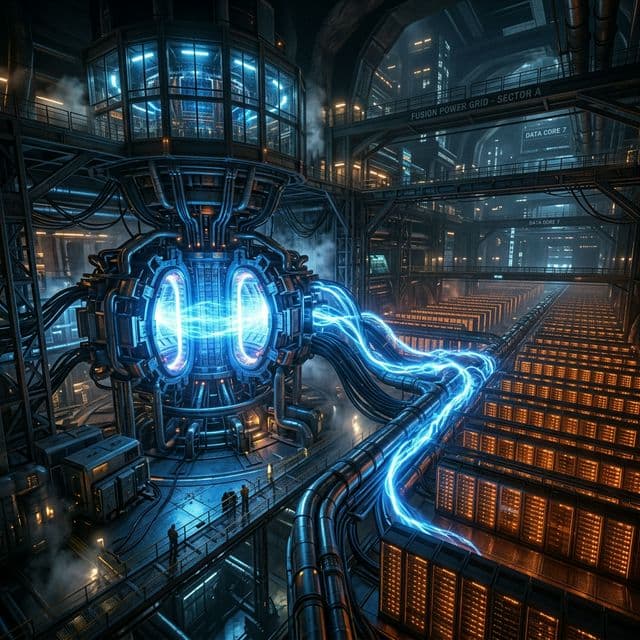
The most groundbreaking part of the March 2026 briefing was the showcase of the Polaris Fusion Cluster in Washington State. For the first time, a magnetic-confinement fusion reactor provided stable 50MW power directly to an NVIDIA Blackwell cluster for 72 consecutive hours.
While large-scale commercial fusion for the public grid remains years away, Dedicated Industrial Fusion for AI is already becoming a reality. These reactors don't need to power a city; they just need to keep a high-density "Intelligence Factory" running at 99.999% uptime.
graph TD
    A[Fusion Core / SMR] -->|Direct DC Power| B[Liquid-Cooled Server Racks]
    B -->|Waste Heat| C[Heat Exchange System]
    C -->|District Heating / Desalination| D[Local Community Benefit]
    B -->|Compute Cycles| E[Global AI Agent Swarm]

    style A fill:#4FC3F7,stroke:#333,stroke-width:2px,color:#000
    style B fill:#333,stroke:#4FC3F7,color:#fff
Economic Implications: The Power-Intelligence Standard
In 2026, the value of a tech company is increasingly being measured by its Power-to-FLOP Ratio. Companies that own their power generation are protected from the volatile energy prices that are crippling traditional cloud providers.
| Infrastructure Type | Energy Density | Reliability | 2030 Outlook |
|---|---|---|---|
| Grid Hybrid | Low | Low (Intermittent) | Phase-out for AI |
| On-Site SMR | High | High (Base Load) | Mainstream (2028) |
| Industrial Fusion | Infinite | Experimental | Dominant (2032) |
Frequently Asked Questions (FAQ)
Is placing nuclear reactors next to data centers safe?
SMRs (Small Modular Reactors) are designed with "Passive Cooling" and "Walk-Away Safety." Unlike 20th-century plants, they automatically shut down safely without human intervention or power if an anomaly occurs.
How does this impact the cost of using AI?
By bypassing the retail power grid and its associated taxes/transmission fees, "Atomic Data Centers" can reduce inference costs by up to 60%, accelerating the move toward "Intelligence as a Utility."
What happens to the heat generated?
AI-Nuclear clusters are "Circular Energy" hubs. The waste heat from the server racks is often piped to local green-houses or used for district heating in nearby residential zones, turning a waste product into a community asset.
Conclusion: The Sun and the Silicon
The convergence of nuclear power and artificial intelligence is the definitive industrial narrative of the late 2020s. We are witnessing the birth of Energy-Intelligence Hubs—autonomous islands of infinite power and infinite thought. As the first fusion-powered clusters go online in 2026, we are finally decoupling our digital future from the fossil fuels of the past. The road to AGI is paved with atoms.
This investigative report was prepared by Sudeep Devkota for the AI Infrastructure Index. Technical data provided by the Atomic Intelligence Consortium and the March 2026 Fusion Safety Review.