The Agent Wars 2026: Navigating the Framework Explosion
# The Agent Wars 2026: Navigating the Framework Explosion In early 2024, the term "AI Agent" was a buzzword for a slightly smarter Python script. Today, agents...
The Agent Wars 2026: Navigating the Framework Explosion
In early 2024, the term "AI Agent" was a buzzword for a slightly smarter Python script. Today, agents are the backbone of the $3 trillion AI automation economy. They handle supply chain logistics, conduct legal research, and write their own unit tests. But as the capabilities have grown, so has the complexity of the tools used to build them.
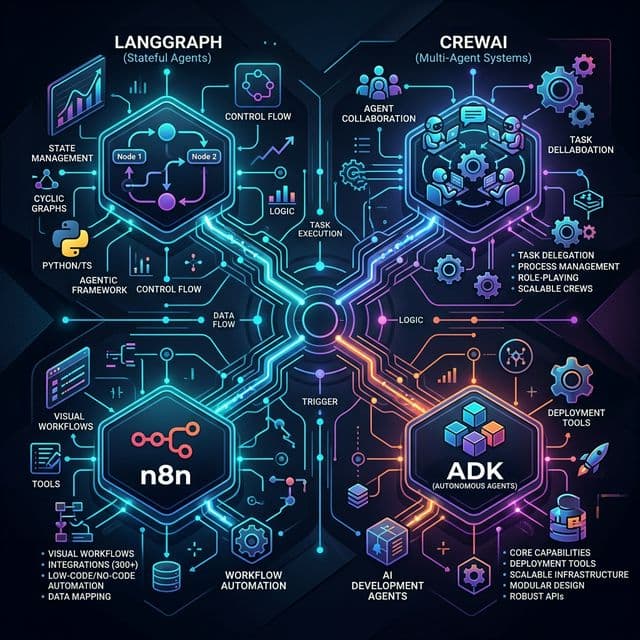
In this 2026 definitive guide, we compare the four dominant ecosystems for agent orchestration: The "Low-Code King" n8n, the "Stateful Architect" LangGraph, the "Collab Specialist" CrewAI, and the new contender for industry standardization, the Agent Development Kit (ADK).
The State of Agentic Design
Modern agents have evolved from linear RAG (Retrieval-Augmented Generation) pipelines into Circular Reasoning Graphs. An agent no longer treats a task as a single query; it treats it as an ongoing mission with internal state, external tool-use, and multi-agent coordination.
Comparison Matrix: Who is for What?
| Feature | LangGraph 3.0 | n8n PI | CrewAI 4.1 | ADK (Agent Dev Kit) |
|---|---|---|---|---|
| Logic Type | Code-First / Directed Graphs | Low-Code / Node-Based | Role-Based Orchestration | Protocol-First / Universal |
| State Persistence | Extreme (Memory Saver) | Moderate (Execution Data) | High (Consensus Logs) | Immutable (Agent Blockchain) |
| Multi-Agent Support | Native (Nodes) | Via Sub-Workflows | Elite (Process Flows) | Swarm Integration |
| Target User | AI Engineers / Scientists | Operations / Growth Teams | Startup Founders / Devs | Enterprise Architects |
1. LangGraph 3.0: The Engineer’s Choice
LangGraph has maintained its lead by being the most flexible and rigorous. For 2026, LangGraph 3.0 introduces "Recursive Memory Checkpointing," allowing agents to "time-travel" back to a previous state if they realize a current path is failing.
Why Use It: You need absolute control over the decision-making graph. If your agent is handling financial auditing or code refactoring, the stateful nature of LangGraph is non-negotiable.
# The standard 2026 LangGraph State Machine
from langgraph.graph import StateGraph, END

def agent_plan(state):
    # Reasoning logic here
    return {"next_step": "validate_tools"}

workflow = StateGraph(MyAgentState)
workflow.add_node("planner", agent_plan)
workflow.set_entry_point("planner")
workflow.add_edge("planner", "execute")
2. n8n PI: The Low-Code Powerhouse
The "PI" (Personal Intelligence) update for n8n has turned it from a workflow tool into an Agent Runway. With the addition of "AI Agent Nodes" that can be self-hosted or cloud-based, non-technical teams are now building complex agents for customer success and content marketing.
Why Use It: Speed to market. n8n was the first to realize that most "agents" are just 80% glue code and 20% LLM reasoning. By providing the glue out of the box, n8n remains the ROI leader.
3. CrewAI 4.1: The Multi-Agent Specialist
CrewAI's genius is in its Role-Based process. While other frameworks treat agents as nodes, CrewAI treats them as employees. Version 4.1 adds "Conflict Resolution Protocols" where agents will actually "debate" the best approach to a task before executing.
Why Use It: You have a clearly defined business process with multiple roles (e.g., Researcher, Writer, Editor, SEO Expert). CrewAI makes managing these "crews" intuitive.
4. The Agent Development Kit (ADK): The New Standard
Announced at the AI World Congress 2026, the ADK is an open-source initiative backed by Microsoft, Apple, and Anthropic. Its goal is to create a "Universal Agent Protocol" (UAP).
ADK is not just a framework; it's a standardized runtime. Any agent built with ADK can theoretically move between different clouds (Azure AI to AWS Bedrock) without losing its memory or tool-permission set.
Key Innovation: Agent Attestation. ADK agents "sign" their actions using a distributed ledger, providing a cryptographic audit trail for every tool call. This is the first time agents have been truly "Enterprise Ready" for highly regulated industries like Healthcare and Defense.
sequenceDiagram
    participant User
    participant ADK Runtime
    participant Agent Swarm
    participant Tool Registry
    User->>ADK Runtime: Initiate Mission
    ADK Runtime->>Agent Swarm: Distribute Tasks (Signed)
    Agent Swarm->>Tool Registry: Attest Permission
    Tool Registry-->>Agent Swarm: Execute Action
    Agent Swarm-->>ADK Runtime: Results with Proof
    ADK Runtime-->>User: Mission Complete
Conclusion: How to Choose?
In 2026, the complexity of your agent determines your framework.
- For Mission-Critical Logic: Choose LangGraph.
- For Rapid Business Deployment: Choose n8n.
- For Collaborative Workforces: Choose CrewAI.
- For Future-Proof Enterprise Grade: Choose ADK.
The "Agent Wars" have only just begun. As these frameworks converge, the real winners aren't the toolmakers, but the engineers who can finally build the autonomous future we’ve been promised for years.
Antigravity AI's 'Agent Builder' course for ADK starts this April. Register now.