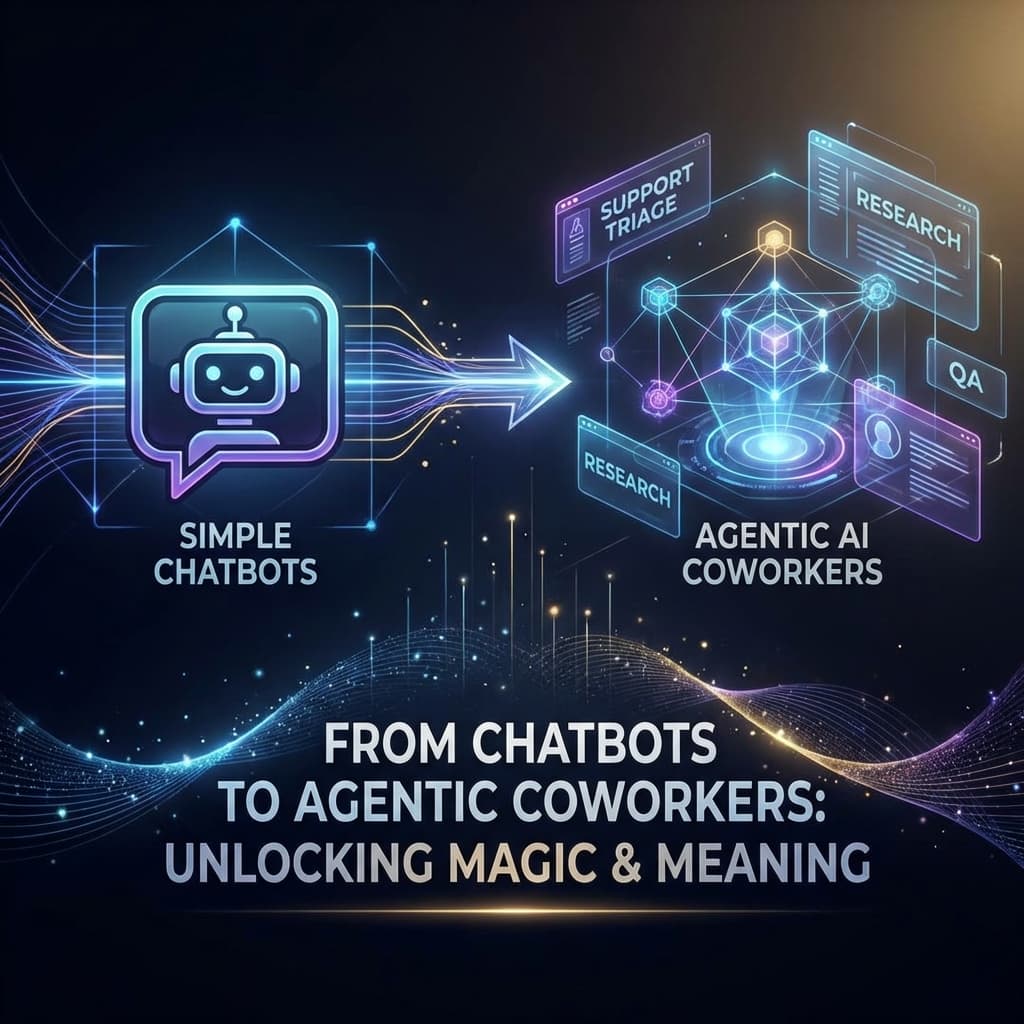
From Chatbots to Coworkers: How Agentic AI Is Quietly Eating White-Collar Work
Discover how AI is evolving from simple chat interfaces to autonomous agents that act as coworkers. This guide explains agentic workflows, realistic use cases in support and research, and how your team can start small with AI agents.
For the last two years, we’ve been obsessed with the "Chat" in AI. We’ve learned how to talk to boxes, how to prompt for better poems, and how to summarize long emails. But while we were busy chatting, something far more profound was happening. The technology was learning how to act.
We are moving out of the era of Generative AI (AI that makes things) and into the era of Agentic AI (AI that does things).
If you feel like the noise around AI is getting louder, it’s because the stakes just got higher. We aren't just talking about a better Google search anymore. We are talking about a new kind of coworker—one that doesn't just answer your questions, but actually takes the "work" off your plate.
In this guide, we’re going to look past the hype and the technobabble. We’re going to understand what agents actually are, why they are different from the chatbots you’ve used, and how they are already quietly transforming the daily grind of white-collar work.
Part 1: The Magic Behind the Curtain – What is an "Agent"?
Most people think of AI as a very smart encyclopedia. You ask it a question, it gives you an answer. This is a Linear Workflow.
Agentic AI is different. An agent is more like a junior employee with a laptop, a set of tools, and a specific goal.
Imagine you ask a standard chatbot: "Find me the best three leads for my software company in New York." The chatbot might give you a list of three companies based on what it knows.
Now, imagine you give that same task to an AI Agent. The agent doesn't just give you a list. It:
- Plans: It decides it needs to search LinkedIn, check company websites, and look for recent news.
- Acts: It uses a "Browser tool" to actually search the web. It clicks links. It reads "About Us" pages.
- reasons: It realizes one company is actually a competitor, not a lead. It discards it and looks for another.
- Refines: It looks for the email address of the CEO for each company.
- Delivers: It gives you a spreadsheet with the leads, their contact info, and a summary of why they are a good fit.
The "Magic" of the Agent is Autonomy. You give it a destination, and it finds the path.
The Components of a Coworker
For an AI to act like a coworker, it needs four things:
- A Brain (LLM): To understand language and make decisions.
- Memory: To remember what it did ten minutes ago so it doesn't repeat mistakes.
- Tools: Access to your email, your CRM, the web, or your internal databases.
- Planning: The ability to break a big goal into small, manageable steps.
Part 2: The Meaning – Why "Eating" White-Collar Work?
When we say AI is "eating" work, it sounds scary. But for most of us, it should sound like a relief.
White-collar work today is often 20% high-value decision-making and 80% "Digital Glue"—the act of moving data from one window to another, summarizing meetings, triaging requests, and chasing down information.
AI Agents are hungry for that 80%. They are built to thrive in the "messy middle" of business operations. They aren't replacing the person; they are replacing the grunt work that makes the person feel like a machine.
Part 3: Real-World Workflows – AI in the Trenches
To understand how this looks in practice, let’s look at three realistic scenarios where Agentic AI is moving from "experimental" to "essential."
1. The Support Triage Agent
The Old Way: A customer sends a complex email. A human support rep reads it, realizes it’s about a billing error, looks up the customer in Stripe, finds the transaction, realizes it was a duplicate charge, and then writes an email explaining the refund.
The Agentic Way:
- The email arrives. An Agent is triggered.
- It reads the email and identifies the "Intent" as a billing issue.
- It automatically queries the database to see the customer’s history.
- It sees the duplicate charge.
- It "Reasons": "I have permission to refund up to $50, but this is $150. I need human approval."
- It drafts the refund request for a manager, including all the links to the transactions.
- Once approved, it executes the refund and drafts a polite email to the customer.
The Result: The support rep only spends 10 seconds approving a pre-prepared solution instead of 15 minutes doing "digital archaeology."
2. The Lead Research Agent
The Old Way: A sales rep spends Friday afternoon searching for prospects, copying names into a CRM, and trying to find a "personal hook" for an outbound email.
The Agentic Way:
- The rep tells the agent: "Watch these 50 target accounts. If any of them hire a new VP of Engineering, let me know."
- The agent continuously monitors news feeds and LinkedIn.
- When a change is detected, it researches the new VP’s background.
- It finds a podcast they were on and summarizes their philosophy.
- It puts a draft email in the sales rep’s inbox: "Congrats on the new role! I saw your talk on [Topic] and thought our tool might help with [Specific Pain Point]."
The Result: The sales rep spends their time talking to people rather than stalking people on the internet.
3. The QA Triage Agent (The "Bug Whisperer")
The Old Way: A developer wakes up to 100 automated alerts. They have to sort through them to find the "real" bugs versus the "noise" of temporary network blips.
The Agentic Way:
- The agent receives every alert.
- For each one, it logs into the server, checks the last 5 minutes of logs, and tries to reproduce the error.
- If it’s a "flaky" alert, it closes it and adds a note: "Checked logs, temporary latency, resolved itself."
- If it’s a real bug, it finds the exact line of code that changed recently and links to the Github commit.
- It summarizes the issue for the developer: "The checkout is failing because of a missing comma in the new tax calculation module."
The Result: The developer starts their day fixing a bug, not hunting for one.
Part 4: The Playbook – How to Start Small
You don't need a $100 million budget or a PhD in Machine Learning to start using agents. You just need to change how you look at your "To-Do" list.
1. Identify the "Loop"
Look for tasks that you do at least three times a week that involve:
- Checking multiple sources of information.
- Making a simple "If/Then" decision.
- Taking an action in a software tool.
2. Document the "Logic"
Before you can automate it with an agent, you have to be able to explain it to a human. If you can’t write down the steps of the task in a simple bulleted list, the AI will fail.
3. Use "Low-Code" Gateways
Don't try to build a custom agent from scratch. Use platforms like n8n, Zapier Central, or LangChain’s newer templates. These allow you to connect your "Brain" (ChatGPT/Claude) to your "Tools" (Email/Sheets) without writing 1000 lines of code.
4. Always Keep a Human in the Loop (HITL)
The most successful agentic teams use the "Draft & Approve" model. The agent does the legwork and presents a finished "draft" of the work. The human provides the final 5% of judgment. This eliminates 95% of the effort while maintaining 100% of the quality.
Part 5: The "Boring but Beautiful" Future
There is a lot of talk about AI leading to "AGI" or sci-fi robots. But the reality of the next few years is much more "boring"—and much more beautiful.
The future of work is a workspace that anticipates your needs. It’s a CRM that cleans itself. It’s an inbox that prioritizes itself. It’s a company where "data entry" is a relic of the past, like the typewriter or carbon paper.
We are moving toward a world where we spend our time on Meaning—strategy, creativity, empathy, and connection—while the AI agents handle the Mechanics.
The agents aren't eating our work; they are eating the parts of our work that we never liked anyway.
Final Thoughts for Leaders
If you are leading a team, your job is no longer just managing people. It is managing a Hybrid Workforce.
Ask yourself:
- Which of my team’s "digital glue" tasks can be handled by an agent tomorrow?
- How can I free up my best people to do the work only they can do?
The companies that win in 2026 won’t be the ones with the biggest LLM. They will be the ones who learned how to turn their "Chatbots" into "Coworkers."
Step-by-Step Checklist for Your First Agentic Project:
- Define a Narrow Task: Don't try to "Automate Marketing." Try to "Automate finding 5 relevant podcasts for our CEO."
- Select Your Tools: What websites or apps does the agent need access to?
- Establish Guardrails: What is the agent not allowed to do? (e.g., "Do not send emails without approval.")
- Beta Test: Run the agent alongside a human for a week. Compare the results.
- Scale: Once it works for one task, move to the next.
Welcome to the era of the Agentic Coworker. It’s time to get to work.