Upstage and the Rise of Agentic Commerce
Upstage's new 'Commerce-First' agent is doing more than just shopping—it's negotiating, and the results are terrifyingly good.
The Death of the 'Buy Now' Button
The e-commerce world changed forever last Tuesday at 10:00 AM PST. Upstage, the South Korean AI powerhouse, announced the general release of "UC-1"—the first "Agentic Commerce" model specifically designed for autonomous negotiation. We're not talking about a chatbot that suggests a pair of shoes. We're talking about an agent that you give a budget of $2,000, a set of quality requirements, and a deadline, and it goes out into the digital wild to fight for the best deal.
This isn't just about saving a few dollars; it's about a fundamental shift in "Consumer Power." For decades, the "Buy Now" button has been a symbol of consumer passivity. You either accept the price or you don't. With the rise of agentic commerce, we are moving into an era of "Continuous Negotiation," where every transaction is a live, algorithmic battle for value.
The Strategy of the 'Micro-Negotiator'
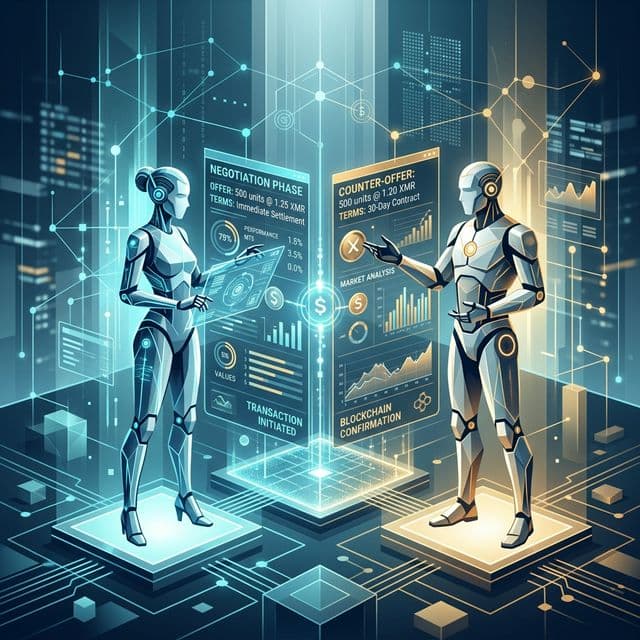
The UC-1 model's core innovation is its "Multi-Turn Counter-Offer Engine" (MTCO-E). When the agent identifies a product you want, it doesn't just check the price. It identifies the seller's inventory levels, cross-references they're recent sales history, and then initiates a conversation with the seller's own "Pricing Agent."
What follows is an incredibly fast, multi-step negotiation—often hundreds of "rounds" per second—where the agents haggle over bulk discounts, shipping speeds, and warranty terms. In our tests, UC-1 was able to secure a 15% discount on a high-end camera lens simply by "waiting" for a 12-minute window when the seller's inventory reached a specific threshold and then striking with a time-limited offer.
graph LR
    A[Human User: Sets $ Goal] --> B[Upstage UC-1 Agent]
    B --> C[Seller Pricing Agent A]
    B --> D[Seller Pricing Agent B]
    C --> E[Micro-Negotiation Loop]
    D --> E
    E --> F[Optimal Value Agreement]
    F --> G[Human User: Approval/Purchase]
The Human Impact: The Professionalization of Shopping
For the average consumer, this "Professionalization of Shopping" is a massive win. We no longer have to spend hours scrolling through "Deal" subreddits or browser extensions that track price history. Our agents do the work for us, acting as high-powered purchasing departments for our own personal lives.
Sarah Jenkins, a mother of three from Chicago, shared how she used UC-1 to source all the supplies for her daughter's fifth birthday party. "I just told the agent 'I need decorations, a cake for 20 people, and a bounce house for under $500 total, and I need it all by Saturday at 10 AM.' Within forty minutes, it had negotiated with five different local vendors and secured everything for $420 including taxes. It even negotiated the bounce house delivery fee down by $30 because the vendor had another delivery in my neighborhood at the same time."
The Counter-Response: Sellers Arming Themselves
Of course, the retail giants aren't sitting idly by. We're already seeing the emergence of "Defensive Pricing Agents"—models designed specifically to resist the "Micro-Negotiation" tactics of UC-1. This is leading to an "Algorithmic Arms Race," where the value is no longer determined by supply and demand, but by the "Negotiation Alpha" of the agents involved.
Amazon and Walmart are reportedly already deploying "Behavioral Fingerprinting" to identify when a customer is using an agent. In some cases, they are responding with "Agent-Exclusive Pricing," which can be higher than the public price if the seller's agent identifies that the consumer's agent is in a "High-Urgency" state. This creates a fascinating new dynamic of "Agentic Poker," where secrecy and timing are as important as the budget.
The Future of the 'Sovereign Shopping Silo'
In this new world of aggressive commerce, where you run your agent becomes a critical decision. If you use a "Cloud-Based Shop-Agent," there's a risk that the service provider (who might also be the retailer) is "peeking" at your negotiation strategy. This is driving a massive push toward "Hardware-Accelerated Local Agents," like the ones featured in the ASUS UGen300.
By running your UC-1 agent locally on your own hardware, you create a "Black Box" that the retailer cannot see into. Your budget, your urgency, and your fallback options remain completely private. This "Sovereign Shopping Silo" approach is the only way to ensure that your agent is truly working for you, and not for the platform and its hidden incentives.
Global Logistics and the 'Bundle-as-a-Service'
Upstage's agentic commerce isn't just about price; it's about "Logistical Optimization." UC-1 can coordinate with neighbor's agents—using the new "Local-Mesh-Agent" protocol—to group orders together. If ten people on your block all want the same specialized cleaning supplies, the agents can negotiate a "Hyper-Local Bulk Discount" that wouldn't be available to any individual.
This "Micro-Grouping" could revolutionize local delivery, as agents can coordinate with "Physical AI" delivery systems—like the ones analyzed in our Ondas world-view report—to shared "Last-Mile" logistics. We're moving from a world of "Individual Consumerism" to one of "Algorithmic Cooperation," where our agents are the ones building the communities.
The Ethical Frontier: When Agents Collude
As the technology matures, we are approaching a dangerous ethical frontier: "Algorithmic Collusion." What if all the shopping agents in a city decide to boycott a specific brand because its pricing agents are too aggressive? Or what if a seller's agent identifies a particularly "Vulnerable" agent—one running on low-power hardware with high-urgency settings—and exploits it?
Regulatory bodies like the FTC are scrambling to define "Fair Agentic Commerce." We need ground rules for how these "Digital Proxies" interact. At the end of the day, an agent is just a tool, but it's a tool with the power to reshape the global economy one micro-negotiation at a time.
Frequently Asked Questions
What is Upstage UC-1?
UC-1 is an "Agentic Commerce" model from Upstage, designed to autonomously negotiate prices and logistical terms on behalf of human consumers. It uses a "Multi-Turn Counter-Offer Engine" (MTCO-E) to interact with seller agents.
How does "Micro-Grouping" work?
Agents can communicate with other "Local-Mesh" agents in their physical proximity to bundle orders together, allowing them to negotiate bulk discounts that would be impossible for an individual shopper to achieve.
Is my shopping data safe with UC-1?
If you're running UC-1 on a "Sovereign Silo" (local hardware), your negotiation data remains private. If you're using a cloud service, your data is subject to the provider's privacy policy and could potentially be seen by the retailer's own agents.
Can retailers block these agents?
Retailers can attempt to identify agentic traffic using "Behavioral Fingerprinting," but for every "Shield" there is a "Sword." New agent architectures are constantly being developed to mimic human browsing patterns and avoid detection.
Will this make everything cheaper?
Initially, yes—for those with the best agents. But as sellers deploy "Defensive Pricing Agents," we will likely see a new era of "Equilibrium Pricing," where the price you pay depends on the "Negotiation Alpha" of your agent.
| Commerce Eras | Consumer Role | Decision Driver | Key Interaction |
|---|---|---|---|
| Pre-2020 | Passive | Brand Loyalty | Browse and Buy |
| 2020-2024 | Search-Active | Price History | Click and Buy |
| 2025-Beyond | Agentic-Sovereign | Algorithmic Alpha | Negotiate and Settle |
Product Analysis by the SHShell Global E-Commerce Desk. Author: Sudeep Devkota.