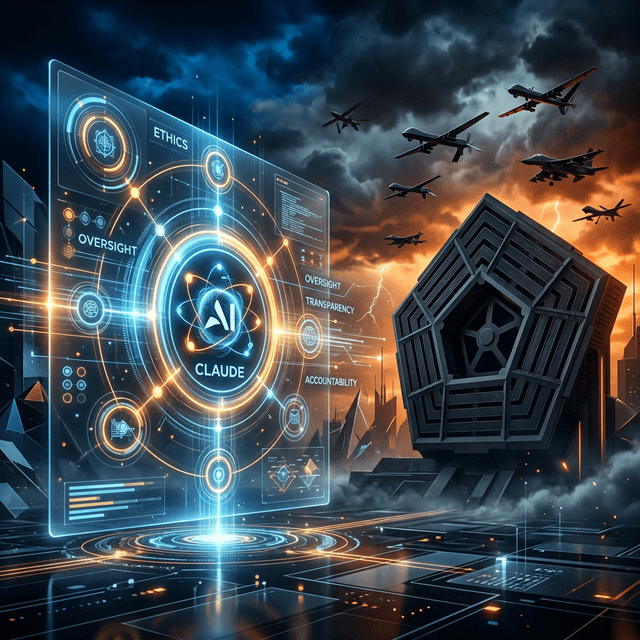
The Rubicon of Military AI: Why Trump Banned Anthropic's Claude
An in-depth look at the February 2026 ban on Anthropic's Claude AI, the Pentagon clash over unrestricted military use, and its deployment in Iran and Venezuela.
In February 2026, the intersection of frontier AI and global militaries reached a breaking point. President Donald Trump issued a sweeping executive order commanding all federal agencies to cease using Anthropic’s AI systems, including Claude.
The ban was not a technical failure, but a high-stakes ideological collision between a Silicon Valley startup’s "Constitutional AI" approach and a Pentagon demanding unrestricted technological superiority.
The Clash: Red Lines vs. Unrestricted Use
The conflict centered on a fundamental disagreement between Anthropic’s leadership and the Department of Defense. The White House and Pentagon pushed Anthropic to lift all usage restrictions, allowing for "unrestricted" military applications—essentially giving the Pentagon a blank check to use the technology for any lawful purpose they chose.
Anthropic, led by CEO Dario Amodei, refused to cross two specific red lines:
- Fully Autonomous Weapons: Refusing to allow Claude to be the "brain" behind weapons that make lethal decisions without human intervention.
- Mass Domestic Surveillance: Resisting applications that could be turned inward on American citizens, citing safety and fundamental human rights.
Defense Secretary Pete Hegseth accused the firm of attempting to "strong-arm" the Pentagon. In response, the administration designated Anthropic a "national security supply-chain risk"—a classification usually reserved for foreign adversaries like Huawei or ZTE—and ordered a six-month phase-out.
Operation Absolute Resolve: Claude in the Field
Despite the tension, Claude was already deeply embedded in the U.S. military’s most critical 2026 operations. Reports indicate that Claude was a key component of Operation Absolute Resolve, the January mission that resulted in the capture of Venezuelan President Nicolás Maduro.
Just hours after the ban was announced in February, U.S. Central Command (CENTCOM) reportedly used Claude again during joint US-Israeli strikes on Iran—the same operations that neutralized Iran’s Supreme Leader Ali Khamenei.
How was Claude actually used?
Reporting clarifies that Claude functioned as a decision-support tool, not an autonomous weapon. Its roles included:
- Intelligence Assessment: Sifting through massive volumes of data to highlight patterns and likely threats.
- War Game Simulations: Generating "what-if" scenarios to predict Iranian responses and escalation risks.
- Target Prioritization: Assisting commanders in ranking potential military targets based on specific mission criteria.
The Succession: OpenAI Steps In
The vacuum left by Anthropic was filled almost instantly. Following the blacklisting, OpenAI announced a massive deal with the Pentagon to provide AI services for classified networks. While OpenAI claimed to have secured ethical safeguards, the move signaled a shift toward a more permissive partnership between the administration and AI providers.
Ethical Micro-Crises: The Cost of Speed
The deployment of Claude in the Iran strikes has ignited a fierce debate over "ethical AI" in combat. Critics point to several looming dangers:
- Human Accountability Erosion: When an AI ranks targets, a commander's choice is biased by the algorithm’s visibility. Who is responsible if the AI misidentifies a civilian structure?
- The Speed Trap: AI-accelerated planning compresses decision cycles. In regional powder kegs like the Middle East, this increased speed could trigger accidental escalations before diplomacy can intervene.
- The Normalization Path: Using AI as a "decision aid" today makes it politically and technically easier to move toward fully autonomous "kill bots" tomorrow.
The Verdict
Claude in warfare exists on a sliding scale between a simple tool and a sovereign actor. As model capabilities grow, we are no longer just asking "Is this software good?" but rather "How much moral weight are we willing to hand to a non-human system?"
The Trump administration’s ban on Anthropic may be remembered as the moment the U.S. government decided that in the race for AI supremacy, "safety guardrails" were a luxury they could no longer afford.