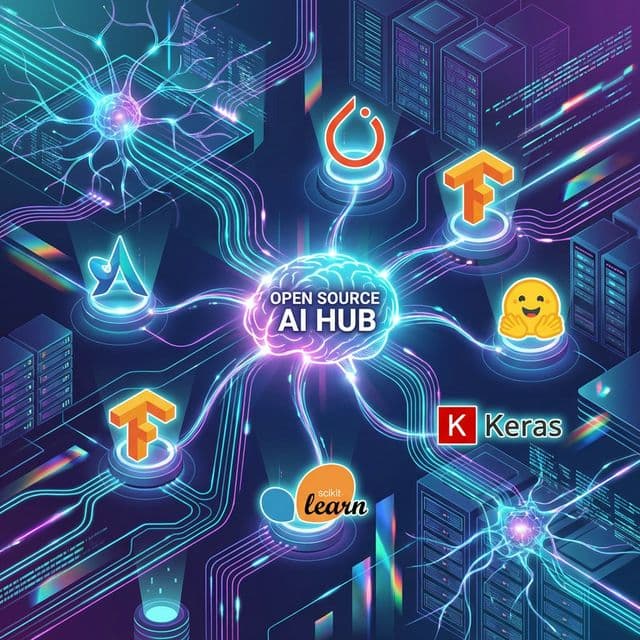
Top 10 Open Source AI Projects You Need to Know
Explore the most influential open-source AI projects including PyTorch, Hugging Face, Stable Diffusion, and LangChain that are shaping the ML landscape.
The open-source community is the driving force behind the rapid advancement of artificial intelligence. By democratizing access to models, frameworks, and infrastructure, open-source AI projects enable developers and organizations worldwide to push the boundaries of what's possible.
Below is a curated list of the top 10 open-source AI projects, plus a few notable mentions, that are shaping our AI-driven future.
1. PyTorch
A top-tier deep learning framework favored for both research and production. Developed initially by Meta, PyTorch offers dynamic computational graphs which make it incredibly flexible, backed by a vast ecosystem of tools and libraries for everything from reinforcement learning to computer vision.
2. TensorFlow
Created by Google, TensorFlow is a comprehensive open-source platform for machine learning. It is ideal for end-to-end AI workflows and deployment, providing robust infrastructure for training and serving models on everything from edge devices to massive server clusters.
3. Hugging Face Transformers
The ultimate hub for state-of-the-art models. The Hugging Face Transformers library is the go-to tool for accessing, training, and fine-tuning thousands of pre-trained models across LLMs, computer vision, and audio processing.
4. Stable Diffusion
A leading latent diffusion model designed for generating high-quality images from text prompts. Stable Diffusion has reshaped the generative art landscape by providing a powerful, open-source alternative to proprietary image generation models, allowing developers to run inference locally and fine-tune models on custom datasets.
5. OpenCV
A foundational computer vision library that has been a staple in the industry for years. OpenCV is heavily utilized for real-time image processing, object detection, and video analytics across multiple platforms and languages.
6. LangChain
If you're building applications powered by Large Language Models, LangChain is essential. It is a framework designed to focus on composability and data connection, giving developers the tools to orchestrate prompts, handle memory, and connect LLMs to external data sources seamlessly.
7. MindsDB
Bringing machine learning directly to where the data lives. MindsDB is a platform that makes AI models accessible within databases using standard SQL. This drastically simplifies machine learning integration, allowing developers to build predictive systems without complex data pipelines.
8. Ollama / vLLM
As the demand for private and cost-effective AI grows, running LLMs locally has become critical.
- Ollama: A straightforward tool that simplifies setting up and interacting with LLMs on your personal hardware.
- vLLM: A high-throughput, memory-efficient framework built specifically for serving large language models at scale in production.
9. AutoGPT / BabyAGI
At the experimental edge of AI are autonomous agents. Projects like AutoGPT and BabyAGI use LLMs to break down complex goals into actionable tasks, assign priorities, and autonomously execute them, giving us a glimpse into the future of autonomous computing.
10. Rasa
A highly customizable, open-source framework designed for building sophisticated conversational AI and chatbots. Rasa offers granular control over natural language understanding (NLU) and dialogue management, making it an excellent choice for enterprise-grade conversational interfaces.
Understanding the Landscape
Here is a quick breakdown to help you map these projects to your specific needs:
graph TD
    A[Open Source AI Projects]

    A --> B[Core Frameworks]
    B --> B1(PyTorch)
    B --> B2(TensorFlow)

    A --> C[Models & Generation]
    C --> C1(Hugging Face)
    C --> C2(Stable Diffusion)

    A --> D[App Orchestration]
    D --> D1(LangChain)
    D --> D2(AutoGPT/BabyAGI)

    A --> E[Serving & Infrastructure]
    E --> E1(Ollama / vLLM)
    E --> E2(MindsDB)
Notable Mentions
While our top 10 covers many foundational areas, the open-source AI ecosystem is vast. Here are a few notable mentions that deserve your attention:
- Detectron2: Meta's advanced library for object detection and image segmentation.
- Fabric: A growing framework for seamlessly integrating AI into enterprise-grade workflows and applications.
- Unbody: A powerful, modular backend built specifically for making AI-native application development easier.
- GPT Engineer: An AI assistant that can generate entire codebases and project structures simply based on user prompts.
Are you building with any of these open-source tools? Let us know what you're creating!