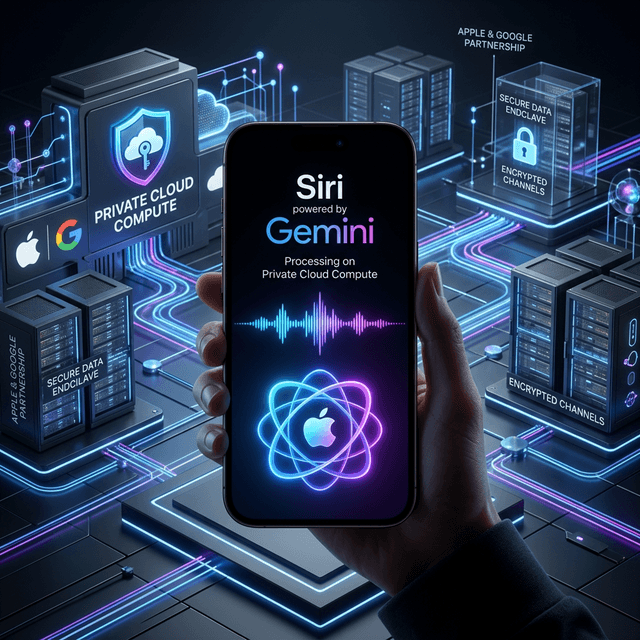
The Apple-Google AI Alliance: Siri Powered by Gemini via Private Cloud Compute
Apple and Google have joined forces to integrate Gemini into Siri. Explore how Private Cloud Compute ensures user privacy while delivering next-gen AI capabilities in iOS 26.4.
The Apple-Google AI Alliance: Siri Powered by Gemini
In a move that has sent shockwaves through the technology industry, Apple and Google have formally announced a multi-year partnership to integrate Google's Gemini large language models (LLMs) into the core experience of Siri and Apple Intelligence.
Launched alongside iOS 26.4 in March 2026, this collaboration marks a fundamental shift in Apple's AI strategy, prioritizing rapid feature deployment and contextual depth through a hybrid architecture of on-device processing and Private Cloud Compute (PCC).
Why Apple Partnered with Google
For years, Siri lagged behind competitors in conversational fluency and complex task reasoning. While Apple's internal models, such as the Ferret series, made significant progress in on-device efficiency, they lacked the massive scale required for open-ended knowledge queries and "planner-style" multi-step executions.
By licensing Gemini, Apple instantly gains access to:
- On-Screen Awareness: Siri can now "read" and understand what you are looking at across first and third-party apps.
- Personalized Planning: Ability to cross-reference your emails, calendar, and photos to create complex travel itineraries or task lists.
- Creative Content Generation: High-fidelity text and code generation directly within the iOS interface.
The Privacy Fortress: Private Cloud Compute (PCC)
The most controversial aspect of the partnership was how Apple could maintain its "Privacy First" brand while sending user data to Google's models. The answer lies in Private Cloud Compute.
When you ask a complex question that exceeds on-device capacity:
- Encryption: Data is encrypted using keys that Google never touches.
- Apple Silicon Cloud: The request is routed to Apple-owned data centers running on M5 chips.
- Stateless Processing: Gemini runs within a "Secure Data Enclave." Once the answer is generated, the prompt and data are instantly wiped.
- No Training: A core tenet of the $1 billion-a-year deal is that Google is forbidden from using Apple user data to train future models or for advertising.
graph TD
    User[User Request] --> OnDevice[iPhone On-Device AI]
    OnDevice -- Complex Task? --> PCC[Private Cloud Compute]
    PCC --> Enclave[Secure Data Enclave]
    Enclave -- Load --> Gemini[Google Gemini Model]
    Gemini --> Result[Encrypted Result]
    Result --> User
    Enclave -- Wipe --> Delete[Data Deleted - Stateless]
The Infrastructure Challenge
Despite the official launch, the integration has not been without hurdles. Internal reports suggest that Apple's PCC infrastructure is currently experiencing a "capacity paradox." While Apple owns thousands of servers, they are optimized for general-purpose computing, not the massive parallelization required for multi-billion parameter models.
Consequently, rumors suggest Apple is exploring a secondary "Privacy Bridge" to run Gemini commands on Google's TPUs while maintaining Apple's end-to-end encryption protocols. This highlights the sheer scale of compute needed to power AI for over 1 billion iPhone users.
Conclusion: A Bridge to the Future
The Google-Apple partnership is a strategic bridge. It allows Apple to satisfy consumer demand for "Smart AI" today while its internal Research & Development teams work on the next generation of sovereign Apple models (Ferret-3).
For users, the result is the most capable digital assistant ever built—one that knows your world but respects your walls.
Stay updated on the latest AI governance and privacy breakthroughs at ShShell.com.