Siri AI Can Find the Family Recipe. The Real Test Is What It Does Next.
Apple’s Siri AI beta links personal context to app actions, with important limits on authorization, cloud processing, devices, and availability.
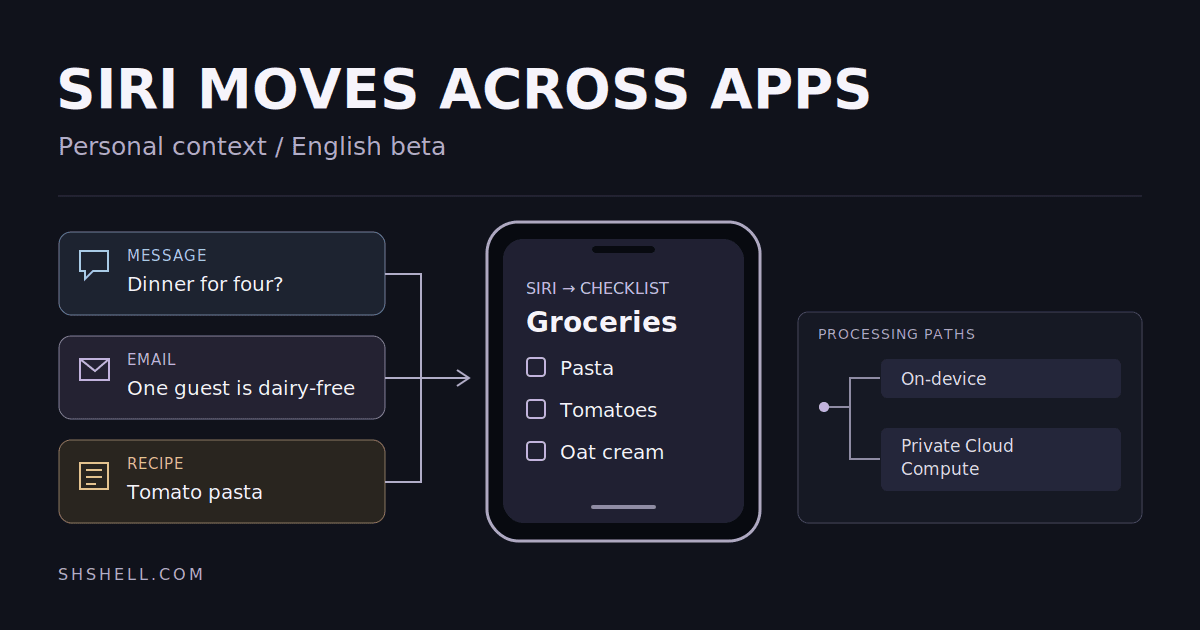
Apple’s launch announcement illustrates its new assistant with a family visit that becomes a grocery list. Asked what a relative suggested doing together, Siri AI finds a message about baking a family recipe, retrieves the cooking instructions from an earlier email, and adds the ingredients to Reminders. The example, described in Apple’s September 14 announcement, captures the launch more precisely than a promise of smarter conversation: private correspondence becomes the basis for changing something in another app.
Finding the recipe and deciding what to do with it are different responsibilities. Apple began rolling out Siri AI in beta in English on September 14 with its 27-series operating systems, combining personal context, onscreen awareness, and expanded app actions. The practical test is whether an assistant can carry the right information into the right action under the user’s authority. Apple’s example demonstrates the intended handoff; the announcement does not establish a universal confirmation policy or independently verified reliability for those transitions. That distinction defines the significance of this beta release.
The rollout also has a narrower footprint than the surrounding Apple Intelligence branding might suggest. Device eligibility, language, geography, app integration, and daily server usage limits all affect what a person can actually delegate. Apple’s support document published September 14 describes the wider feature collection, while the launch announcement specifies separate restrictions for Siri AI. Reading those boundaries together reveals an agent launch whose value depends as much on dependable access and carefully scoped actions as on the quality of its answers.
The recipe crosses a boundary that search does not
Apple’s recipe example involves several kinds of interpretation. The assistant must connect a relative with an upcoming visit, identify the relevant suggestion, and locate an earlier email containing the recipe. It must then turn cooking instructions into entries in a particular grocery list. Apple says Siri’s rebuilt architecture uses a system orchestrator that accesses the Spotlight index and App Toolbox, with those core capabilities working entirely on device. That gives the Apple-described cross-app sequence an architectural basis beyond a model producing plausible prose.
But retrieval success does not settle authorization. A message can establish what a relative proposed without establishing that the user wants every ingredient added immediately. An email can contain the correct recipe alongside alternatives or commentary. These are analytical distinctions, not reported failures in Apple’s example. They matter because the moment an assistant writes into Reminders, it moves from presenting evidence to altering the user’s working environment.
Consider a hypothetical variation: the relative’s email contains the original recipe and a later substitution, while the grocery list already contains some ingredients. The assistant could retrieve the right correspondence yet still choose the wrong version or create unwanted duplicates. A useful evaluation would therefore examine which source was selected, how the ingredients were interpreted, and what actually appeared in the destination. A fluent explanation of the recipe would answer only part of that question.
Apple extends the same pattern to screen content. Its launch announcement describes asking Siri to find a sports team’s upcoming home games from a website and add them to Calendar. Another example turns a music festival poster viewed through the Camera app into multiple calendar events. These are Apple’s stated capabilities and examples, rather than evidence that every page or poster will be interpreted correctly. In each case, the agent must identify information and then translate it into app-specific objects.
The following flowchart is an analytical reading of the recipe task, not a claim about Siri’s internal implementation or the exact prompts it displays. It separates the stages that a successful handoff must reconcile.
flowchart LR
    A[User request] --> B[Find message and recipe]
    B --> C[Interpret ingredients and destination]
    C --> D[Resolve ambiguity and authority]
    D --> E[Add items to Reminders]
    E --> F[Report the result]
The important product question lies between interpretation and execution. Showing the selected recipe and intended list would make mistakes easier to catch; reporting what changed would make completion easier to verify. Those are recommendations arising from the task’s structure. The published launch material does not document whether Siri always provides those checkpoints, so they should not be described as shipped safeguards.
App Intents makes the handoff concrete, but coverage remains uneven
Apple’s developer material distinguishes discoverable content from executable capabilities. Entity schemas contribute app content to the Spotlight semantic index for personal context understanding. Intent schemas make actions available through natural language. The View Annotations API maps onscreen views to entities so users can refer conversationally to what they see. These mechanisms, described on Apple’s developer page, help explain how a request can refer to an object in an app without requiring the user to name an exact command.
That separation is consequential. Making an item searchable does not, by itself, define every permissible operation on it. A restaurant recommendation can be an identifiable piece of content while saving it to a trip requires a supported action and a destination. Likewise, recognizing a document on screen is different from exposing a capability to modify or distribute it. Apple’s schemas provide the connection between language and app concepts; the developer material does not establish unrestricted access to every feature of every installed app.
Apple’s launch wording reflects this uneven coverage. It describes texting through WhatsApp and playing a book through Audible as actions users can continue taking. Drafting an email in Microsoft Outlook, searching for homework in Notability, and adding a restaurant recommendation to Tripsy are described as coming “soon.” These are different availability commitments. Treating all the named apps as newly completed integrations would erase the distinction between existing actions and promised extensions.
There is a concrete launch-day example beyond Apple’s own apps. TechCrunch reported on September 14 that Daydream introduced shopping searches from saved outfit images and natural-language searches through Siri. The reported requirements include iOS 27, Siri AI enabled, and the Daydream app installed. Daydream’s image feature identifies clothing pieces and surfaces purchasable matches or similar styles. This supplies evidence of an actual integration while keeping its function specific: product discovery.
Daydream chief executive Julie Bornstein told TechCrunch that its Style Passport can make results more tailored using information such as sizes, preferred brands, style, and budget. She described the launch as a step toward a broader shopping agent. Those are company explanations and ambitions reported by TechCrunch, not proof of autonomous purchasing. Searching for a blazer and completing a purchase remain distinct actions with different consequences.
For developers, the strategic opening is therefore more precise than “add AI.” Content needs to be identifiable, actions need meaningful scope, and destinations need to be distinguishable in ordinary language. That is an analytical recommendation grounded in Apple’s entity and intent mechanisms. The assistant can become an entry point to an app, but usefulness depends on what the app exposes and how reliably the system connects a user’s words to those capabilities.
Early use exposes the importance of choosing the right object
Independent reporting offers a useful counterweight to the polished recipe sequence. TechCrunch’s Ivan Mehta wrote that he had used iOS 27 through developer and public betas and was using Siri for more complex requests. He reported successfully asking it to find useful iOS features and add them to a note. He also described a more revealing difficulty: while collecting coffee recommendations, Siri sometimes struggled to add information to the correct note, and simplifying the note’s name improved consistency in his experience. These are Mehta’s observations for TechCrunch, not a controlled reliability study.
That destination problem goes directly to the agent proposition. Finding a useful coffee recommendation is information retrieval. Selecting the intended note is object resolution. Writing the recommendation is execution. A system can perform the first task convincingly while remaining troublesome at the second. Mehta’s account does not establish how often the problem occurs, but it identifies a concrete failure mode more informative than a broad judgment that Siri has become smarter.
The same reporting shows how additional context can change interpretation. Mehta wrote that Siri initially identified a drink as green juice from its appearance, then suggested Jaljeera or Aam Panna after he supplied the restaurant context; he said the drink was Aam Panna. The reported exchange illustrates the value of conversational refinement. Analytically, however, there is a difference between correcting an answer before using it and correcting an interpretation after it has already driven an app action.
On the Mac, Mehta reported retrieving membership IDs, details about an upcoming trip, and an embargo date without manually opening the underlying files. He also described selecting a focused window or a smaller screen region as context for Visual Intelligence. Those macOS 27 observations suggest why the same assistant may feel different on a desktop: the available documents and the user’s ability to select relevant material change the task.
Selection is especially important because context is not automatically intent. A window can contain several dates, names, or destinations. Choosing a particular region narrows the material the assistant should interpret, but does not independently answer what it should change. The reporting supports a richer interface for providing context; it does not demonstrate that onscreen material can safely be treated as instructions.
A sensible early assessment should therefore distinguish answer quality from destination accuracy and completed action quality. This is a recommendation, not a claim that Apple publishes such a breakdown. The evidence so far includes useful multistep work and a specific note-selection problem in TechCrunch’s beta experience. Neither supports dismissing the launch nor treating conversational fluency as proof of dependable delegation.
The cloud model and the local orchestrator have different jobs
Apple says the new Apple Foundation Models were custom-built in collaboration with Google and its Gemini models, and run both on device and on servers using Private Cloud Compute. In the same announcement, it places Spotlight and App Toolbox access under Siri’s system orchestrator and says those capabilities work entirely on device. These architectural statements should remain separate. Model collaboration does not establish the destination of every request, and local orchestration does not mean every task completes without cloud inference.
Apple’s current privacy page says many requests are fulfilled on device and only data required for a request is sent to Private Cloud Compute. It also says those cloud requests are processed without being stored or made accessible to Apple. Those are Apple’s privacy claims. The published material does not provide a request-by-request trace of the recipe example, so it cannot establish exactly which recipe details stay local or enter a cloud prompt in that example.
The historical technical explanation is more specific about what cloud processing entails. In its June 10, 2024 Private Cloud Compute overview, Apple explained that inference requires the compute node to access the request’s unencrypted contents. The device encrypts the request to validated nodes, protecting it in transit, but the node must process readable data. Describing this simply as end-to-end encryption without that qualification would obscure the central privacy engineering problem.
Apple’s 2024 design addresses that problem through technical restrictions: stateless processing, deletion after a response, signed executable code, and the absence of remote shells or general-purpose logging on compute nodes. The document also describes cryptographic attestation against publicly logged software measurements. These are Apple’s published architectural protections, offered as dated background. They explain the foundation of the privacy promise, rather than independently demonstrating the behavior of every deployment serving the new beta.
The infrastructure story has also evolved. A substantive Apple Security Research summary dated June 8, 2026 says Apple is collaborating with Google and NVIDIA to run new Apple Intelligence workloads on Google Cloud Platform, extending PCC commitments beyond Apple’s data centers. That summary establishes Apple’s announced expansion, but does not supply the full technical design. The 2024 description therefore should not be used to assert that every current workload runs on the original hardware arrangement.
These distinctions prevent several misleading shortcuts. Google’s involvement in model development, a third-party data-center deployment, and access to readable user information are separate questions. Apple claims its PCC protections carry into the expanded arrangement; that is not equivalent to independent verification. Equally, the presence of cloud inference does not establish that a remote model directly controls app permissions. The launch’s local orchestrator description places the action machinery in a different part of the system.
Privacy protection cannot decide whether a task was authorized
Apple’s platform security guide describes third-party apps on iOS, iPadOS, and visionOS as sandboxed, with access beyond their own information occurring through explicitly provided system services. It also explains that signed entitlements govern access to user information and privileged capabilities. These are documented platform mechanisms, not a newly announced Siri-specific authorization model. They establish that cross-app work takes place within an operating system with defined access boundaries.
The guide does not settle how Siri handles each ambiguous conversational request. It does not specify, for example, which actions require an additional confirmation, how a partially completed multistep task is presented, or how the new assistant distinguishes text retrieved from an email from an instruction supplied by its user. Those are evidence gaps in the published Siri material. It would be equally unsupported to claim that safeguards are absent or to assume that sandboxing answers those questions.
A hypothetical illustrates the distinction. Suppose a recipe email includes a request to forward another document to a relative. That sentence is part of retrieved correspondence. Whether the assistant may act on it is a separate question from whether it may read the email. Protecting the cloud processing of that text would not, by itself, establish permission to send a document. The conceptual boundary is between using content as evidence and treating it as authority.
Apple’s privacy promises also have different scopes. Its current privacy page says PCC processes requests without retaining them. Its Siri launch announcement says the dedicated Siri app uses iCloud to sync conversation history across products. These statements describe different handling of information. “Never stored” should not be broadened into a claim that no conversation history or task output persists anywhere.
For users evaluating delegation, the useful question is consequently more concrete than whether an assistant is private. What information was consulted, which action was requested, and what result was saved or shared? Those are analytical criteria. Apple’s App Intents mechanisms supply structured content and actions, while its privacy architecture addresses processing and access. A trustworthy experience needs those layers to work together without allowing the assurance attached to one layer to stand in for evidence about another.
The English beta sits inside a much wider software release
The launch is easy to overstate because Apple Intelligence and Siri AI share branding while carrying different eligibility rules. Apple’s support page lists broad language support for Apple Intelligence across the 27-series releases. Siri AI itself begins in English, with French, Japanese, Korean, Portuguese, and Spanish promised for the following month. The September 14 announcement also says Siri AI is unavailable to users under 13. None of those conditions disappears because the operating system update is available.
Geographic restrictions are similarly specific. Apple says Siri AI and features relying on it are initially unavailable in the EU on iOS, iPadOS, and watchOS. That wording does not announce the same exclusion for macOS or visionOS. Meanwhile, Apple’s support page says EU users can access other next-generation features, including advanced photo editing, Image Playground, and intelligent browsing on supported platforms. Describing the EU as receiving none of the new Apple Intelligence features would therefore be inaccurate.
| Capability or condition | September 14 position | Practical implication |
|---|---|---|
| Siri AI language | English beta; more named languages next month | Wider Apple Intelligence language support does not establish Siri AI access |
| EU rollout | Siri AI initially excluded on iOS, iPadOS, watchOS | Availability must be checked by platform and feature |
| Third-party actions | Existing examples plus integrations described as coming soon | A named app is not necessarily ready for every advertised task |
| Server-backed features | Variable daily limits | Device eligibility does not establish unlimited use |
| Expanded access | Fee-based access planned for the future | No published price or fixed allowance in the published announcement |
The distinctions in the table come from Apple’s launch terms and availability guidance. China has a separate set of restrictions: Apple says supported devices purchased in mainland China cannot currently use Apple Intelligence. For supported devices bought elsewhere, the support page specifies a combination of being in mainland China and having the Apple Account country or region set there. Apple also says new features remain unavailable in China while it works through regulatory requirements.
Hardware qualification is another independent filter. Apple lists iPhone 16 models or later, iPhone 15 Pro and Pro Max, supported Apple-silicon iPads and Macs, MacBook Neo, and Apple Vision Pro among eligible devices. Supported Watches require an Apple Intelligence-enabled iPhone, with proximity requirements varying by feature. Its support document also requires matching supported device and Siri languages and local model storage. Installing the operating system is only part of becoming ready.
Even eligible hardware does not receive every model capability. Apple reserves AFM Core Advanced features such as more expressive voices and advanced dictation for a narrower set of devices, including specified newer iPhones and qualifying iPads and Macs with at least 12GB of unified memory. The launch footnote lists those requirements separately. This makes “supports Siri AI” an insufficient description of the complete experience, particularly when comparing devices already owned.
Daily limits become part of the delegation contract
Apple says certain server-backed features face daily usage limits, including Siri AI, intelligent photo editing, Image Playground, and AFM 3 Cloud models in Shortcuts. Limits can vary with the feature, request complexity, system demand, system policies, and other factors. The company promises expanded access for a fee in the future, but the published support guidance provides neither a fixed allowance nor a price. There is no evidentiary basis for calculating a dependable daily workload from this announcement.
For an agent, that uncertainty has a different practical meaning than a limit on occasional image generation. In a hypothetical workflow, a user might retrieve information and begin assembling an action before needing another model response. The published sources do not explain precisely how Siri handles a limit reached during such a sequence, so it would be speculative to describe a particular failure behavior. Nevertheless, continued availability belongs in an assessment of whether a recurring task can be delegated.
Developer access should not be confused with unlimited Siri access either. Apple’s consumer product page says apps can use on-device models offline with no cost per request. Its developer documentation describes the Foundation Models framework as supporting models on device and in Private Cloud Compute, as well as compatible providers. Those are distinct execution options. The offline, no-per-request-cost statement about local models does not establish unlimited cloud-backed capacity for the assistant.
The roadmap further complicates an all-at-once reading of the release. Apple places Siri Recap and Live Rewind in a later-2026 beta, with specific Watch and iPhone requirements, rather than in the September Siri AI rollout. Its product page also marks automatic password updating as coming in a future software update, although TechCrunch's iOS beta account reports that the Passwords app can now automatically change passwords on a user's behalf. Those accounts do not resolve its precise availability. The distinction matters because an assistant's apparent scope can expand dramatically when future examples are silently counted as generally available functions.
A useful agent must leave a legible result
The family recipe remains the clearest way to judge the launch. Apple has described an assistant that can connect correspondence to an action in Reminders, with local orchestration, structured app integration, and access to cloud models. Independent TechCrunch reporting supplies evidence of useful multistep work and a concrete destination-selection difficulty. Together, those sources support taking the beta seriously while keeping claims about reliability narrower than the ambition.
The strongest practical recommendation is to judge completed changes against the request that authorized them. For the recipe, that means the intended version, appropriate ingredients, and correct list. For the Daydream integration reported by TechCrunch, it means useful shopping results without mistaking discovery for permission to purchase. These are different workflows, but both depend on preserving the distinction between understanding a person’s context and acting with that person’s authority.
Apple’s September 14 beta brings that distinction into ordinary app use. Its announced language, geographic, hardware, integration, and usage boundaries determine where the proposition can presently be exercised. The meaningful advance is the possibility of carrying a personal request through to a concrete result. The standard it must meet is just as concrete: the right change, in the right place, for a reason the user actually supplied.
Sudeep Devkota writes about AI systems, enterprise software, and the practical limits of automation.