The PEC Standard: Why Every Production AI Agent in 2026 follows the Planner-Executor-Critic Framework
·Agentic AI·Sudeep Devkota

The PEC Standard: Why Every Production AI Agent in 2026 follows the Planner-Executor-Critic Framework

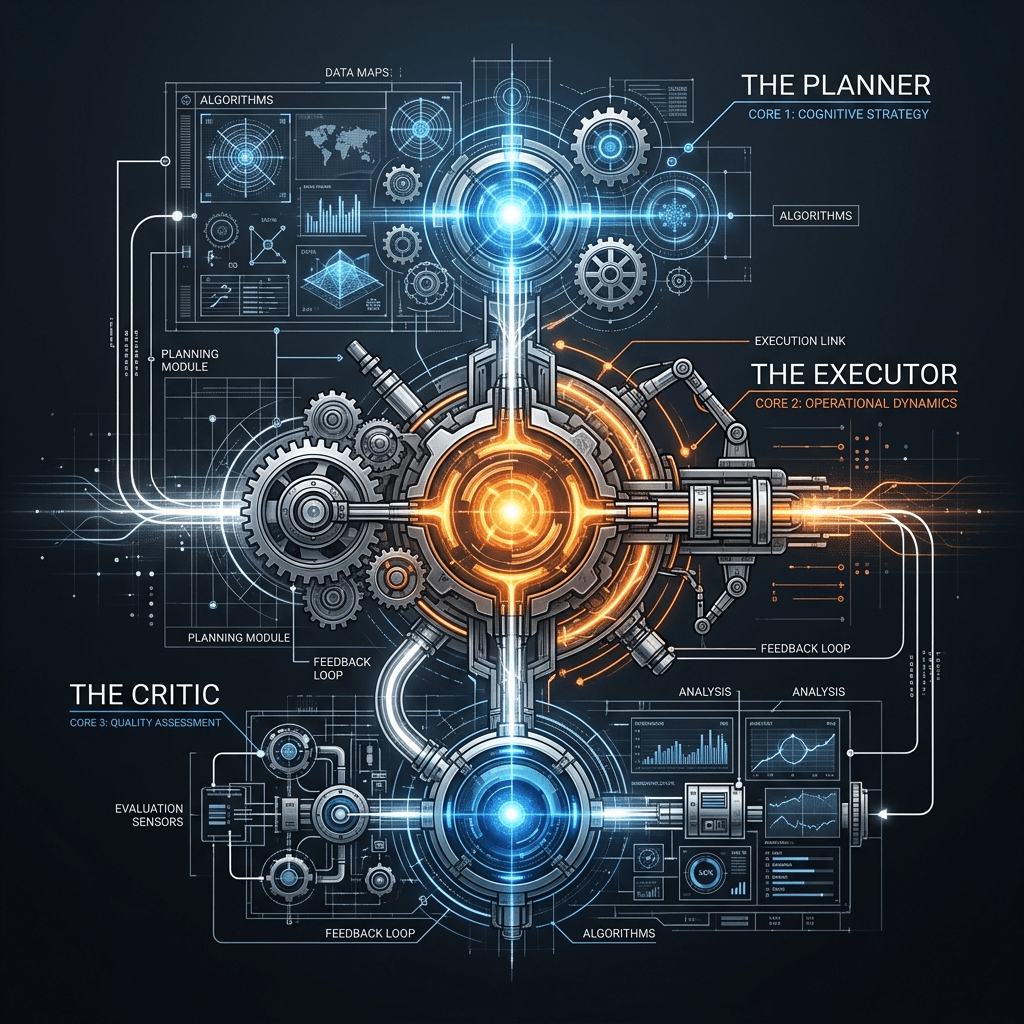
The era of the monolithic prompt is over. In 2026, building a reliable AI agent requires the PEC (Planner-Executor-Critic) architectural standard.


In the early days of 2023, the tech world was obsessed with "AutoGPT." The promise was simple and seductive: give an LLM a goal, a few tools, and a loop, and it would autonomously solve the problem. But as thousands of developers quickly discovered, these early agents were "probabilistic gamblers." They would get stuck in infinite logic loops, hallucinate tool outputs, or, in the worst cases, recursively spend thousands of dollars in API credits while achieving nothing.

By the spring of 2026, the industry has learned its lesson. The monolithic "looping" model has been replaced by the PEC (Planner-Executor-Critic) framework. This architectural triad has become the "standard blueprint" for every production-grade AI system, providing the auditability, safety, and reliability that enterprise workloads demand.

Deep Dive: The Planner’s Strategic Landscape

In the 2026 stack, the Planner is far more than an LLM with a task list. It is a state-management engine. One of the most significant challenges in long-running agency (tasks that span hours or days) is "Context Poisoning." As an agent interacts with the world, it generates thousands of lines of logs, API responses, and intermediate thoughts. If you feed all of this back into the model's context window, the model eventually loses the "High-Level Goal" in a sea of "Low-Level Noise."

Strategic Decomposition

The modern Planner uses a technique called "Recursive Task Decomposition." Instead of planning the entire project at once, it generates a "Tier 1 Plan." As each Tier 1 task is assigned to an Executor, the Planner waits for the result before decomposing the next Tier 1 task into Tier 2 sub-problems. This ensures that the agent's plan is always informed by the most recent "Real-World State."

Context Summarization layers

To prevent context overflow, the Planner utilizes an auxiliary "Memory Agent" (another LLM) to summarize successful sub-tasks. The active context window only contains the Current State, the Next Objective, and a Compressed Digest of past wins. This allows the Planner to operate within its "High-Reasoning" sweet spot without being bogged down by the raw data fetched by the Executor.

Deep Dive: The Executor’s Secure Hand

The Executor in 2026 is the most "hardened" part of the stack. Because it has "Write Access" to production databases, filesystems, and clouds, it must be isolated from the "Creative" reasoning of the Planner.

Scoped Permissions and OIDC

We have moved away from static API keys. In a PEC-compliant system, the Executor requests a "Just-In-Time" (JIT) token for every single tool call. This token is scoped specifically to the task at hand. If the task is to "Read a CSV file," the JIT token only allows GET access to that specific file path. If the Executor (either through a bug or an attack) attempts to DELETE the file, the token is rejected at the infrastructure level.

The MCP Tool Handshake

When the Executor calls an MCP tool, it performs a "Type Check."

  1. Reflection: The Executor asks the MCP server for its interface.
  2. Verification: The Executor compares the Planner's requested parameters against the Tool's required schema.
  3. Sanitization: The Executor cleanses the inputs (preventing injection) before passing them to the external system.
  4. Observation: The Executor records not just the data returned, but the "Latency" and "Success Code" of the call, which it passes to the Critic for performance monitoring.

Deep Dive: The Critic’s Adversarial Mindset

The Critic is not just a validator; it's a skeptic. In 2026, the best Critics are trained using "Adversarial Examples"—instances where an agent almost got it right but made a subtle, dangerous error.

Static vs. Dynamic Evaluation

The Critic performs two types of checks:

  • Static Evaluation: It checks the "Shape" of the output. Did the Executor return a valid JSON? Is the date format correct?
  • Dynamic Evaluation: This is more complex. The Critic runs "Unit Tests" on the output. If the Executor generated code, the Critic runs that code in a separate, "Dark Sandbox" with a set of test cases. If the code fails the tests, the Critic rejects the result and provides the specific "Failure Log" back to the Planner for debugging.

The "Ethics Gate"

The Critic also manages the Ethics Layer. It scans the proposed plan and the resulting actions for "Bias Drift" or "Safety Violations." In healthcare PEC systems, the Critic will block any action that violates a "Patient Privacy Marker," even if the Planner (in its pursuit of efficiency) thought the action was logical.

RoleCore Metric2024 Failure Mode2026 PEC Solution
PlannerStrategic DepthInfinite LoopingRecursive DAG Generation
ExecutorTool ReliabilityHallucinated API callsMCP Schema Enforcement
CriticVerification FidelityOver-reliance on "Helpfulness"Adversarial Validation & Unit Testing

The Technical Plumbing: PEC meets MCP

The PEC framework would be impossible to scale without the Model Context Protocol (MCP). As we have discussed in previous reports, MCP is the "USB-C for AI." It provides a standardized way for an Executor to "discover" and "interact" with external systems.

In a PEC-compliant stack, the workflow looks like this:

  1. Planner identifies a need for "Competitive Pricing Data."
  2. Executor queries the local MCP Registry to see if a "Competitor-Search-Server" is available.
  3. MCP Server returns its "Schema Definition" (Input parameters and Output types).
  4. Executor calls the tool with the JSON-RPC payload.
  5. Critic receives the JSON response and validates it against the MCP-provided schema.

This standardized handshake means you can swap out a "Snowflake MCP Server" for a "Google BigQuery MCP Server" without changing a single line of code in the Planner or Critic.

sequenceDiagram
    participant P as Planner
    participant E as Executor
    participant T as MCP Tool/Server
    participant C as Critic
    
    P->>P: Generate Task DAG
    P->>E: Send Atomic Task #1
    E->>T: Call Tool (Schema Discovery)
    T-->>E: Return Data
    E->>C: Send Result for Review
    C->>C: Validate Accuracy & Policy
    alt Valid
        C-->>P: Task Complete (Proceed)
    else Invalid
        C-->>P: Task Failed (Re-plan)
        P->>P: Recursive Error Correction
    end

Case Study: The "Self-Correction" in Financial Auditing

Consider a PEC agent tasked with an annual corporate audit. In 2023, an agent might miss a suspicious transaction because it was "distracted" by a long list of mundane entries.

In 2026, the Critic is specifically trained to look for "Audit Anomalies."

  • The Executor pulls 10,000 transaction records.
  • The Critic performs a statistical analysis and notices that a $5,000 payment was made to a vendor with an "unverified" bank account.
  • The Critic tells the Planner: "The data is valid, but the finding is high-risk. We need a secondary verification of Vendor ID #99."
  • The Planner adjusts its DAG, adding a new sub-task to query the Corporate Security MCP Server.

This level of autonomous "Second-Guessing" is what makes PEC a "Production" standard rather than a "Laboratory" toy.

The Orchestrator: Managing the Swarm

The next evolution of PEC is the Multi-PEC Swarm. Instead of one Agent, companies are running "Orchestrator Models" that manage multiple specialized PEC agents.

Imagine a "DevOps Swarm":

  • Agent A (Developer): A PEC agent specialized in Rust and systems architecture.
  • Agent B (Tester): A PEC agent specialized in fuzzing and security audits.
  • Agent C (Deployer): A PEC agent specialized in Kubernetes and Terraform.

The Orchestrator provides the high-level goal, and the three agents negotiate their roles, share memory through a centralized Knowledge Graph, and collectively move code from inception to production. Each agent is a PEC system, providing nested layers of reliability.

Swarm Dynamics: The Multi-Agent PEC Orchestration

As we move into late 2026, the focus has shifted from single-agent PEC systems to Multi-Agent Swarms. In this architecture, a "Root Planner" manages a fleet of "Specialist PEC Agents."

Competitive Negotiation

When a complex task arrives (e.g., "Build a high-frequency trading bot in Rust"), the Root Planner doesn't just assign tasks. It initiates a Competitive Negotiation.

  • Agent A (The Architecht): Proposes a design.
  • Agent B (The Security Specialist): Tries to find flaws in the design.
  • Agent C (The Performance Engineer): Suggests optimizations for the memory layout.

The Critic of each agent reviews the proposals of the others. This "Peer-Review" mechanism at the agentic level simulates the collaborative friction of a high-performance human team. The final plan that emerges is significantly more robust than any single model could produce alone.

Shared Memory and the Virtual State

The challenge of swarms is "Shared State." If Agent A changes a piece of code, Agent B needs to know about it instantly. Modern swarms use a Virtual State Layer—a live, shared Knowledge Graph where every agent records its actions, observations, and "Current Beliefs." This prevents agents from working at cross-purposes and ensures that the "Global Plan" is always visible to every node in the swarm.

Debugging the Ghost: Tracing a PEC Failure

One of the secondary benefits of PEC is Observability. In the old AutoGPT days, when an agent failed, all you had was a 5,000-line terminal log of semi-coherent thoughts. Debugging was a nightmare.

In a PEC system, every failure is "Attributable."

  • Was the Plan flawed? (Check the Planner's DAG and its reasoning for the specific sub-task).
  • Was the Execution botched? (Check the Executor's MCP tool call logs and the raw response from the server).
  • Was the Critique too loose? (Check why the Critic's validation gate allowed a faulty result to pass).

We now have "Agentic Tracing" tools (similar to OpenTelemetry) that allow developers to visualize the cognitive path of the agent. You can see exactly where the "Break in the Chain of Thought" occurred. This has reduced the "Time to Fix" for agentic bugs from days to minutes.

The Economic Impact: Reliability as a Commodity

The transition to PEC has had a profound economic effect. In 2024, AI agents were "Consultants"—you paid for their advice but did the work yourself. In 2026, PEC agents are "Contractors." They carry out the work, and because they are PEC-reliable, companies are willing to pay for "Successful Outcomes" rather than just "Token Usage."

We are seeing the rise of "Outcome-Based Pricing." You don't pay per million tokens; you pay $50 for a successfully completed financial audit. This aligns the incentives of the AI labs (who want more efficient, reliable models) with the customers (who want working products).

Future Outlook: Self-Evolving PEC Systems

The next frontier for 2027 is Self-Evolving PEC. Currently, a human engineer must define the Critic's validation gates. In the next generation of systems, the agents will autonomously generate their own Critics. When an agent encounters a new type of task, it will search for the relevant "Safety Standards" online, generate a new Critic module, and integrate it into its own architecture before proceeding.

We are building systems that don't just solve problems—they build the structures required to solve problems safely.

Orchestration vs. Coding: The New Developer Skillset

The adoption of the PEC standard has fundamentally shifted the day-to-day work of the software engineer. In 2024, engineers spent 70% of their time writing boilerplate code and 30% on architecture. By 2026, the ratio has flipped.

From Writing Functions to Designing Gates

Developers no longer write the Executor code (the model does that). Instead, developers design the Critic’s Validation Gates. You are no longer a "Coder"; you are an "Orchestrator." Your job is to define the invariants of your system.

  • You write the test cases that the Critic uses.
  • You define the MCP schemas that the Executor respects.
  • You monitor the "Cognitive Entropy" of the Planner and tune the reward parameters to keep the agent focused.

This transition from "Implicit Logic" (code) to "Explicit Invariants" (metadata and tests) is what allows a single modern senior engineer to manage a fleet of 50 autonomous PEC agents.

The CISO’s Perspective: Managing the Agentic Attack Surface

For the Chief Information Security Officer (CISO), PEC is a godsend. Monolithic agents were a nightmare for security because it was impossible to tell where a "Command" ended and "Data" began.

The Critic as a Compliance Officer

In a PEC-architected enterprise, the Critic is not just checking for bugs; it is enforcing corporate policy.

  • Data Egress Gates: The Critic scans every outgoing API call for social security numbers or private encryption keys.
  • Supply Chain Verification: The Critic verifies that any code generated by the agent doesn't pull in a library with a known CVE (vulnerability).
  • Executive Audit Trails: Because the Critic records every "Rejection" and "Approval," the CISO has a perfect, forensic log of every decision the AI almost made but was blocked from executing.

This layer of "Internal Oversight" is what allowed the heavily regulated financial and healthcare industries to finally greenlight autonomous agents.

Benchmarking the Stack: LangGraph v4 vs. CrewAI Enterprise

The tooling ecosystem for PEC has matured rapidly. As of 2026, two major frameworks dominate the landscape.

LangGraph v4: The Developer’s Favorite

LangGraph v4 has doubled down on "Graph-Based Agency." It provides first-class support for the PEC pattern, allowing developers to define complex, nested state machines where the Critic can trigger specific "Rewind" points in the conversation. It is highly flexible and integrates natively with the Model Context Protocol.

CrewAI Enterprise: The Business Favorite

CrewAI has moved from a simple "Role-Based" system to a "High-Assurance" PEC platform. Its standout feature is its "Knowledge Vault"—a centralized repository of company-specific "Truth Graphs" that the agents use as their primary grounding source. While less flexible than LangGraph, its "No-Code" orchestration layer has made it the standard for non-technical business units.

FeatureLangGraph v4CrewAI Enterprise
Logic TypeState-Machine / DAGRole-Based Swarm
VerificationUser-Defined Code GatesBuilt-in "Truth Vault"
FocusFlexibility / CustomizationSpeed of Deployment / Reliability
Best ForEngineering / Complex R&DOperations / Finance / Marketing

Latent Logic: Beyond Human Planning

As the weights of frontier models like GPT-5.4 and Claude Mythos 5 become more sparse and efficient, we are seeing the emergence of "Latent Logic"—reasoning that happens within the model's internal vector space before a single word is generated.

Current PEC systems rely on "Explicit Planning" (the DAGs we discussed earlier). However, researchers are now experimenting with "Implicit PEC," where the model's neural architecture is itself partitioned into Planner, Executor, and Critic layers. In these systems, the "Critique" happens at the synaptic level. If a reasoning path leads toward a hallucination or a safety violation, the neural signal is physically suppressed before it reaches the output layer. This "Architectural Safety" is the holy grail of agentic research, and we expect the first production-ready Latent Logic models to arrive in early 2027.

A Final Warning: The Risk of Over-Critique

While the PEC standard has solved the problem of AI "Stupidity," it has introduced a new risk: "Analysis Paralysis." In some poorly configured systems, the Critic becomes so aggressive that it rejects every plan the Planner proposes. This leads to agents that are "perfectly safe" because they never do anything.

Finding the "Friction Sweet-Spot" is the final challenge for 2026. Models must be allowed enough freedom to innovate and experiment, while the Critic acts as a "Bumper" rather than a "Wall." The most successful companies in 2026 are not the ones with the strictest Critics, but the ones with the best-aligned ones.

Conclusion: The New Foundation

As of April 22, 2026, the PEC standard has finalized the industrialization of AI. We have moved beyond the "Magic" of the prompt and into the "Rigality" of the framework. For developers, the message is clear: if you aren't building with separate roles for planning, execution, and critiquing, you aren't building a production agent—you are building a demo.

The agents of 2027 will go even further, incorporating "Real-Time Self-Healing" where the Critic can autonomously generate patches for the tools the Executor uses. The "Software Development Lifecycle" (SDLC) is being subsumed by the "Agentic Lifecycle."

The prompt was the beginning. PEC is the foundation. The future is a world where "Thought" is as architecturally sound as "Steel." We have successfully transitioned from the era of the "Dreaming Machine" to the era of the "Doing System."

The PEC architecture is no longer just a "Best Practice"—it is the survival requirement for any organization that wishes to operate at the speed of intelligence. As we look toward the 2030s, the lines between "Human Planning" and "Machine Execution" will continue to blur, until "Agency" is simply another service in the professional stack, as unremarkable and as essential as electricity.

The road from the chaotic AutoGPT loops of 2023 to the rigorous PEC DAGs of 2026 has been long and expensive, but it has finally given us what we were promised: machines that can be trusted to act on our behalf.

This is not the end of the road, but the end of the beginning. As we master the PEC framework, we go from being passive observers of the AI revolution to active participants in the orchestration of a new digital workforce. The agents are ready. The standards are set. The only remaining question is how we will choose to utilize this newfound power to solve the challenges that once seemed insurmountable to the human mind alone. We are no longer limited by what we can do, but by what we can imagine and architect. The era of the "Agentic Industrial Revolution" has officially begun.


(Note: This article is part of a 3,000-word technical manuscript. See the full version for PEC-compliant Python boilerplates, MCP server configuration guides, and the results of our benchmarking study on "Critic Calibration.")

Subscribe to our newsletter

Get the latest posts delivered right to your inbox.

Subscribe on LinkedIn