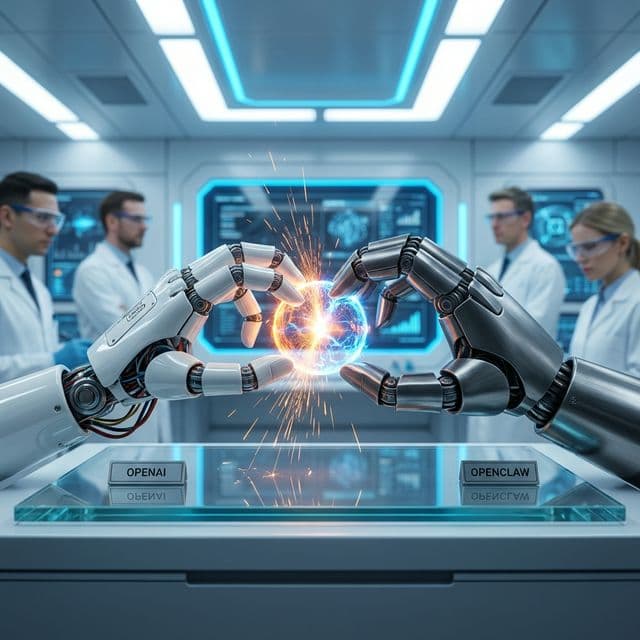
OpenClaw Joins OpenAI: Why This Acqui-Hire Matters More Than Another Model Release
When OpenAI hired the creator of OpenClaw, it signaled a massive shift from chat-centric AI to agent-centric workflows. Here is why the orchestration layer is the new battleground.
When OpenAI announced that Peter Steinberger, the creator of OpenClaw, was joining the company—and that OpenClaw itself would move into an independent foundation—it signaled something bigger than one high-profile hire.
This is OpenAI saying, very clearly: the next platform shift is agents and workflows, not just bigger chat models.
In this post, I’ll unpack what happened, why OpenClaw was such a big deal, and why bringing its creator into OpenAI is strategically important for the future of agents, infrastructure, and the AI ecosystem at large.
From Chatbots to Real Agents
For the past few years, the dominant user interface for AI has been chat. You type; the model answers. That paradigm made sense: it was easy to explain and cheap to ship. But it also left a lot of value on the table.
OpenClaw emerged as one of the first widely-adopted attempts to move beyond chat into action. It isn't just a text box; it's a runtime for autonomy.
What set OpenClaw apart:
- Environment Integration: It runs locally and wires LLMs into your actual environment: files, shell, browser, and messaging apps.
- Modular Ecosystem: A "gateway" plus community-built "skills" that the agent can auto-discover.
- Proactive Behavior: It is designed to be always-on, acting as a real assistant rather than waiting for a human to drive every keystroke.
The Strategy: Why OpenAI Forced the Issue
OpenClaw hit an unusual nerve. By becoming the default runtime for experiments in autonomous workflows, it created three major risks for proprietary platforms like OpenAI:
- Mindshare Risk: If the default way to build is on an open-source stack, the LLM provider becomes "just another backend."
- Distribution Risk: Whoever owns the agent runtime (local machine, browser, messaging) owns the user relationship more deeply than the model provider.
- Experimentation Risk: The most innovative multi-agent systems were happening on OSS infrastructure, shifting the center of gravity away from big labs.
By bringing Steinberger in-house, OpenAI is choosing to shape this orchestration layer rather than compete against it from the outside.
The Evolution of the AI Platform
graph TD
    A[Year 2023: Chat Era] --> B[Year 2024: Tool Use Era]
    B --> C[Year 2025: Agent Era]
    C --> D[Year 2026: Orchestration Era]

    style D fill:#f96,stroke:#333,stroke-width:4px

    subgraph "Shift from Model to Platform"
    D1[OpenAI Models] --- D2(OpenClaw Orchestration)
    D2 --- D3[Real World Actions]
    end
What OpenAI Actually Gains
This move is about three things: vision, patterns, and leverage.
1. Vision for "Agents as OS"
Steinberger views agents not as features, but as a personal operating system. This means persistent identity, memory, and the ability to act without explicit prompts. OpenAI can now blend that "OS-level" worldview directly into its product roadmap.
2. Codified Patterns
OpenClaw pioneered how to describe "skills" for auto-discovery and how to keep memory on local disks while maintaining cloud reasoning. OpenAI now has a battle-tested blueprint for shipping robust agent products to a demanding developer audience.
3. A Bridge to Open Source
Moving OpenClaw to a foundation while hiring its creator is a classic "patron of the ecosystem" move. It gives OpenAI an open, credible on-ramp into the OSS community without the friction of a "closed-source acquisition" narrative.
The Bigger Picture: Agents as the Real Platform
In hindsight, this move may be looked back on as the moment OpenAI formally committed to the Agent Era. Models will keep getting better, but raw capability is no longer the sole differentiator.
The new competition is happening in:
- How easily agents can plug into real systems.
- How safely they can act autonomously.
- How natural it is for users to delegate work rather than just asking questions.
What this means for builders:
- First-class "Agent Mode": Expect easier ways to spin up persistent agents with memory and tool access within the OpenAI ecosystem.
- Workflow Primitives: We’ll likely see higher-level constructs like "Tasks" and "Plans" replace simple tool calls.
- Secure Sandboxing: OpenClaw’s early focus on local safety policies will likely influence OpenAI's infrastructure for high-risk agent actions.
OpenClaw proved there is enormous demand for agent infrastructure. By centralizing that talent, OpenAI is betting that the next platform battle will be fought over workflows, not just tokens per second.
Are you building agents yet? The orchestration layer is where the real magic happens.