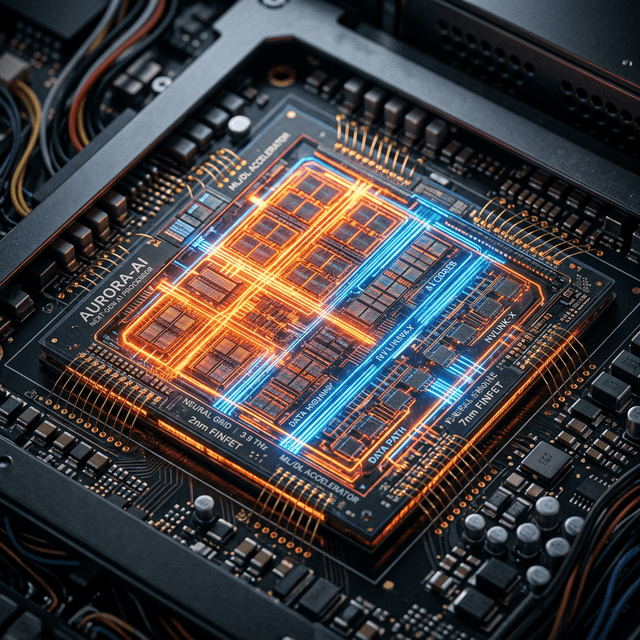
The Compute Cold War: NVIDIA Vera Rubin, AMD Ryzen AI 400, and Meta's MTIA Clash in 2026
Delve into the next-generation AI hardware battle of March 2026. Explore NVIDIA's Vera Rubin H300, AMD's Ryzen AI 400 for PCs, and Meta's custom MTIA chips reshaping massive data center architectures.
The backbone of the artificial intelligence revolution isn't software; it's silicon. In March 2026, the hardware landscape has reached a boiling point of hyper-competition and staggering innovation. As large language models grow into multimodal, trillion-parameter behemoths and autonomous AI agents require constant edge processing, the world's leading semiconductor manufacturers and cloud giants are aggressively vying for absolute dominance.
At the center of this clash are three fundamentally different philosophies and architectures: NVIDIA’s colossal scalable data center platform, "Vera Rubin"; AMD’s push for local intelligence with the "Ryzen AI 400" series; and Meta’s fierce independence driven by its custom "MTIA" infrastructure. Here is a definitive look at the state of AI hardware in 2026.
The Titan Unveiled: NVIDIA's Vera Rubin Platform
Following the overwhelming success of its Hopper and Blackwell architectures, NVIDIA formally launched the much-anticipated Vera Rubin platform at its GTC 2026 conference. Designed relentlessly for the era of multi-trillion-parameter Mixture-of-Experts (MoE) models, Vera Rubin is less a single chip and more a complete, rack-scale supercomputing ecosystem.
The Power of the H300 GPU
The star of the Vera Rubin platform is the H300 GPU. For AI training and high-end inference, it offers a monumental generational leap.
Engineered with an astounding 336 billion transistors and deeply integrating next-generation HBM4 memory, the H300 is projected to deliver between 3.3x to 5x higher efficiency in FP4 precision networking compared to its predecessor. This massive computational thrust is necessary to process the unimaginably dense routing required by modern Agentic AI workflows.
Rack-Scale Architecture
NVIDIA's strategy in 2026 is avoiding bottlenecks by controlling the entire data pathway. The Vera Rubin architecture firmly unites the custom ARM-based "Vera CPU" with the Rubin GPU via the sixth-generation NVLink interconnects. By coupling this with ConnectX-9 NICs and BlueField-4 Data Processing Units (DPUs), NVIDIA minimizes data latency across vast server farms.
graph TD
    A[Vera Rubin Super-Node] --> B(Vera CPU - ARM Based)
    A --> C(H300 GPU Array)
    B <==>|NVLink Gen 6: Ultra-low latency| C

    C --> D{Networking Layer}
    D --> E[BlueField-4 DPUs]
    D --> F[ConnectX-9 NICs]

    E -.->|Scales out to| G[Massive AI Clusters]
    F -.->|Scales out to| G
However, this raw power comes at a physical cost: the Vera Rubin architecture demands nearly double the electricity of the Blackwell generation, intensifying global data center power procurement constraints and forcing a rapid shift toward advanced liquid cooling solutions.
The Edge Intelligence Push: AMD's Ryzen AI 400 Series
While NVIDIA focuses on the colossal data centers powering the cloud, AMD has strategically maneuvered to dominate the edge—bringing powerful, localized AI directly to the user's desk and lap. At the Mobile World Congress (MWC) 2026, AMD formally unrolled its Ryzen AI 400 and PRO 400 series processors.
The "AI PC" Becomes a Reality
The era of relying solely on cloud connections for AI tasks is ending. The Ryzen AI 400 series integrates Zen 5 CPU architecture, highly updated RDNA 3.5 graphics, and, crucially, the XDNA 2 Neural Processing Unit (NPU).
This dedicated NPU is capable of pushing 50 to 60 TOPS (Tera Operations Per Second). This metric is critical because it meets and exceeds Microsoft’s stringent requirements for "Copilot+ PCs," allowing complex large language models, image generators, and autonomous agents to execute natively on the hardware without an internet connection.
Implications for the Enterprise
AMD’s local-first architecture presents a massive value proposition for enterprise IT architecture:
- Absolute Privacy: Analyzing sensitive financial ledgers or intellectual property locally guarantees zero risk of cloud-based data exfiltration.
- Zero Latency: Voice agents and real-time coding assistants perform instantly, unburdened by server ping times and network congestion.
- Cost Deflection: Utilizing local NPUs drastically reduces the expensive API calls that companies must make to cloud providers for heavy AI lifting.
Independence at Scale: Meta's Custom MTIA Chips
Perhaps the most disruptive long-term trend in 2026 is the rapid rise of custom silicon produced by cloud and social media giants. Meta has aggressively accelerated its in-house Meta Training and Inference Accelerator (MTIA) project to break its multi-billion-dollar dependency on NVIDIA and AMD.
An Inference-First Strategy
Running the world's most sophisticated recommendation algorithms natively while deploying Generative AI to billions of users across Facebook, Instagram, and WhatsApp requires a distinctly different type of hardware.
Meta is currently operating on an accelerated six-month iteration cycle. While the MTIA 300 chip is currently handling daily ranking and recommendations training, the highly anticipated MTIA 400, 450, and 500 variants are specifically optimized for GenAI inference.
By designing chips modularly around their exact software needs and existing data center environments, Meta achieves vastly superior cost-efficiency for its specific workloads compared to buying generic off-the-shelf high-performance GPUs. This move signals a wider industry trend: companies like Google (with TPUs) and Amazon (with Trainium/Inferentia) are proving that massive AI infrastructure is cheaper when you build the silicon yourself.
The Intersection of Physical AI and Digital Twins
As hardware advances in March 2026, we are also seeing a rapid pivot from strictly generative AI toward "Physical AI." Complex silicon arrays are now dedicated to simulating the physical laws of the universe via "Digital Twins."
NVIDIA's overarching narrative heavily positions the Vera CPU and Rubin GPU integration as foundational platforms for robotics, automated manufacturing, and complex spatial simulations. This allows companies to train robotic systems in hyper-realistic simulated environments entirely in silicon before deploying a physical prototype into the real world.
Frequently Asked Questions (FAQ)
What is the difference between a GPU and an NPU?
A GPU (Graphics Processing Unit) is a highly versatile processor originally designed for rendering graphics but heavily co-opted for training massive AI models in data centers due to its parallel processing power. An NPU (Neural Processing Unit) is a specialized chip tailored specifically to execute AI algorithms (like neural networks) incredibly efficiently and with low power consumption, making them ideal for laptops and smartphones.
Why is power consumption such a big issue in 2026?
Next-generation chips like the NVIDIA H300 draw vast amounts of electricity to power their dense transistor grids. The primary bottleneck for AI expansion is no longer the availability of chips, but the ability of power grids to supply electricity to new data centers and the implementation of liquid cooling infrastructure required to keep them from melting.
Will AMD's Ryzen AI 400 run models like GPT-5?
While a laptop NPU cannot train or run an uncompressed trillion-parameter model like full GPT-5.4, it can run highly capable, compressed ("quantized") models—like DeepSeek V4-mini or Llama 3 8B—entirely locally with extreme speed and privacy.
Why is Meta building its own chips?
Control and cost. Relying entirely on NVIDIA creates severe supply chain vulnerabilities and astronomical costs for Meta. By designing the MTIA specifically tailored to Meta's unique database architectures and software algorithms, they drastically lower the cost-per-inference.
Conclusion: A Bifurcated Compute Future
The semiconductor wars of March 2026 paint a fascinating picture of a bifurcated AI future. On one end, NVIDIA continues to stretch the laws of physics to construct god-like, multi-rack supercomputers dedicated to pushing the absolute boundaries of artificial intelligence. On the other end, companies like AMD are radically democratizing AI, ensuring that high-level intelligence and immediate inference are embedded locally in every digital device on the planet. For enterprises, mastering this decade means navigating both extremes successfully.