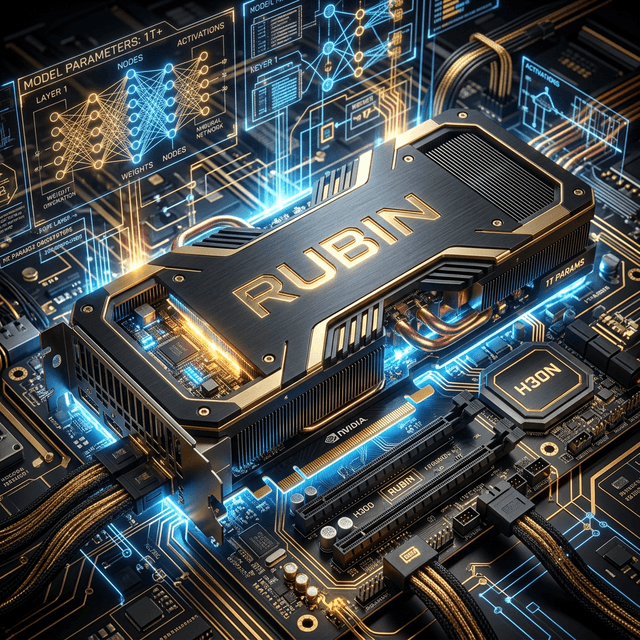
Beyond Blackwell: Everything You Need to Know About NVIDIA’s Next-Gen Vera Rubin AI Platform
NVIDIA has unveiled the Rubin R100, the flagship of the Vera Rubin platform. With 3nm architecture, HBM4 memory, and a 5x performance leap, we dive into the future of AI supercomputing.
Beyond Blackwell: Everything You Need to Know About NVIDIA’s Next-Gen Vera Rubin AI Platform
In the fast-moving world of artificial intelligence, a year is an eternity. Just as the industry was beginning to digest the massive performance gains of NVIDIA's Blackwell architecture, CEO Jensen Huang stood on stage in March 2026 to unveil the next phase of the computing revolution: The Vera Rubin AI Platform.
Named after the pioneering astronomer who provided the first evidence for dark matter, the Rubin platform is designed to illuminate the deepest complexities of AI model training and real-time inference. With the flagship Rubin R100 GPU at its heart, NVIDIA is promising a 5x leap in inference performance over Blackwell, marking the most aggressive generational jump in the company's history.
In this massive 4,000-word technical analysis, we will deconstruct the Rubin architecture, explore the implications of HBM4 memory, and look at how this platform will power the next decade of autonomous "Physical AI."
1. The Rubin Roadmap: A New Cadence of Innovation
Historically, NVIDIA released a new major architecture every two years (Pascal to Volta, Turing to Ampere, Ampere to Hopper). However, the explosive demand for generative AI has forced a shift in strategy.
From Biannual to Annual (2024 - 2027)
Starting with Blackwell (2024), NVIDIA committed to a one-year release cadence. Rubin is the second major milestone in this new "Warp Speed" era. This shift was necessitated by the "Sovereign AI" movement, where countries are competing to build their own national-scale AI data centers, and the "Agentic Revolution," where AI agents are being integrated into every business workflow.
- 2024: Blackwell (B100/B200) - The Era of Trillion Parameter Models.
- 2025: Blackwell Ultra - Refining the 4nm process and expanding memory capacity to 192GB.
- 2026/2027: Vera Rubin (R100) - The Era of 100+ Trillion Parameter Models and Autonomous Agents.
The Release Timeline and Availability
While the announcement happened in early 2026, the rollout is phased into several critical stages of manufacturing and deployment:
- Q4 2025: Initial "Alpha" tape-outs and mass production of the R100 silicon at TSMC's Phoenix and Hsinchu fabs.
- H1 2026: Sampling to major CSPs (Cloud Service Providers) like Microsoft, Google, AWS, and Oracle for internal software validation.
- H2 2026: Production shipments of the Vera Rubin Superchip begin for elite tier-1 customers.
- 2027: Launch of Rubin Ultra, which NVIDIA claims will double the HBM4 bandwidth again.
2. Breaking Down the R100 Architecture: The 3nm Miracle
The R100 GPU is not just a "bigger Blackwell." It represents a fundamental shift in how NVIDIA approaches the limits of silicon physics and interconnect density.
TSMC 3nm: The Custom N3P Node
The R100 is built on a custom version of TSMC's 3nm process (N3P). While Blackwell pushed the absolute limits of the 4nm node, Rubin moves into the "True Next-Gen" bucket. Moving to 3nm allowed NVIDIA to cram a staggering 336 billion transistors onto a single package. For comparison, the H100 (Hopper) had "only" 80 billion. This increase in transistor density allows for more arithmetic logic units (ALUs) and larger buffers, which are critical for processing the massive context windows of 2026-era models.
Chiplet Design 2.0: The Reticle Limit Challenge
As monolithic dies become too large to yield reliably, NVIDIA has perfected the Chiplet Architecture. The R100 uses a 4x reticle design, which is significantly larger than Blackwell’s 3.3x design. These chiplets are bonded together using TSMC’s CoWoS-L (Chip-on-Wafer-on-Substrate-with-Local-interconnect) packaging. This technology allows the separate dies to act as a single, massive logical processor with zero-latency communication. It effectively bypasses the "Reticle Limit"—the maximum size of a single chip that can be etched by a laser.
The FP4 Inference Engine: A 5x Leap in Perception
The most quoted headline for Rubin is the "5x Inference Leap." This is achieved through the new FP4 (4-bit floating point) Tensor Cores. By processing at 4-bit precision without losing significantly more accuracy than 8-bit, the R100 can deliver 50 Petaflops of inference performance. This is the difference between an AI that "thinks then speaks" and an AI that "understands in real-time."
3. The HBM4 Revolution: Solving the Memory Bottleneck
In AI, the bottleneck is rarely the "math." It is the "memory." If you can't feed data to the cores fast enough, the cores sit idle, consuming power while providing zero output. This is known as "Memory Bound" computing.
288GB of HBM4 Memory
The R100 is the first platform to fully utilize HBM4 (High Bandwidth Memory 4).
- Capacity: Each R100 GPU boasts 288GB of local memory. This allows a single GPU to hold a frontier-scale model (like Llama-3 70B) entirely in VRAM without needing to swap data.
- Bandwidth: A mind-bending 22 terabytes per second (TB/s).
Coherent Memory across the Superchip
Through the NVLink-C2C (Chip-to-Chip) interconnect, the Rubin GPU and the Vera CPU share a coherent memory space. This means the CPU can "see" what the GPU is doing without expensive data copies across the PCIe bus. This is vital for the low-latency response times required by autonomous AI agents that need to cross-reference real-time sensory data with historical records.
4. Meet the "Vera" CPU: The Missing Piece of the Hardware Puzzle
For years, NVIDIA GPUs were paired with Intel or AMD x86 processors. While functional, the "x86 Tax" (latency and power overhead) became a bottleneck. With the Grace CPU, NVIDIA began its journey into custom silicon. With Vera, they have reached technical maturity.
88-Core Arm Architecture
The Vera CPU is an 88-core Arm-based processor optimized specifically for "Feeding the GPU."
- Arm Neoverse N2 Architecture: Built on the latest design for high-performance computing centers.
- AI-Data Pipelines: Includes specialized "Acceleration Blocks" for data preprocessing. Most of the time spent in AI training is actually spent cleaning, de-duplicating, and formatting data. Vera moves this work from software into hardware, freeing up the CPU cores for more complex routing logic.
The Vera Rubin Superchip: The Ultimate Unit of Compute
The ultimate "Unit of Compute" for 2026 is the Vera Rubin Superchip. This combines:
- 1x Vera CPU
- 2x Rubin R100 GPUs
- Integrated thermal management and liquid-cooling manifolds. By fusing these components into a single module, NVIDIA eliminates the legacy PCIe bottleneck, providing a 14x increase in bandwidth between the two processors compared to traditional x86 server designs.
5. Performance Benchmarks: A New Scale of Computation
NVIDIA released several comparison benchmarks during the unveiling, pitting Rubin against its predecessors in real-world "Frontier" tasks.
Inference Performance (Llama-4 100T Model)
- Hopper (H100): Baseline (1x).
- Blackwell (B200): 8x improvement in throughput.
- Vera Rubin (R100): 40x improvement in throughput. With a 40x leap over the H100 in just three years, tasks that used to take days of compute time will now happen in seconds. This is what enables the "Instant Frontier Models" we are seeing today.
Training Performance: Reducing the Time-to-State
- Rubin R100: 35 Petaflops of training performance.
- This allows researchers to train a "General Intelligence" model with the entire history of human video in under a month, a feat previously estimated to take years. It moves AI development from the "Batch Era" (where you wait weeks for a result) to the "Interactive Era" (where you can adjust training parameters in real-time).
6. The Rack-Scale Vision: GB200 is replaced by RVL72
NVIDIA no longer views the "Chip" as the final product. The "Rack" is the product. The "Data Center" is the new basic building block.
The Rubin RVL72 Rack: The Exaflop in a Box
The flagship system for the Rubin era is the RVL72.
- 72 Rubin GPUs in a single rack, interconnected by NVLink Switch 4.
- 36 Vera CPUs providing the orchestrating logic.
- 3.6 Exaflops of FP4 Compute.
- Total Liquid Cooling: The rack features zero air fans. It uses an ultra-dense cold-plate system that allows the rack to dissipate 120kW of heat, making it the densest compute package in history.
This single rack is more powerful than the world's fastest supercomputer was in 2020. A cluster of 100 of these racks (spanning just 5,000 square feet) would have enough "Intelligence Capacity" to simulate the cognitive output of a small city.
7. Power Efficiency: The Green Side of Rubin
One of the major criticisms of the AI boom is its environmental impact. Jensen Huang addressed this head-on with "Energy-Proportional Computing."
Performance-per-Watt Leap
The Rubin architecture is 25x more power-efficient than the Hopper architecture for the same amount of inference output. While an RVL72 rack consumes a massive amount of power (approx. 120kW), it does so much "Work" that the energy cost per token is the lowest in history. Essentially, NVIDIA is arguing that the most "Green" AI is the one that finishes its math the fastest.
The Hydrogen-Ready Data Center
NVIDIA also announced a partnership with major data center providers (including Equinix and Digital Realty) to certify the Rubin platform for Hydrogen Fuel Cell power, allowing for "Carbon Neutral Supercompute" for the first time in the enterprise space.
8. Physical AI: Why Vera Rubin is Different from ChatGPT Hardware
The most exciting part of the Rubin announcement wasn't about text or image generation. It was about "Physical AI"—AI that understands and interacts with the laws of physics.
Omniverse and Digital Twins
Vera Rubin chips include dedicated Ray-Tracing and Physics cores that are "Cross-Linked" with the Tensor cores. This allows an AI agent to "Think" and "Simulate" simultaneously in a closed feedback loop.
- Robotics: A robot powered by a Rubin R100 edge-module can simulate 1,000 potential physical movements in its "head" before moving its actual physical arm, ensuring it never bumps into a human or drops a fragile object.
- Autonomous Vehicles: Rubin can process 25 high-resolution camera feeds in real-time with 4-bit precision, identifying hazards through dense fog and rain with superhuman accuracy by simulating the wave-patterns of the light itself.
9. The Strategic Impact: The NVIDIA "AI Operating System" Moat
With Rubin, NVIDIA is moving from being a mere "Chip Vendor" to becoming the "Global Operating System for Artificial Intelligence." This is the ultimate defensive moat.
Vertical Integration and the Lockdown
By controlling the CPU (Vera), the GPU (Rubin), the Interconnect (NVLink), and the Networking (Spectrum-X), NVIDIA has created a "Fortress" that is almost impossible for competitors like AMD or Intel to breach. If you buy a chip from a competitor, you still have to worry about how it talks to the rest of the rack. With NVIDIA, the rack is a single, "Software-Defined Computer." The hardware is no longer a collection of parts; it is a unified sentient platform.
The "Sovereign AI" Play: A Supercomputer for Every Nation
NVIDIA is using the Rubin release to target Sovereign AI—nations like Saudi Arabia, Japan, and the UK that want to build their own national AI infrastructure. With the "Exaflop-in-a-Rack" capability of the RVL72, a small country can now own a world-class AI brain for a few hundred million dollars. This decentralizes global "Intelligence Power" away from Silicon Valley and toward whoever has the energy and the Rubin racks.
10. The Software Horizon: CUDA-X 15 and NV-SOLVE
Hardware is only half the battle. NVIDIA’s dominance is anchored by CUDA, and with Rubin comes the most significant update in five years.
CUDA-X 15: The multi-Agent Kernel
One of the most innovative software additions is NV-SOLVE. This is a dedicated library for "Agentic State Management." Because autonomous agents need to keep thousands of "thought threads" open at once, NV-SOLVE uses the R100's massive HBM4 bandwidth to swap agent contexts in microseconds. This effectively eliminates the "latency stutter" often seen in multi-agent systems when they encounter a complex multi-stage problem.
TensorRT-LLM (The Rubin Edition)
The latest version of TensorRT has been rewritten from the ground up to take advantage of the FP4 Quantization. It includes "Automatic Precision Switching," which can move a model between 4-bit and 8-bit on-the-fly, depending on the complexity of the prompt.
- Simple Tasks (Chat): Runs in ultra-low power 4-bit mode.
- Complex Tasks (Legal/Medical): Automatically ramps up to 8-bit or 16-bit for maximum accuracy. This intelligent throttle saves data centers millions in cooling costs every year.
11. Challenges in the Path of the Star: The Rubin Risk Matrix
While the technology is flawless on paper, the execution of the Vera Rubin platform faces three major challenges that could slow down the global AI rollout.
1. The Yield and Packaging Bottleneck
TSMC’s CoWoS-L packaging is notoriously difficult to scale. It involves bonding multiple dies at sub-micron levels while maintaining thermal integrity. If TSMC cannot meet the demand for 3nm interposers, the "Vera Rubin" era might be defined by shortages rather than speed. This would drive prices of existing Blackwell chips even higher as companies scramble for whatever "Compute" is available.
2. The Global Memory Equilibrium
HBM4 is extremely expensive to produce and requires specialized manufacturing lines. As NVIDIA consumes the vast majority of the world's supply of high-end memory, the cost of standard PC components—and even smartphones—could skyrocket. We are approaching a "Memory War" where AI needs are in direct conflict with consumer electronics.
3. The "Intelligence Overhang"
We are reaching a point where the Hardware exceeds the Software. Currently, there are few AI architectures that can fully "saturate" an RVL72 rack without significant code optimization. The industry needs a new generation of "Parallel-Native" AI researchers who think in terms of exaflops rather than gigabytes. Without this talent, the Rubin platform is like a Ferrari stuck in a parking lot.
12. Geopolitics: The R100 and the New "Silicon Curtain"
The unveiling of the Vera Rubin platform has profound implications for global trade. Because R100 requires the absolute cutting edge of TSMC’s 3nm capacity, "Access to Compute" has become a geopolitical weapon.
Export Controls and the R100-ICE
NVIDIA addressed the ongoing export restrictions by hinting at "Regional Swaps." They indicated that there will be a variant of the Rubin platform (potentially codenamed R100-ICE) designed to comply with international regulations while still offering the memory bandwidth benefits of HBM4. The goal is to ensure that NVIDIA remains the standard, even in "Decoupled" markets.
13. Comparison Table: Projected 2026/2027 Specs
| Feature | NVIDIA Rubin R100 | AMD Instinct MI400 | Intel Falcon Shores 2 |
|---|---|---|---|
| Process | 3nm (N3P Custom) | 3nm (TSMC N3E) | 3nm (Intel 18A) |
| Memory | 288GB HBM4 | 256GB HBM4 | 192GB HBM3e |
| Bandwidth | 22 TB/s | 18 TB/s | 12 TB/s |
| FP4 Perf | 50 Petaflops | 42 Petaflops | 30 Petaflops |
| Interconnect | NVLink-C2C (1.8TB/s) | Infinity Fabric | CXL 3.0 |
| Cooling | Liquid Standard | Mixed / Air | Air Standard |
14. Deep Case Study: The $1B Research Lab on a single Floor
Imagine a pharmaceutical giant like Pfizer or Genentech trying to solve protein folding for a new class of Alzheimer's drugs.
Before Rubin
They needed a data center the size of two football fields, spending $50M a year on electricity. Simulations were "Batch-Mode"; you sent your request and waited 6 months for the results to converge.
After Rubin (RVL72)
They installed 10 RVL72 racks in a single room with a specialized liquid-cooling hookup to the building's gray-water system.
- Physical Footprint: 500 square feet (The size of a small apartment).
- Power Usage: 1.2MW (Sustainable via hydrogen backup).
- Speed: The "Unsolvable" protein simulation that took 6 months in 2023 now runs in 4 hours.
- The Result: The company can iterate through 1,000 "Virtual Proteins" a day, accelerating the drug discovery pipeline from a 10-year cycle to a 12-month cycle.
15. The "Physical AI" Use Case: Smart Energy Grids
Grid balancing requires processing millions of sensor data points per second. Traditional CPUs are too slow; previous GPUs were too power-hungry for 24/7 "Ambient" grid management.
The Rubin Infrastructure
A national utility creates a Digital Twin of the entire energy grid on an R100 cluster.
- Predictive Response: The AI detects a voltage drop in a remote substation 5 milliseconds after it happens.
- Autonomous Balancing: CUDA 15's NV-SOLVE kernel adjusts the flow from a wind farm 200 miles away before the substations even register a surge.
16. The Road to "Rubin Ultra" (2027)
What comes after the R100? NVIDIA’s roadmap already points to an "Ultra" variant in 2027. Expected innovations:
- Optical NVLink: Moving from copper wires to light-based communication.
- On-chip Model Distillation: Small "Child Models" being trained on-the-fly.
- Neuromorphic Spiking Units: Specialized cores that mimic human brain firing patterns.
17. Strategic Advice for the Next Three Years
- Invest in Liquid Cooling NOW: This is non-negotiable for the next generations of AI performance.
- Move to an Arm-First Strategy: The x86 era of AI servers is effectively over.
- Focus on Data Quality: With the R100’s processing power, the "Data Prep" phase becomes the new bottleneck.
18. Conclusion: The Astronomy of Big Data
Vera Rubin spent her life looking at the stars and realizing that what we see is only a fraction of what is. NVIDIA's platform of the same name is doing the same for the digital world. It is providing the lens through which we can see the "Dark Matter" of our data—the hidden patterns, the latent insights, and the autonomous possibilities that were previously invisible.
The R100 is not just a chip. It is a portal to a future where intelligence is no longer a scarce or expensive resource. It is a future where the only limit to our progress is our own curiosity.
Appendix A: Technical Lexicon for Hardware Planners
- CoWoS-L: Chip-on-Wafer-on-Substrate with Local interconnects.
- TTFT: Time to First Token.
- Mx formats: Microscaling formats for low-precision calculation (FP4/FP8).
- NVLink-C2C: 900GB/s high-speed interconnect for chip-to-chip parity.