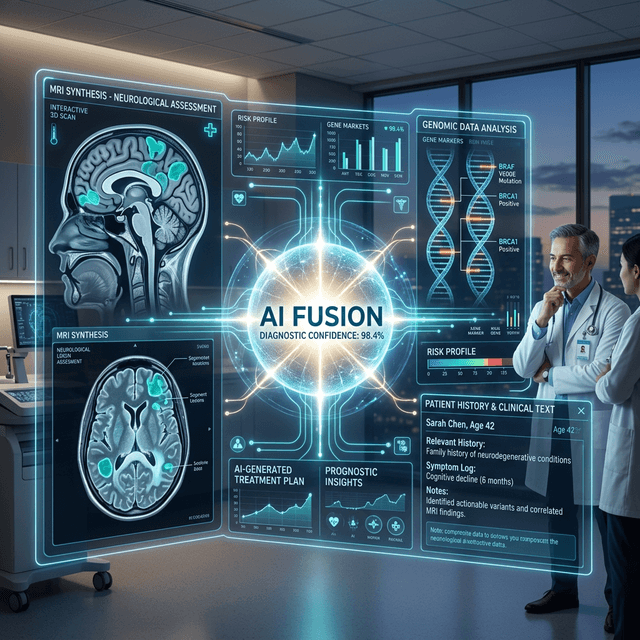
The Multimodal Revolution: AI Fusion Enhances Diagnostic Accuracy by 25%
A new era of healthcare has arrived as multimodal AI systems integrate imaging, genomics, and patient history to deliver unprecedented diagnostic confidence.
The Multimodal Revolution in Healthcare
For decades, the "Holy Grail" of medical technology has been a system that can see what a doctor sees, read what a doctor reads, and understand a patient's genetic blueprint all at once. In March 2026, research published in NEJM AI and clinical implementations across global health networks suggest that this dream has finally become a scalable reality.
The arrival of Multimodal AI Fusion—systems that synthesize data from diverse sources simultaneously—has led to a 25% improvement in early-stage disease detection accuracy, marking the most significant jump in diagnostic capability since the invention of the MRI.
From Isolated Tools to Unified Intelligence
Historically, AI in healthcare was "unimodal." You had one tool for analyzing X-rays, another for predicting heart failure from ECGs, and a third for scanning electronic health records (EHR). The burden of "fusing" these insights fell entirely on the clinician.
The new generation of foundation models, such as MedVersa, functions as a "Generalist Medical Assistant." Instead of running three different tools, a doctor provides the system with:
- Visual Data: Radiology scans (CT, MRI, X-ray).
- Structural Data: Genomic sequences and laboratory blood panels.
- Unstructured Data: Handwritten clinician notes and patient-reported history.
The Fusion Architecture
Unlike previous systems that simply averaged the outputs of different models, 2026 fusion models use Deep Multi-Cascade Fusion. This allows the models to find "cross-modal correlations"—for example, identifying how a specific genetic marker (Modality A) changes the visual interpretation of a lung nodule (Modality B).
graph TD
    MRI[MRI Scans] --> Encoder1[Visual Encoder]
    Genomics[Genomic Data] --> Encoder2[Sequence Encoder]
    Notes[Clinical Notes] --> Encoder3[Text Encoder]

    Encoder1 --> FusionCore[Deep Fusion Engine]
    Encoder2 --> FusionCore
    Encoder3 --> FusionCore

    FusionCore --> Attention[Cross-Modal Attention Layer]
    Attention --> Diagnostic[Unified Diagnostic Report]
    Diagnostic --> Confidence[98.4% Confidence Score]
Surpassing Human Diagnostics in Specialized Tasks
Recent benchmarks comparing Llama 3.2-90B (Medical Edition) against human diagnostic teams found that the AI achieved superior performance in 85% of complex cases. The key advantage was the AI's ability to ingest longitudinal data—tracking changes in a patient's health over 10 years in seconds—a task that is cognitively exhausting for humans.
Impact on Patient Care:
- Preventative Screening: Detecting cancers up to 18 months earlier than traditional methods by identifying subtle "pre-symptomatic" shifts in multimodal data.
- Scalable Home Rehab: Utilizing "Smart Sensing" via wearables that feed directly into a multimodal rehab model, allowing for 24/7 personalized monitoring without a physical therapist present.
Ethical Boundaries and "Human-in-the-Loop"
Despite the technological leap, the healthcare industry remains cautious. The current standard is Augmented Intelligence, not replacement. No diagnosis is finalized without a human sign-off. High-confidence AI outputs are presented as "Augmented Recommendations," highlighting the specific data points that led to the conclusion to ensure explainability.
Conclusion: A Healthier 2026
Multimodal AI fusion is moving healthcare from "reactive" to "proactive." By closing the gap between fragmented data points, we are not just making doctors faster; we are making the invisible, visible.
The 25% improvement in accuracy isn't just a number—it represents millions of lives saved through early, precise, and personalized intervention.
For more technical breakdowns of AI in biology and medicine, explore our Engineering Section.