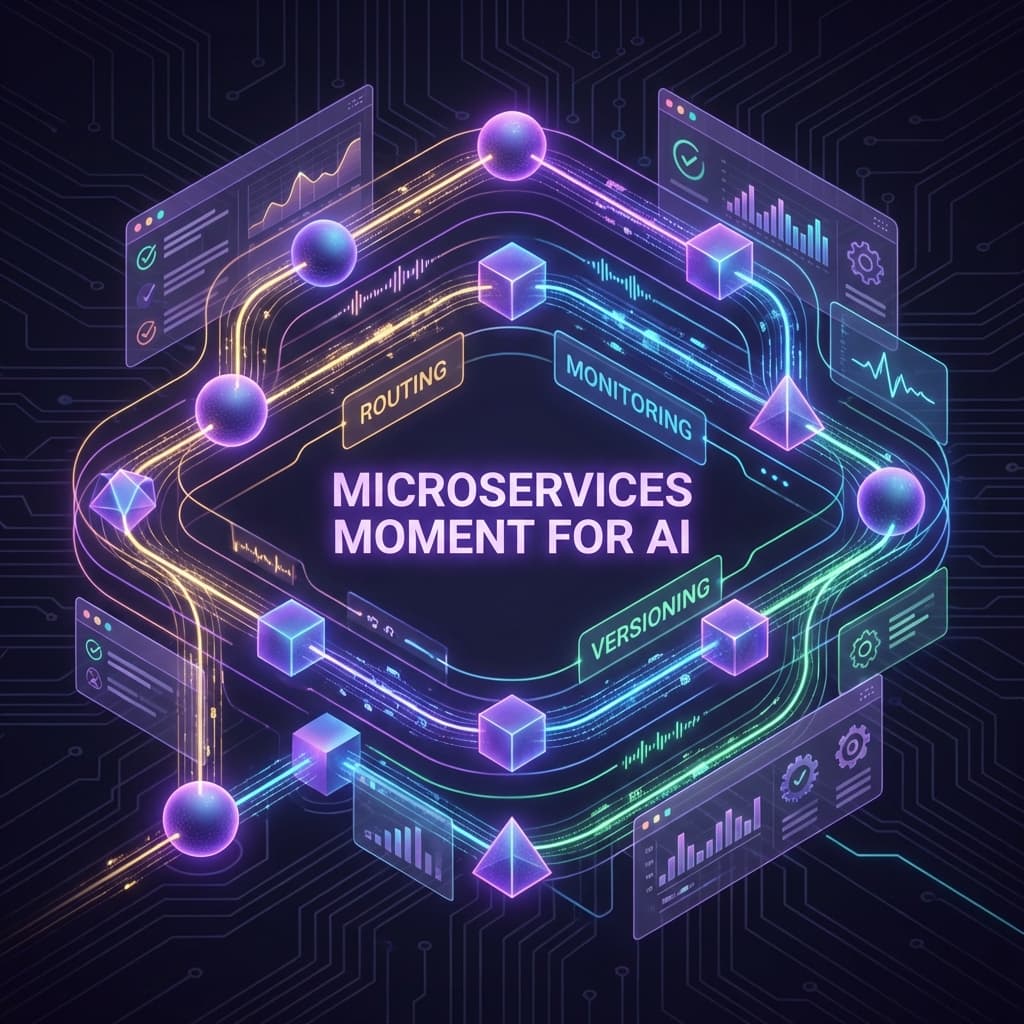
The Microservices Moment for AI: Designing Multi-Agent Systems That Don’t Melt Down
Treating AI agents like microservices is the key to building stable, scalable multi-agent systems. Learn about routing, retries, and monitoring in the age of agentic AI.
In the early 2010s, software engineering had a "Monolith" problem. We built giant, fragile applications where a single bug in a logging script could take down the entire checkout system. The solution was Microservices: breaking the big machine into small, independent parts that talk to each other over a network.
Today, AI is having its own "Monolith Moment."
Most developers start by building a single, giant prompt that tries to do everything: research, write, format, and audit. And like the software monoliths of the past, these "God-Prompts" are breaking. They are slow, they hallucinate, and when they fail, it’s impossible to know why.
We are entering the era of Multi-Agent Systems (MAS). To build AI that actually works in production, we have to stop treating AI like a "chat box" and start treating it like a distributed system.
Part 1: Why Agents Need Boundaries
When you build a multi-agent system, you aren't just giving one AI more tasks. You are creating a team of specialized AI agents. One agent searches the web. Another agent writes Python code. A third agent audits the results for bias.
But here is the problem: Agents are non-deterministic. Unlike a standard database query, an AI agent might give a slightly different answer every time. When you link five of these together, the chances of a "melt down" increase exponentially.
If you don't design your system with boundaries, you end up with the "Loop of Death"—where Agent A asks a question, Agent B gives an answer that Agent A doesn't like, and they spend $50 in API credits arguing with each other until the server times out.
Part 2: Lessons from Microservices
To prevent these meltdowns, we must borrow three core concepts from the world of microservices:
1. Intelligence Routing
In a microservices architecture, you use a "Gateway" to send traffic to the right service. In AI, you need a Router Agent.
Instead of sending every request to your most expensive model (like GPT-5 or Claude 4), the Router identifies the complexity of the task.
- "Is this a simple formatting task?" -> Send to a fast, cheap model.
- "Is this a complex strategy task?" -> Send to the "Big Brain" model.
2. Circuit Breakers and Retries
In software, if a service is down, you don't keep hitting it; you "trip the circuit" to save the rest of the system.
In multi-agent systems, a circuit breaker looks like this:
- If Agent B fails to provide a formatted JSON response after three attempts, stop the workflow.
- Notify a human.
- Do not let the system continue to "improvise" around the failure, which leads to hallucinations.
3. Monitoring and Tracing (The "Black Box" Problem)
In a monolith, you can follow the stack trace. In a multi-agent system, you need Observability. You need to see exactly what Agent A said to Agent B.
Tools like LangSmith or Arize Phoenix are becoming the "Datadog for AI." They allow you to see where the logic broke down. Was it a bad retrieval? A lazy prompt? Or a model update that changed the performance?
Part 3: A Real Failure Story – The "infinite Loop"
Let’s look at a real-world example of a multi-agent system gone wrong.
A company built a "Research and Summary" system.
- Agent A (Researcher) was told to find 5 articles on a topic.
- Agent B (Editor) was told to audit the articles and ensure they were from "reputable sources."
One day, Agent A found an article from a niche blog. Agent B rejected it, saying "Not reputable enough." Agent A, programmed to find exactly 5 articles, searched again and found the same article (because the internet is only so big). Agent B rejected it again.
They did this 400 times in 2 minutes. The company only realized it when they got an automated billing alert from OpenAI for "unusual activity."
How better design would have caught it:
- State Management: The system should have a "memory" of what has already been tried.
- Max Turn Limit: No two agents should be allowed to talk more than 5 times without a "Supervisor" (or human) stepping in.
- Deterministic Checks: Use a simple Python script to check for duplicate URLs before the agents start chatting.
Part 4: Designing for Stability
If you are building a multi-agent system today, here is your architectural blueprint:
1. Stateless Agents, Stateful Orchestrator
Don't let agents hold the "State" of the project. Use an Orchestrator (like LangGraph or a central database) that keeps track of the "Source of Truth." This ensures that if one agent fails, the whole system doesn't lose its place.
2. "Narrow" Tool access
Don't give every agent access to your entire database. Give the "Support Agent" access to the support tables only. This reduces the "search space" and makes the agent much more accurate.
3. Versioning Prompts like Code
In microservices, you never deploy a change without a version number. You should do the same with prompts.
Prompt_V1.2 might work perfectly, but Prompt_V1.3 might introduce a subtle hallucination. Treat prompts as code. Commit them to Git. Test them before they hit production.
The Path Forward: Reliable Agency
We are moving away from the "Magic Box" era of AI. We are building Agentic Infrastructure.
The goal isn't to build a system that is "smart." The goal is to build a system that is predictable. A predictable system that is 80% smart is infinitely more valuable than an unpredictable system that is 100% smart.
Treat your agents like services. Design your handoffs like APIs. And always, always have a kill switch.
Your Architectural Checklist:
- Do I have a "Max Turns" limit on my agent loops?
- Is there a "Router" choosing the right model for the right task?
- Am I logging every "Inter-Agent" conversation?
- Do I have a fallback plan for when an agent provides malformed data?
- Can I "Version" my prompts independently?
The microservices moment for AI is here. Are you building a monolith, or a team?