Mistral’s €3 Billion Round Puts a Price on Sovereign AI Independence
Mistral’s €3 billion Series D backs a full-stack sovereignty strategy. The test is whether open weights deliver control beyond the model itself.
Mistral’s €3 Billion Round Puts a Price on Sovereign AI Independence
An AI model can be downloadable while the business built around it remains difficult to leave. Applications accumulate custom integrations, employees learn a particular interface, and sensitive knowledge becomes entangled with the systems that retrieve and process it. Mistral’s latest financing is a wager that customers will pay to control that entire relationship, not merely obtain a copy of some model weights.
On September 8, 2026, Mistral announced a €3 billion Series D at a post-money valuation of more than €21 billion. Samsung Electronics led the round, alongside co-leads Scaleup Europe Fund, managed by EQT, and existing investor PSG Equity. The company says the money will expand frontier research, training compute, infrastructure, commercial growth, and its international presence. This is a financing announcement for a full-stack sovereignty strategy, not the unveiling of a new model. The distinction matters because its central claims concern control and industrial scale rather than a fresh benchmark result. Mistral’s announcement
The useful question is therefore not whether €3 billion makes Mistral a winner in an abstract race. It is whether the company can turn independence into a product that works for organizations unable to operate an AI research lab themselves. That requires solving an uncomfortable problem: customers want alternatives to concentrated technology suppliers, but delivering a complete alternative can create another concentrated supplier relationship.
What the €3 billion buys, and what the valuation does not prove
Mistral describes the Series D as the largest equity fundraising round completed by a European technology company. That is the company’s characterization, not an independently established ranking here. Its announcement also says Mistral operates across 20 countries and supports more than 125 global enterprises, naming Airbus, ASML, and HSBC. Those statements establish the scale of the business Mistral is presenting to investors; they do not reveal contract values, margins, or the proportion of customer activity already running in production. Company financing and customer statements
The post-money valuation and the financing amount answer different questions. The round provides capital; the valuation expresses the negotiated value of the company after that financing. Neither figure is annual revenue, available infrastructure capacity, or evidence that every proposed use of the money has been funded to completion. Mistral does not disclose a detailed allocation among research, compute, infrastructure, and sales in the announcement. Treating the full amount as a spending commitment to any one of those categories would misread the transaction.
The breadth of the spending plan is nonetheless revealing. Frontier research cannot serve this strategy as a prestige activity separate from the product business. Mistral explicitly calls research the foundation of its infrastructure, products, and sovereignty proposition. If customers must choose between useful capability and control, the sovereignty pitch becomes a request to accept a weaker tool for strategic reasons. Competitive models reduce that sacrifice. Compute and distribution then determine whether the capability reaches customers under acceptable operating conditions. Mistral’s stated investment priorities
That creates several clocks inside the same company. Research investments may take time to become useful models. Infrastructure commitments require planning before demand is certain. Enterprise implementation work can consume staff before it generates repeatable product revenue. The financing gives Mistral room to coordinate those activities, but the announcement does not establish their economics. A large raise can finance an attempt to make a difficult business model work; it cannot certify that the model already works.
For customers, the practical consequence is narrower than the headline might suggest. A better-capitalized supplier may be a more credible long-term candidate, yet procurement still needs evidence about the service being purchased. Financial backing should support due diligence, not replace an availability commitment, a migration plan, or a contract describing who handles a failed deployment. Sovereignty bought as an assurance must eventually become sovereignty specified as an obligation.
Samsung and ASML make this an industrial story, not a national purity test
Mistral places the Samsung-led Series D beside its ASML-led Series C, emphasizing support from advanced manufacturing, engineering, and industrial technology. The current round also includes financial and strategic investors from Europe, Asia, and North America. Its participant list names organizations including NVIDIA, Salesforce Ventures, BNP Paribas CIB, Bpifrance, and existing venture investors. The company presents that breadth as an endorsement of its approach to deploying AI in complex environments. Mistral’s investor account
The industrial connection is analytically important without requiring an invented supply agreement. Samsung’s investment does not, by itself, establish preferential hardware access, a guaranteed customer contract, or a technical integration. Nor does ASML’s presence prove how Mistral models are used inside ASML. The announcement identifies investors and customers; it does not supply the commercial detail needed to infer those arrangements. The defensible interpretation is that Mistral has attracted capital from companies whose businesses make control over technical knowledge a concrete operating concern.
Manufacturing knowledge is not simply a collection of public documents waiting to be summarized. It can include process choices, engineering exceptions, supplier relationships, and accumulated explanations for why an apparently obvious solution failed. In a hypothetical industrial deployment, the valuable asset would be the way a model connects those materials to current decisions. That makes the location and ownership of the resulting knowledge system more consequential than the nationality printed on a model’s launch announcement.
Mistral’s international investor base also complicates simplistic versions of sovereign AI. A European company funded by an international syndicate is not economically isolated from the rest of the world. That is not necessarily a contradiction. Operational sovereignty can mean retaining meaningful choices over data, models, compute, and production systems while still buying equipment and accepting investment internationally. Mistral’s own definition focuses on those operating dimensions rather than claiming a supply chain without foreign dependencies. The company’s four-dimensional definition
The hard question for a government buyer is which dependencies are acceptable and which need substitutes. Ownership structure, legal jurisdiction, infrastructure location, software control, and access to support are related but distinct. A procurement team should not collapse them into a single country label. Mistral benefits if customers make those distinctions carefully, because its argument is about a controllable stack. It risks disappointment if sovereignty is interpreted as a promise that no outside organization can ever affect the service.
Mistral’s four dimensions turn sovereignty into a testable proposition
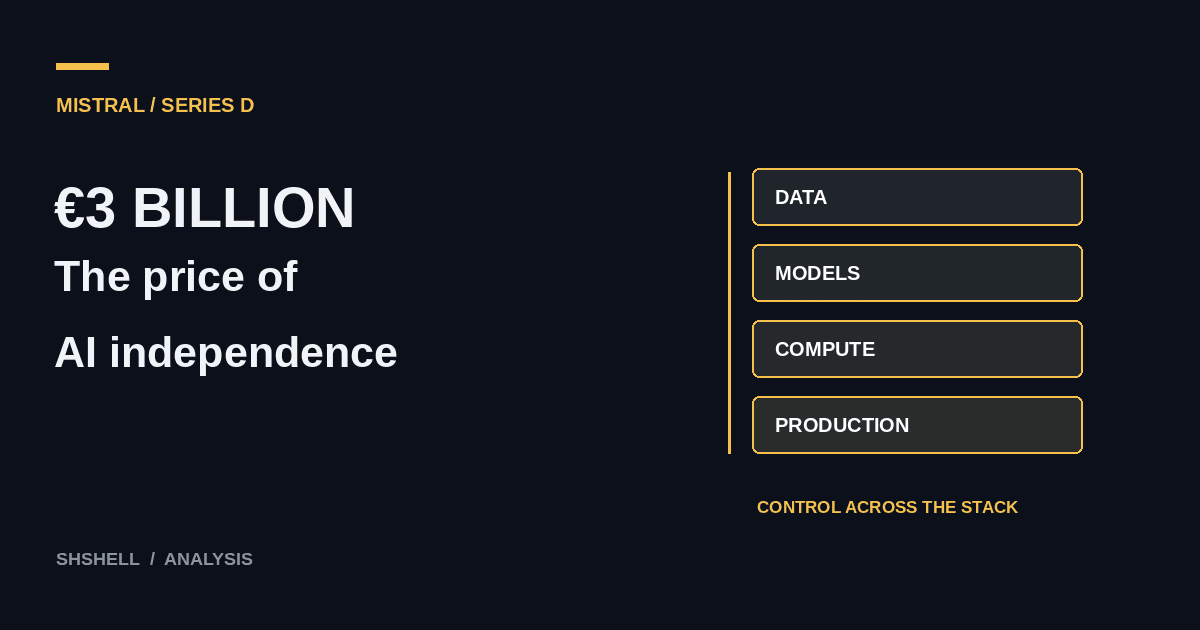
The most useful passage in the announcement is not its superlative about fundraising. It is the definition of the sovereign AI layer: data remains inside an organization’s boundaries, models are controllable and customizable, compute is private and predictable, and production systems are controllable and auditable. Those are Mistral’s stated dimensions, not a certification that every deployment automatically satisfies them. Each can be translated into evidence a buyer can request. Mistral on the sovereign AI layer
| Mistral’s stated dimension | Evidence a buyer should request |
|---|---|
| Data inside organizational boundaries | A data-flow map covering prompts, retrieval, logs, backups, and support access |
| Controllable, customizable models | Applicable licenses, version controls, adaptation rights, and a tested replacement process |
| Private, predictable compute | Documented hosting boundaries, capacity commitments, and recovery arrangements |
| Controllable, auditable production systems | Administrative controls, usable audit records, and an exportable operating history |
The distinction between a slogan and a specification appears immediately at the data layer. Keeping the main inference request local does not establish where search indexes, crash reports, evaluation datasets, or administrative logs go. A customer assessing Mistral’s claim should trace the whole path of sensitive information. Otherwise, an implementation could satisfy the most visible part of the promise while sending valuable context elsewhere through a supporting service. That is a design risk to investigate, not a reported defect in Mistral’s products.
Model control poses a different test. A customer needs to know what it may retain, modify, redeploy, and continue using if the commercial relationship changes. Technical possession of weights and legal permission to use them are separate questions. Mistral’s financing announcement commits to open-weight models at the strategy level, but it is not a substitute for the license and documentation of the particular model a customer selects. Procurement should attach those details to the actual deployment, rather than treating an umbrella commitment as a universal license.
Compute predictability also has more than one meaning. A private environment may offer an isolation boundary but still have limited capacity. A reserved service may offer capacity while restricting operational access. Buyers should define which property matters for each workflow. The same discipline applies to auditability: an attractive dashboard is not enough if records cannot reconstruct which model version, input documents, and permissions produced a consequential output.
The relationship among these dimensions can be represented without assuming a specific Mistral deployment architecture:
flowchart LR
    A[Mistral sovereignty proposition] --> B[Data boundaries]
    A --> C[Model control]
    A --> D[Private predictable compute]
    A --> E[Auditable production systems]
    B --> F[Customer acceptance evidence]
    C --> F
    D --> F
    E --> F
This is an analytical map of the announcement’s claims. Its point is that sovereignty depends on the combination. A downloadable model cannot compensate for an opaque production service, just as private compute cannot compensate for missing rights to continue using the software that runs on it.
Open weights create an exit option, not an effortless exit
Mistral says its full-stack, open approach prevents customers from becoming locked into a single vendor’s roadmap, pricing, or availability. It also describes itself as the only AI company building the stack necessary to deliver that outcome. Both are strong vendor claims. The financing announcement does not provide a comparative survey proving exclusivity, or a contractual guarantee that migration will be easy. The more useful interpretation is a proposed direction of travel: make important components controllable enough that customers have credible alternatives. Mistral’s openness and lock-in claims
Open weights can make that alternative more tangible. With appropriate permissions and an adequate technical environment, an organization may be able to retain a model version, adapt it, or serve it without depending on the original provider’s live inference endpoint. That changes negotiating leverage. A customer who can keep operating while evaluating another supplier has a different relationship from one whose application stops when an external endpoint becomes unavailable. The benefit is optionality, not automatic self-sufficiency.
The rest of the application can still be expensive to move. Retrieval indexes, tool integrations, evaluation suites, user permissions, and monitoring systems do not become portable merely because the central model is. Even prompts can encode assumptions about one model’s behavior. Replacing the model may preserve the application’s shape while changing its error patterns, refusal behavior, or ability to follow a complex procedure. Migration therefore includes proving that the replacement system remains acceptable, not just making it start.
There is also a boundary between access to a trained artifact and knowledge of how it was created. An open-weight commitment does not, on its own, supply the training corpus, the full training procedure, or evidence resolving every question about data provenance. Mistral’s announcement does not make those additional disclosures. A buyer that needs them must request the relevant documentation separately. Otherwise, the word open can absorb obligations that the supplier never actually accepted. That distinction is especially important when an organization wants explainable procurement evidence rather than simply the ability to run inference locally.
Customization adds another layer to that evidence. If an organization adapts a Mistral model using confidential material, it should decide how the resulting artifact is classified, who may copy it, and what happens to intermediate datasets. Keeping the original documents private is not enough if a derived artifact receives weaker handling. This is a hypothetical governance requirement, not a claim that Mistral leaks customer information. It follows from the company’s promise to make models controllable and customizable: the freedom to create a specialized model also creates a new asset the customer must govern.
That is why an exit plan should cover adapted models as well as the original download. The customer needs to know which artifacts it can take, which tools are necessary to use them, and which records establish their lineage. A migration right without a usable inventory can be difficult to exercise under pressure.
For a hypothetical enterprise using Mistral to answer questions from engineering manuals, an exit exercise would have several components. The team would export its documents and access rules, retain the model artifacts allowed by its license, rebuild retrieval in another approved environment, and compare answers against an established evaluation set. It would then test that restricted documents remain restricted. None of this requires predicting a supplier failure. It is a way to establish whether the claimed independence exists before it is needed.
That exercise would also reveal where paying Mistral remains rational. Customers may prefer a supported service even when they possess an alternative, because operating it themselves requires specialists, capacity planning, and incident response. There is no contradiction between paying for convenience and valuing an exit option. The contradiction appears only if the commercial product quietly removes the practical freedoms that made the open-weight proposition attractive in the first place.
Why full-stack control could strengthen Mistral and trouble its customers
Mistral’s announcement binds models, infrastructure, compute, and production products into one offering. The company argues that this combination lets organizations preserve valuable data, workflows, and institutional knowledge within their own boundaries. The strategic logic is coherent: many buyers cannot assemble those pieces safely or efficiently from separate vendors. A supplier capable of integrating them can sell an operating result rather than asking customers to become system integrators. Mistral’s full-stack rationale
Integration can remove genuine coordination costs. If a model update causes a production regression, customers need an accountable party rather than competing explanations from infrastructure, application, and model vendors. A full-stack provider can, in principle, investigate across those boundaries and coordinate a fix. It may also make customization more practical by connecting model adaptation to deployment and evaluation. These are reasons a buyer might select Mistral’s integrated approach even if it could purchase individual components elsewhere.
But integration also creates new places for dependency to accumulate. If the easiest way to customize a model is through a proprietary workflow, and the only convenient way to audit it is through a proprietary console, open weights become just one accessible component inside a less portable system. The financing announcement does not establish that this is happening at Mistral. It does make modularity an essential question, because the company is explicitly raising capital to expand across the stack.
A strong customer contract would distinguish what must remain connected from what can be substituted. Can a buyer use a different model while retaining the application layer? Can it move compute while preserving its evaluation history? Can it export adapted artifacts and supporting configuration in usable formats? Those are more informative questions than asking whether a supplier is simply open or closed. They test whether the boundaries between Mistral’s layers remain usable by the customer.
The commercial tension is real. Mistral needs enough differentiation to capture value from its investment, while customers want enough portability to avoid dependence. The sustainable compromise may be to charge for performance, support, and integration while preserving practical freedom at well-defined interfaces. That is an analytical possibility, not a disclosed business model. Whether Mistral chooses and delivers that balance will matter more to long-term sovereignty than the mere presence of downloadable weights.
A bank and an engineering organization would buy different kinds of control
Mistral names HSBC, Airbus, and ASML among the enterprises it supports, but the announcement does not describe their specific deployments. Their inclusion should not be used to invent customer case studies. Still, the sectors those companies represent help explain why Mistral emphasizes mission-critical use rather than consumer novelty: the value of an AI system can depend on keeping institutional knowledge useful without loosening its existing control boundaries. Mistral’s named enterprise references
Consider a hypothetical bank evaluating a Mistral-based assistant for internal policy questions. Its first acceptance test should not be how elegantly the model writes. It should be whether the assistant retrieves the policy applicable to the employee’s role and jurisdiction, distinguishes an old rule from its replacement, and declines to expose restricted material. Data residency would address one concern, but document permissions and version provenance would decide whether the answer could be used. A sovereign deployment that mishandles those details would be locally controlled and operationally wrong.
The bank might choose private deployment because it needs a particular data boundary, yet still buy extensive support from Mistral. It would need to specify how support personnel inspect failures without receiving prohibited information, how model changes are approved, and how audit records survive an upgrade. Those details would turn the four-dimensional sovereignty definition into an operating arrangement. The financing makes expansion of such arrangements more plausible; it does not prove the terms of any particular contract.
Now consider a hypothetical engineering organization adapting a model to interpret internal maintenance records. Its critical dependency might be the continued availability of a validated model version. A newer general-purpose model could be more capable overall while changing how it handles specialized abbreviations or incomplete service notes. Here, model control means retaining a known configuration and deciding when replacement is justified. Compute predictability means having enough capacity for the workflow at the required moment, not merely knowing the country where a server sits.
These examples point to different buying criteria under the same sovereign label. The bank emphasizes permission boundaries and evidence. The engineering team emphasizes stable behavior and continuity. Neither scenario is a reported Mistral customer deployment. They show why the company’s strategy needs a flexible product and service architecture: sovereignty cannot be delivered as one uniform setting when the asset being protected differs across organizations.
The bill for independence includes work that funding headlines omit
Mistral says the new capital will accelerate commercial growth and expand its international footprint alongside research and infrastructure. That combination acknowledges a difficult part of enterprise AI: the ability to build a model is not the same as the ability to deliver a repeatable deployment across organizations. Its stated presence in 20 countries and work with more than 125 enterprises indicate breadth, but the announcement does not quantify implementation effort, recurring revenue, or support intensity. Mistral’s expansion plans
For customers, comparing an integrated Mistral proposal with a managed external API requires accounting for different responsibilities. A private deployment may incur costs for capacity, security operations, upgrades, evaluation, and recovery that an API price obscures or bundles elsewhere. Conversely, a low usage price may omit the economic risk of changing terms, restricted access, or a difficult migration. There is no universal financial answer in the financing announcement. The correct comparison is between complete operating arrangements for the same workload.
Utilization is one source of divergence. A team with steady demand may value predictable dedicated capacity differently from a team whose workload is sporadic. The cost of maintaining an idle environment matters, but so does the ability to run when outside capacity is constrained. Mistral’s claim of private, predictable compute speaks to this trade-off. Buyers should ask how that predictability is delivered and priced, rather than assuming private hosting is intrinsically cheaper or a managed service intrinsically more reliable.
Human capability is another constraint. Open-weight access gives an organization options only if someone can evaluate and operate those options. That does not mean every customer needs to hire a frontier research team. It means the customer needs sufficient expertise to understand what it is buying, exercise its rights, and recognize when a migration has preserved behavior rather than merely moved files. Otherwise, practical control can remain with a service provider even when contractual rights look generous.
Mistral’s opportunity is to reduce that expertise burden without eliminating customer agency. If its products make private deployment, adaptation, and auditability easier, openness becomes usable by a wider group of organizations. If every deployment demands extensive bespoke work, expansion may be harder to make repeatable. The announcement leaves that economic question open. The next meaningful evidence will concern how reliably Mistral turns its stated architecture into a service customers can maintain and, when necessary, leave.
A valuation above €21 billion needs evidence at the boundaries
The Series D gives Mistral substantial backing for an unusually broad promise: competitive intelligence that organizations can use without surrendering control of the surrounding system. Its September announcement links frontier research to infrastructure and products, rather than presenting openness as a distribution policy alone. That is the strategic significance of the €3 billion raise. The money supports an attempt to make sovereignty part of the production stack, not just part of the model’s identity. Mistral’s financing thesis
The evidence to watch is correspondingly specific. Research progress should improve the capability customers can actually deploy. Infrastructure expansion should produce documented capacity and operating choices. Product development should make customization and auditability easier without trapping the resulting knowledge inside proprietary workflows. Commercial growth should show that these arrangements can be delivered repeatedly, not only through individually engineered engagements. None of those outcomes follows mechanically from a post-money valuation above €21 billion.
For a buyer considering Mistral now, the most revealing demonstration would not be a polished answer generated from public data. It would be a controlled exercise showing a sensitive workflow running inside the required boundaries, producing an intelligible audit trail, and surviving a change of model or infrastructure without losing its rules. That would test the actual proposition investors have funded.
Mistral does not need to eliminate every dependency to make this strategy valuable. It needs to make the important ones visible, governable, and replaceable. The distinction is the difference between buying another platform under a sovereign label and buying a credible measure of independence.