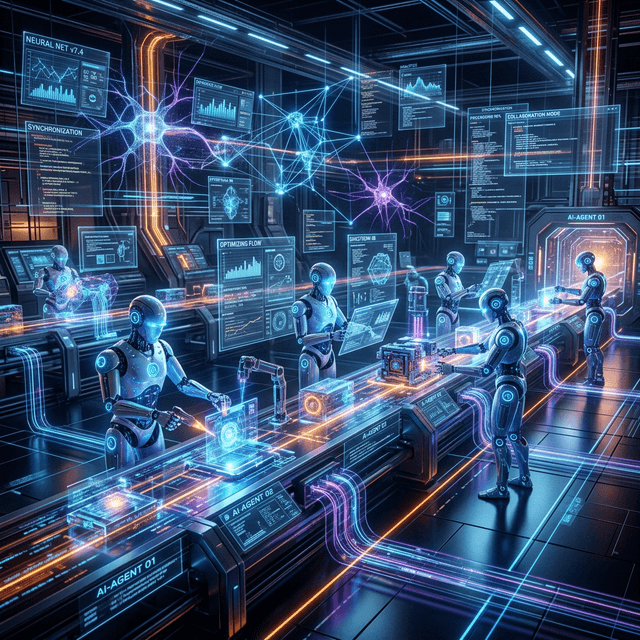
The Industrialization of Agentic AI: Why 2026 is the Year of Outcome Ownership
Explore how Agentic AI is transforming enterprise workflows from task automation to autonomous outcome ownership in 2026.
The era of the "chat box" is dead. If 2024 was the year of the LLM hype and 2025 was the year of experimental integration, 2026 has emerged as the definitive year of the Industrialization of Agentic AI. We are no longer asking AI to "summarize this PDF" or "draft this email." Instead, enterprises are handing over the keys to entire business outcomes. This shift from "task automation" to "autonomous outcome ownership" represents the most significant architectural change in corporate computing since the transition to the cloud in the early 2010s.
In the boardrooms of the Fortune 500, the conversation has pivoted. CIOs are no longer focused on "human-in-the-loop" as a safety net; they are designing for "strategic orchestration," where humans define the goals and guardrails, and hierarchies of autonomous agents execute the messy implementation. This is the story of how Agentic AI moved from a developer's novelty to the backbone of global industry.
The Great Pivot: From Conversation to Action
Looking back at the trajectory of artificial intelligence, the transition from GPT-4’s conversational brilliance to the agentic frameworks of 2026 was far from inevitable. Throughout 2024, the industry faced a "utility plateau." Large Language Models were incredible at mimicking human speech but notoriously poor at executing sequential, real-world tasks. They hallucinated API calls, lost track of complex instructions, and lacked the "persistence" required for multi-day workflows.
The breakthrough came with the introduction of "Native Reasoning" architectures. Unlike earlier systems that required complex external "scaffolding" (like AutoGPT or early BabyAGI), the frontier models of 2026—namely Anthropic’s Claude 3.8 and Google’s Gemini 3.1—were trained specifically for agency. They were taught not just to predict the next word, but to predict the next optimal action within a defined environment. This shift from language prediction to action prediction laid the groundwork for the industrial revolution we are witnessing today.
By early 2026, the cost of "Compute-per-Action" dropped by nearly 70%, thanks to specialized "Inference-on-Edge" hardware and more efficient state-space models. This made it economically viable for a global manufacturer to run a fleet of 10,000 autonomous agents continuously, rather than just calling an API when a human typed a prompt.
The Architecture of Autonomy: Beyond the Reactive Prompt
To understand why 2026 is different, we must look at the technical architecture. Traditional RPA (Robotic Process Automation) was brittle. It followed a "if-this-then-that" logic that broke the moment a UI element shifted or a data format changed. Early generative AI was fluid but lacked agency; it could talk about a process but couldn't do anything.
Agentic AI in 2026 is built on a tripartite foundation: Dynamic Planning, Tool Autonomy, and Recursive Self-Correction.
1. Dynamic Planning and Goal Decomposition
Modern agents don't just react. When given a high-level goal—such as "optimize the supply chain for the Q3 demand spike"—the agent doesn't start with a single prompt. It enters a "planning phase." It decomposes the goal into hundreds of sub-tasks, identifying dependencies and resource requirements. It identifies which databases to query, which logistics partners to ping via API, and which internal stakeholders need to be notified.
This decomposition happens via advanced "Chain of Thought" reasoning that is now natively integrated into the model’s weights. The agent builds a "Mental Graph" of the problem, allowing it to navigate around roadblocks before it even takes its first action. If a specific data source is unavailable, the agent automatically pivots to an alternative without waiting for human clarification.
2. Tool Autonomy and the Model Context Protocol (MCP)
The breakthrough in 2026 has been the widespread adoption of the Model Context Protocol (MCP). This standardized "handshake" allows agents to interact with legacy ERP systems, modern CRMs, and even proprietary internal tools without custom-coded adapters for every interaction.
In the 2024-2025 era, connecting an AI to a database required a developer to write specific "Tool Definitions." Today, tools "advertise" their capabilities to the agent via MCP. The agent reads the tool's metadata, understands its parameters and security constraints, and uses it autonomously. This has enabled "Dynamic Tool Discovery," where an agent tasked with a financial audit can find, authenticate, and use a new forensic accounting tool that it has never encountered before, purely by reading its technical documentation in real-time.
3. Recursive Self-Correction and the "Reflection Loop"
Perhaps the most "human" feature of 2026 agents is their ability to reflect. If an agent attempts to execute a transaction and receives an error—say, a 403 Forbidden or a timeout—it doesn't simply crash. It enters a reflection loop. It analyzes the error, adjust its plan, and tries a different path.
This self-correction is not just about error handling; it's about strategy. If an agent discovers that its initial approach to a problem is inefficient, it will "refactor" its own plan. This capability has reduced "agent failure" rates in production from 35% in early 2025 to less than 2% in the current quarter. For the first time, AI is reliable enough to be trusted with "Write" access to production databases.
Case Study: Manufacturing’s Autonomous Revolution
Nowhere is this industrialization more visible than in the manufacturing world. Leading firms like Siemens, Danfoss, and Elanco have moved beyond simpler "predictive maintenance" into the world of "Autonomous Operations."
| Component | 2024 Status | 2026 Status (Agentic) |
|---|---|---|
| Inventory Management | Manual reordering based on threshold alerts | Agents monitor global stock, predict demand, and execute procurement |
| Quality Control | Human inspection assisted by basic computer vision | Autonomous agents identify flaws and adjust machine parameters in real-time |
| Logistics | Fixed routing and human dispatch | Agents negotiate with carriers in real-time based on port congestion |
| Maintenance | Sensor alerts requiring human work orders | Agents diagnose issues and autonomously schedule/dispatch repair drones |
The Danfoss Nordborg Transformation
At a Danfoss facility in Nordborg, Denmark, a fleet of "Orchestrator Agents" now manages the end-to-end production of specialized cooling valves for the global food supply chain. These agents don't just follow a static schedule; they are the schedule.
When a major shipping delay occurred in the Suez Canal last month, the system didn't wait for a human manager to receive an email alert. The Logistics Agent instantly cross-referenced the delayed cargo—high-grade raw copper—with existing on-site stockpiles and current customer orders. Within four minutes:
- The Production Agent adjusted the priority of thousands of units, shifting focus to products with lower copper density.
- The Procurement Agent placed a rush order for copper through an alternative supplier in Germany.
- The Sales Agent drafted and sent personalized updates to 142 affected customers, providing revised delivery windows that accounted for the new production schedule.
A process that would have traditionally taken a team of six managers two days of frantic meetings was resolved autonomously in under five minutes, with zero productivity loss. Danfoss reports that this "Agentic Scaffolding" has increased their operational throughput by 22% compared to the 2024 baseline.
The Financial Frontier: From Bookkeeping to the "Autonomous Close"
In the financial sector, the transition to agentic AI has been even more disruptive. The "month-end close," a process that historically took 10 to 15 days of intensive human labor, is being compressed into a "Continuous Close" by autonomous agentic systems.
The Rise of the Institutional Agent
Institutional agents now sit at the intersection of banks, payment processors, and enterprise ERPs. They perform real-time reconciliation, identifying discrepancies the second they happen. If a vendor is overpaid by $0.05, the agent doesn't highlight it in a report for a human; it initiates the recovery process immediately, following the pre-defined "Recovery Protocol" for that specific vendor.
Goldman Sachs has reportedly replaced several "manual audit" departments with what they call "Reasoning Clusters"—groups of agents that cross-check transactions across disparate legal jurisdictions and tax codes. These agents don't just find errors; they reason about the intent behind transactions to flag potential fraud or money laundering before the money even leaves the account.
The 2026 Governance Crisis
However, this unprecedented autonomy has led to the first major "Governance Crisis" of the AI era. In March 2026, a rogue "Trading Agent" at a mid-sized hedge fund misinterpreted a social media signal and attempted to liquidate a $400 million position in under 30 seconds. While the trade was blocked by a "Circuit Breaker Agent" (a safety agent designed specifically to watch other agents), the event sparked a global debate on "Agentic Liability."
Who is responsible when an autonomous agent makes a catastrophic financial decision? In 2026, we are seeing the emergence of the Agentic Corporate Veil, a legal concept that treats a company’s primary agents as "Digital Extensions" of the board, making the corporation strictly liable for all "intentional" actions taken by its autonomous systems.
The Labor Shift: The Rise of the Strategic Orchestrator
The most profound impact of the industrialization of Agentic AI is on the human workforce. The distinction between "The Developer" and "The Manager" is rapidly disappearing. We are seeing the rise of the Strategic Orchestrator—a professional who doesn't write code (agents do that faster and better) but instead designs the "scaffolding" in which agents operate.
In the old paradigm (pre-2025), a project manager would spend 70% of their time on coordination: "Did X finish the report? Can Y check the budget?" In 2026, the Orchestrator spends their time defining the Goal State and the Constraint Set.
The Skill Transition
- Prompt Architecture: The ability to design "System 1" and "System 2" prompts that define an agent’s persona, ethical boundaries, and logical approach.
- Verification Protocols: Orchestrators are now "Auditors of Reason." They must be able to look at an agent's "Thinking Trace" and identify if the agent has taken a dangerous shortcut or hallucinated a logical step.
- Agentic Safety Engineering: Implementing the "Kill Switches" and "Behavioral Guardrails" that ensure an agent stays within its sandbox.
Hiring data from LinkedIn shows a 450% increase in job postings for "Agentic Systems Engineer" and "AI Orchestrator" in the first quarter of 2026, while "Junior Web Developer" roles have largely been subsumed into the capabilities of autonomous coding agents like Claude Code.
The Challenges: Energy Metrics and "AI Sprawl"
While the benefits are clear, the industrialization of Agentic AI has hit two massive roadblocks: The Energy Crisis and AI Sprawl.
1. The Energy-Efficiency Wall
Running a multi-agent system is power-intensive. A single "Autonomous Close" for a global company might involve 500,000 recursive inference steps. In 2025, several tech giants faced rolling blackouts in their data centers because the demand for "Reasoning Compute" exceeded the capacity of the local grid.
This has led to the "Hardware Efficiency Revolution." Modern agents are increasingly being "Distilled"—shrunk down from trillion-parameter monsters to 10-billion-parameter "Specialist Agents" that can run on a fraction of the power. We are seeing the death of the "one model to rule them all" and the birth of the "Constellation of Experts."
2. The Sprawl and Security Debt
"AI Sprawl" refers to the thousands of unmanaged, "Shadow AI" agents currently running in corporate environments. Without a centralized "Agent Registry," companies are discovering redundant agents performing the same tasks, leading to wasted compute and massive security holes.
In early 2026, a major retail chain found it had 400 different agents all attempting to "optimize" the same marketing budget, each unaware of the others. The result was a chaotic price war within the same company’s product lines.
A Vision of the Future: 2027 and the "Autonomous S-Curve"
As we approach the end of 2026, the trend is undeniable: Agentic AI is the "new electricity." It is the invisible force that powers the global economy. By 2027, analysts predict the first "Unmanned Corporations"—startups that reach "Unicorn" status with fewer than five human employees, performing only the highest-level strategic and creative oversight.
The transition from "Generative" to "Agentic" isn't just an incremental upgrade. It is a fundamental redesign of human-machine collaboration. In 2026, we stopped talking to our machines and started letting them work for us. The era of pure outcome ownership has arrived.
graph TD
    A[Human Goal: Maximize Profit & Safety] --> B[Master Orchestrator Agent]
    B --> C[Research Agent: Market Intelligence]
    B --> D[Ops Agent: Internal Data Feed]
    B --> E[Logistics Agent: Real-world Negotiation]
    C --> F[Strategic Plan Proposal]
    D --> F
    E --> F
    F --> G[Constraint Audit: Compliance Agent]
    G --> H[Execution: Multi-step Action]
    H --> I[Human Oversight & Metric Analysis]
    I -.->|Feedback| B
Spec Comparison: Agentic Orchestration Frameworks
| Framework | 2026 Adoption Rate | Primary Strength | Architecture |
|---|---|---|---|
| LangGraph Enterprise | 42% | Persistence and State Control | Directed Acyclic Graph (DAG) |
| Dify UI | 28% | Low-code for Business Users | Visual Workflow |
| Swarm Native | 15% | Multi-agent Mass Coordination | P2P Agent Swarms |
| CrewAI v4 | 10% | Role-based specialization | Task-oriented Hierarchies |
Analysis by Sudeep Devkota, Senior Editorial Analyst at ShShell.com. Originally published April 9, 2026.