The Silicon Sovereignty War: Tesla’s $2B Mystery Play and the Cambridge Neuromorphic Breakthrough
Tesla has silently made a $2B hardware acquisition, while Cambridge researchers have unveiled a neuromorphic chip that could end NVIDIA’s GPU monopoly.
The world’s attention in April 2026 has been fixed on the software giants—the GPT-5.5s and the Claude Mythos of the world. But in the deep-tech corridors of Austin, Texas, and Cambridge, UK, a more fundamental revolution is taking place. This revolution isn't about code; it’s about the silicon that runs it.
Within the last 48 hours, two major hardware shifts have signaled the end of the "GPU Era." First, Tesla disclosed a staggering $2 billion mystery acquisition of an unnamed AI hardware company. Second, researchers at the University of Cambridge unveiled a Neuromorphic Memristor breakthrough that could slash AI energy consumption by 70%, effectively making existing GPU clusters look like steam engines.
Tesla's $2B "Silence": The Optimus Connection?
The disclosure of Tesla’s $2 billion agreement was buried deep in a 10-Q filing. No press release, no announcement on X, and no mention during the earnings call. This level of institutional silence usually points to a strategic "moat building" exercise that Tesla isn't ready for competitors to see.
While the target company remains unknown, industry analysts point to three likely possibilities:
- A Terafab Silicon Partner: Tesla is moving to bring the entire FSD (Full Self-Driving) and Dojo chip manufacturing process in-house, bypassing TSMC.
- Edge-AI Packaging Specialist: Essential for the massive rollout of Optimus Gen-III humanoid robots, which require high-density, low-power inference chips that can think in the "wild" without a persistent cloud connection.
- Optical Computing (Photonics): If Tesla has acquired a leader in silicon photonics, it could reduce the latency between Dojo compute nodes by 100x, creating a supercomputer that operates at the speed of light.
The Capex Wave
Tesla’s capital expenditure guidance for 2026 has already crossed $25 billion. This isn't just for cars; it's for the infrastructure of the "Physical AI" world. If this $2B acquisition is indeed related to in-house chip design for Optimus, it marks the point where Tesla becomes a semiconductor company that happens to make robots and cars.
The Cambridge Breakthrough: The Brain-on-a-Chip
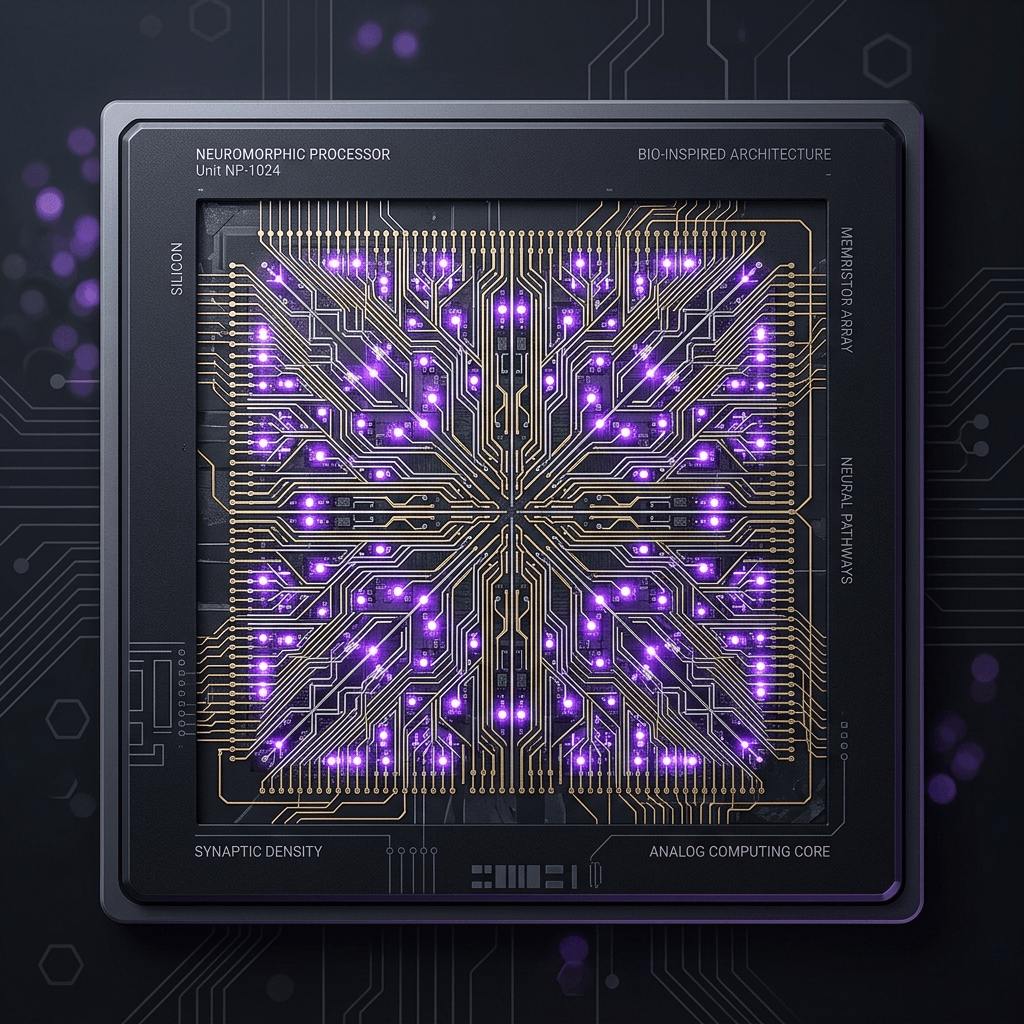
While Tesla focuses on scaling existing silicon, the University of Cambridge has just rewritten the physics of computation. Led by Dr. Babak Bakhit, the team has successfully engineered a stable Hafnium Oxide Memristor using a p-n junction interface.
Why Memristors Matter
Traditional computers (Von Neumann architecture) are hampered by the "Memory Wall"—the constant, energy-sucking movement of data between the processor and the RAM. Memristors solve this by being the memory and the processor at the same time.
They mimic the human brain’s synapses:
- Stable Multi-States: Unlike a binary transistor (0 or 1), the Cambridge memristor can hold hundreds of stable conductance states.
- Low Power: It operates at currents millions of times lower than conventional chips.
- Neuromorphic Learning: It "learns" through spike-timing dependent plasticity, meaning it becomes more efficient at a task the more it performs it—just like a biological brain.
The End of the GPU Monopoly
For the last three years, the AI industry has been held hostage by NVIDIA’s GPU supply and pricing. However, the Cambridge breakthrough and the move toward custom silicon (ASICs) by Tesla, Google, and Amazon signal that we have reached "Peak GPU."
The future logic suggests that general-purpose GPUs are too wasteful for the specialized, agentic workloads of 2026. We need Neuromorphic Edge Units (NEUs) that can run a model like Claude Mythos on a battery the size of a wristwatch.
Comparison: Traditional CMOS vs. Cambridge Neuromorphic
| Metric | Traditional H100/Rubin (CMOS) | Cambridge Memristor (Neuromorphic) |
|---|---|---|
| Primary Limitation | The Memory Wall (Power Leakage) | Material Scalability (Currently addressing) |
| Energy Efficiency | Base (1x) | 70x - 100x Improvement |
| Architecture | Von Neumann (Separate CPU/RAM) | Synaptic (In-Memory Compute) |
| Task Specialty | Brute-Force Floating Point | Pattern Recognition / Agentic Reasoning |
| Sustainability | High Carbon Footprint | Green Silicon Era |
Geopolitics: "The Silicon Sovereignty"
In 2026, chips are the new oil. Sovereignty is no longer measured in land, but in "Compute Seconds." Tesla’s acquisition and the UK’s support of the Cambridge project are part of a broader "Reshoring" movement.
The US and UK are desperately trying to build a hardware stack that does not rely on the fragile geopolitical stability of the South China Sea. By moving from general-purpose silicon to specialized "Agentic Hardware," these nations are trying to leapfrog the existing manufacturing monopolies.
Market Analysis: The Hardware Renaissance
The "Smart Money" is shifting. In 2024, the investment was all about LLM applications. In 2026, the focus has returned to the "Metal."
Venture capital funding for semiconductor startups has increased by 400% YOY. We are seeing a renaissance in material science—doping hafnium oxide with strontium and titanium to create the "Brain-Chips" of the next decade. These are the components that will allow AI to live in the physical world, powering everything from surgical swarms to self-correcting power grids.
Mermaid: The Neuromorphic Logic Flow
graph LR
    subgraph "Traditional Computing"
    A[Central Processor] <-->|Energy Loss| B[Memory Bank]
    end
    subgraph "Cambridge Neuromorphic"
    C[Hafnium Oxide Synapse]
    C -->|Store + Compute| C
    C -->|In-Place Logic| D[Low-Power Result]
    end
    subgraph "Tesla's Dojo/Optimus Hub"
    E[Custom Silicon] --> F[Robot Sensory Fusion]
    F --> G[Real-Time Decision]
    G --> E
    end
The Human Impact: The Edge-AI Revolution
What does 70% less power consumption mean for you?
- Augmented Reality: Glasses that can run a 2B parameter real-time translation agent for 18 hours on a single charge.
- Autonomous Survival: Humanitarian drones that can navigate disaster zones for days without needing a recharge.
- Privacy: If you can run a frontier-level model on a local neuromorphic chip, you never have to send your personal data to the cloud again. Local Privacy is the ultimate hardware outcome.
Conclusion: Beyond the Transistor
The $2B check signed by Tesla and the breakthroughs in the Cambridge labs tell a single story: the age of the transistor is drawing to a close. We are building the foundations for a "Biomorphic Computing" era, where the line between natural and artificial intelligence becomes a matter of substrate, not architecture.
By the end of 2026, we will look back at the era of the giant GPU-powered data center as a quaint, inefficient stepping stone. The future of AI is fast, it is local, and it is incredibly efficient.
The Silicon War is over. The Sovereignty War has begun.