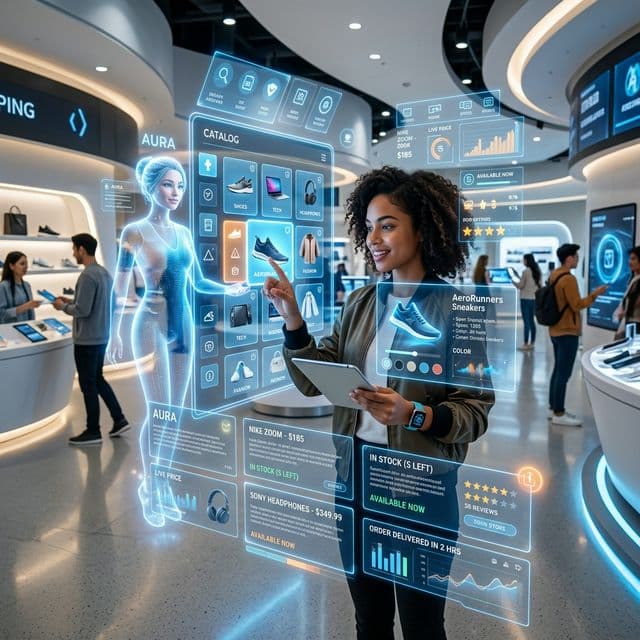
Agentic Commerce: How Google’s UCP Update is Turning AI into Your Personal Shopper
Google's Universal Commerce Protocol (UCP) just received a massive update, granting AI agents the ability to autonomously handle multi-store carts, real-time inventory, and loyalty linking.
Agentic Commerce: How Google’s UCP Update is Turning AI into Your Personal Shopper
The goal of "zero-click shopping" just took a massive leap forward. On March 19, 2026, Google announced a transformative update to its Universal Commerce Protocol (UCP). While UCP has existed as a standard for structured product data for years, this update—version 4.5—is specifically engineered for the Agentic Era.
AI agents, such as Gemini, Claude, and specialized shoppable bots, now have a "certified bridge" to interact directly with retailer backend systems. No longer restricted to just "searching" for products, these agents can now see real-time inventory, manage complex carts, and apply personal loyalty points across thousands of retailers simultaneously.
The Technical Breakthrough: UCP 4.5 and the Agentic Hook
At its core, the update introduces the "Agentic Transaction Layer". This is a new set of API hooks that allow an AI agent to perform stateful actions on a retailer's website without needing a browser-based UI.
Key New Capabilities:
- Multi-Item Cart Persistence: Agents can now save multiple items to a "Unified Cart" from different stores. If you ask your agent to "Find me a perfect outfit for a beach wedding under $500," it can pick shoes from Nordstorm, a linen shirt from J.Crew, and sunglasses from Warby Parker—managing all three carts in the background.
- Real-time Inventory Pings: Using the new
LIVE_CHECKhook, agents can verify if an item is truly in stock at a specific local store before suggesting it, eliminating the "out of stock" frustration at the final checkout step. - Identity Linking & Loyalty Integration: This is perhaps the most significant change. Google Pay now supports Secure Identity Handshakes. An agent can prove to a retailer that it is "acting on behalf of Sudeep Devkota," allowing the retailer to instantly apply member discounts, free shipping for loyalty tiers, and past order preferences.
The Agentic Shopping Flow (2026)
sequenceDiagram
    participant User
    participant Agent as Gemini Agent
    participant UCP as Universal Commerce Protocol
    participant Store as Retailer API (UCP 4.5)

    User->>Agent: "Find a mountain bike under 15kg in stock near me."
    Agent->>UCP: Query: Specifications + Geo-Location
    UCP->>Store: LIVE_CHECK Request
    Store-->>UCP: Inventory: 2 in stock, Price: $1299
    UCP-->>Agent: Validated Result
    Agent-->>User: "Found it at BikeCentral (2 miles away). Use your 10% member discount?"
    User->>Agent: "Yes, buy it using Google Pay."
    Agent->>Store: AUTHORIZED_TRANSACTION (via Google Pay)
    Store-->>Agent: Receipt & Pickup QR Code
    Agent-->>User: "Done! Your QR code is in your wallet. Ready for pickup."
Why This Matters for Retailers: The "Feed Wars" of 2026
For retailers, the game has changed from "SEO" (Search Engine Optimization) to "AEO" (Agent Engine Optimization). In the past, you wanted your website to rank #1 on Google. Today, you want your product to be the #1 recommendation inside the Gemini interface.
The AEO Checklist:
- Semantic Metadata: Retailers must provide high-density semantic tags. An agent doesn't just need "Size: Large"; it needs "Fit: True to size, slightly tapered, based on 500 returns."
- API Latency: Since agents are now making real-time pings, a slow API response (over 200ms) will lead to an agent "timing out" your product and moving to a competitor with a faster feed.
- Trust Badges (Agentic Proof): Retailers must maintain a "Agent Trust Score." If your UCP feed says "In Stock" but the agent finds it's actually "Out of Stock" 5% of the time, the agent will deprioritize your store.
The Consumer Experience: From Searching to Decisions
The updated UCP turns the AI agent into a sophisticated broker. Instead of scrolling through endless lists of "sponsored" results, the user simply states a goal.
Case Study: The "Home Renovation" Agent Imagine you are renovating a kitchen. In 2024, you would spend hours on Home Depot, Lowe's, and Amazon comparing faucets. In late 2026, you tell your agent: "I need a brushed gold kitchen faucet that matches SKU #1234 on my Pinterest board. Ensure it has a high review-to-return ratio and can be delivered by Friday."
The agent uses UCP's vision capabilities to match the SKU's aesthetic, checks the return data (now part of the UCP anonymized trust feed), and executes the purchase. This reduces a 3-hour task to a 3-second conversation.
Impact on Market Metrics
| Metric | Pre-UCP (2024) | Post-UCP Update (2026) | Trend |
|---|---|---|---|
| Search-to-Purchase Time | 42 Minutes | 4.5 Minutes | 89% Faster |
| Cart Abandonment | 70% | 12% (Agent managed) | Massive Conversion |
| Average Store Discovery | 2.1 Stores | 8.5 Stores (via Agent) | More Local Discovery |
| Return Rate | 22% | 8% (Better spec-matching) | Cost Reduction |
Security and Privacy: The "Agentic Shield"
Google has anticipated the privacy concerns of "letting agents shop." The UCP update includes the Agentic Data Perimeter.
- One-Time Virtual Credit Cards: Google Pay generates a unique virtual card for every agent transaction, ensuring the retailer never sees your actual banking details.
- Privacy Handshakes: The agent only shares the minimum required information. If a retailer doesn't need your birthday to ship a shirt, the agent won't provide it.
- Audit Logs: Every "decision" the agent makes (why it picked Store A over Store B) is logged in a transparent "Decision Journal" for the user to review.
Frequently Asked Questions (FAQ)
Does this mean retailers are losing control of their customers?
Actually, the opposite. By allowing Identity Linking, retailers can maintain their direct relationship and loyalty data. The agent is simply a high-efficiency delivery mechanism for the retailer's existing value proposition.
Can my agent find the best coupons?
Yes. UCP 4.5 includes a COUPON_SCAN hook. The agent will automatically query the retailer for public and account-specific coupons before finalizing the price.
Is UCP an open standard?
Google manages the primary protocol, but it is developed in collaboration with the Agentic Commerce Alliance, which includes players like Salesforce, Stripe, and Shopify to ensure broad interoperability.
Conclusion: The Death of the Browse-and-Click Model
The update to the Universal Commerce Protocol on March 19, 2026, marks the end of "browsing" as the primary mode of online consumption. We are entering the era of Goal-Oriented Commerce, where the AI understands not just what we want, but the context of why we want it. For retailers, the path forward is clear: optimize your data feeds, open your APIs, and prepare for the agents.
This report was prepared by Sudeep Devkota for the Daily AI News initiative. Data sourced from Google’s Commerce Blog and the March 2026 Retail Innovation Summit.