Personal Intelligence: Google's Gemini Now Knows Your Life Better Than You
Google's launch of 'Personal Intelligence' marks a shift from general chatbots to deeply personalized AI that understands your Gmail, Photos, and YouTube history.
Personal Intelligence: Google's Gemini and the End of Generic AI
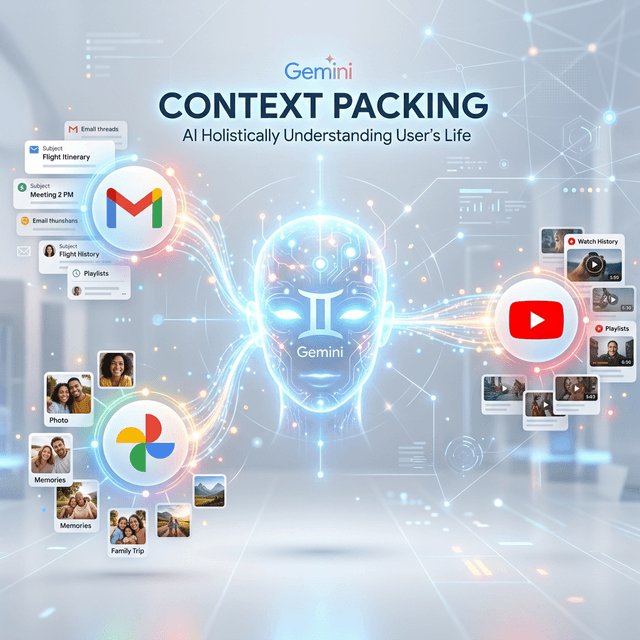
In March 2026, the concept of a "generic" AI response is becoming a relic of the past. Google has officially moved its Personal Intelligence feature into wide-scale beta, allowing the Gemini engine to weave together a holistic understanding of your life by connecting the dots between your Gmail, Google Photos, and YouTube history.
No longer does a user need to copy-paste a flight itinerary into a chat; Gemini already knows you’re landing in Tokyo on Tuesday, and it’s already drafted a list of gluten-free ramen shops within walking distance of your specific hotel.
Context Packing: The Tech Behind the Personalization
The magic of Personal Intelligence lies in a new architectural method Google calls Context Packing. Traditionally, AI models had to "query" your email or photos to find an answer. Context Packing allows Google to compress your significant life events into a dense, perpetually active context layer for the model.
Cross-App Synergy in Action:
- Gmail + Calendar: Analyzing restaurant reservations in your inbox to suggest optimal travel times based on historical Google Maps traffic data.
- Photos + Search: Pulling pictures of your specific car model from your photo library to answer maintenance questions or find compatible tires on Google Search.
- YouTube + Keep: Cross-referencing your "Watch Later" list with your shopping notes to suggest products you’ve researched but haven't bought yet.
The Privacy Trade-Off: Data Bleed Concerns
With great personalization comes significant privacy anxiety. Google has implemented an Opt-In Only architecture, but critics point to the risk of "Data Bleed."
Data Bleed occurs when information from one context (e.g., a professional email) is accidentally synthesized into another (e.g., a creative writing prompt). To combat this, Google 3.1 Pro includes:
- Context Siloing: The ability to manually exclude specific labels (like "Work" or "Private") from the Personal Intelligence engine.
- Temporary Conversations: A "ghost mode" where personalization is completely disabled for a single session.
- Local Scrubbing: While the reasoning happens in the cloud, specific PII (Personally Identifiable Information) is scrubbed locally before the "Packed Context" is uploaded.
graph LR
    Gmail[Gmail Data] --> CP[Context Packing Core]
    Photos[Photo Metadata] --> CP
    YouTube[Watch History] --> CP

    CP --> Siloing[Privacy Silo Filter]
    Siloing --> Gemini[Gemini 3.1 Pro Engine]

    User[User Prompt] --> Gemini
    Gemini --> Result[Personalized Response]

    subgraph Google_Privacy_Safe
        CP
        Siloing
    end
The Business Reality: AI Pro and Ultra
Currently, Personal Intelligence is a tiered feature. While basic summarization is available to all, the full cross-app "Personal Assistant" experience is reserved for Google One AI Pro and Ultra subscribers. This signals Google's intent to move AI from a free search utility to a premium "Operating System for Life."
Conclusion: Toward a Proactive Assistant
Google Personal Intelligence represents the shift from Reactive AI (answering questions) to Proactive AI (anticipating needs). As Gemini becomes more integrated into our digital footprint, the barrier between our data and our tools is vanishing.
The future of search isn't a text box; it's a teammate that has already done the research before you even realized you needed the answer.
Follow the ShShell AI Audit series for weekly reviews of the latest Google and Microsoft AI updates.