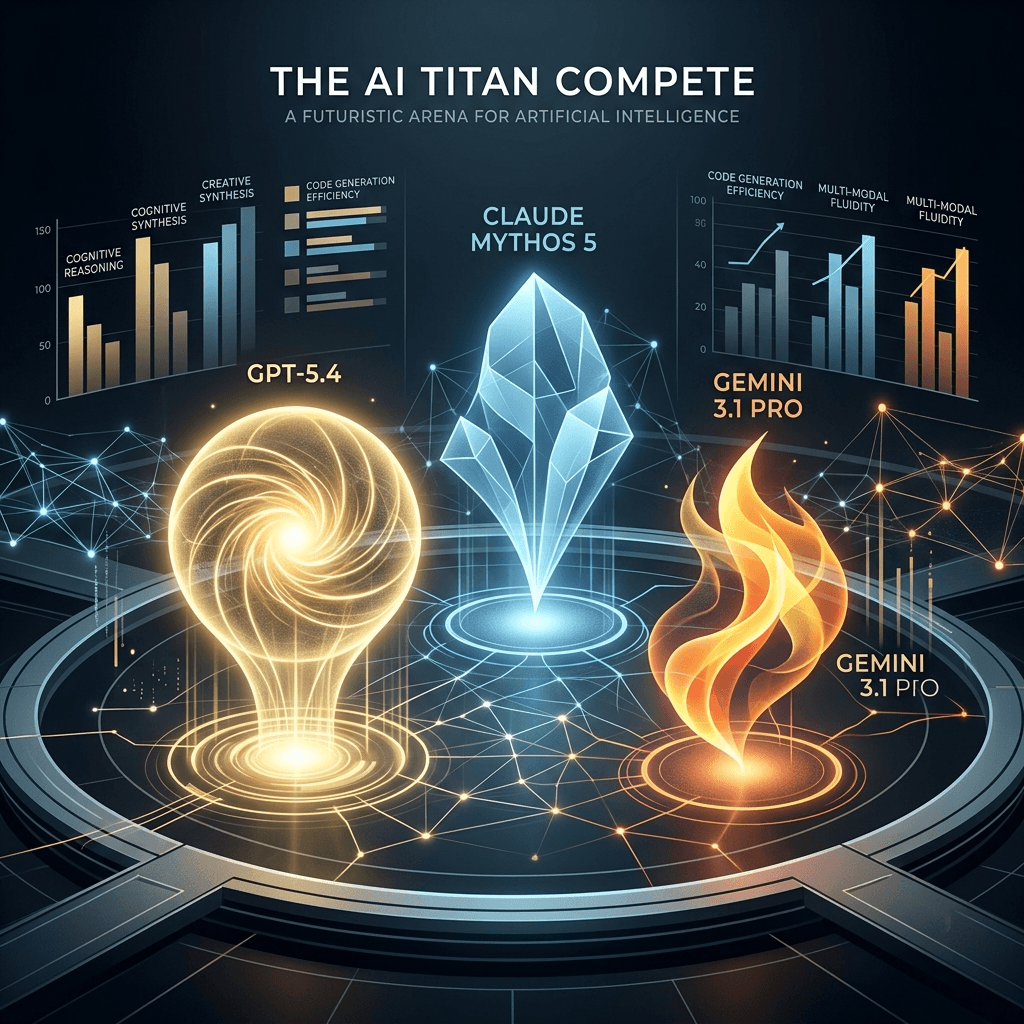
Beyond Human Expert: Benchmarking the Frontier Model War of April 2026
With the release of GPT-5.4, Claude Mythos 5, and Gemini 3.1 Pro, the artificial intelligence industry has officially crossed the threshold of human-expert parity across all major professional domains.
The landscape of artificial intelligence in April 2026 is no longer a race for "better chat." It is a full-scale industrial war for cognitive dominance. Within the span of 45 days, the three major AI labs—OpenAI, Anthropic, and Google DeepMind—have released their most potent models to date: GPT-5.4, Claude Mythos 5, and Gemini 3.1 Pro.
To call these systems "language models" is now an anachronism. They are natively multimodal, agentic reasoning engines that have collectively surpassed the "Human Expert" baseline on over 90% of standardized professional benchmarks. We are no longer asking if AI can pass the Bar Exam; we are asking if an AI can autonomously manage a complex multi-jurisdictional legal firm.
The Ancestry of Giants: From o1 to GPT-5.4
To understand the magnitude of today's models, we must trace their lineage back to the "Great Inference Shift" of late 2024. Before that period, LLMs were largely "reactionary" systems. You gave them a prompt, and they started spitting out tokens immediately. This was the "Thinking Fast" era of AI.
The paradigm changed with the introduction of OpenAI's o1 series (codenamed "Strawberry"). It was the first mainstream model to utilize "Inference-Time Compute," allowing the model to "speak to itself" in a hidden chain of thought before providing a final answer. This was the transition from "System 1" (instinctive) to "System 2" (deliberative) intelligence.
Throughout 2025, this technique was refined. Models like o3 demonstrated that you could scale intelligence not just by adding more data or more parameters, but by giving the model more time to think. GPT-5.4 represents the ultimate expression of this scaling law. It no longer needs to be told to "think step by step." The model dynamically determines the complexity of a query and allocates the appropriate amount of internal "reasoning tokens" to verify its own logic before the USER sees a single word.
The Benchmark Breakdown: Measuring the Expert
In 2026, the benchmarks of 2023 (like MMLU or GSM8K) have been retired. They are simply too easy; every frontier model scores near-perfect on them. To differentiate the giants, we now use "Adversarial Stress Benchmarks."
1. OSWorld: The Computer-Use Frontier
OSWorld tests a model's ability to operate a full desktop environment—Linux, Windows, or MacOS. It isn't just about clicking buttons. The model must interpret visual UI changes, handle lag, manage file systems, and recover from software errors. GPT-5.4's 75% score is historic. It means the model can perform "General Virtual Assistance" with a lower error rate than a typical human administrative assistant.
2. Cybench: The Autonomous Security Test
Cybench is a "Capture the Flag" (CTF) style environment for AI. It contains real-world vulnerabilities ranging from simple SQL injections to complex, multi-stage memory corruption exploits. Claude Mythos 5's 100% score has sent shockwaves through the cybersecurity community. It suggests that Anthropic has succeeded in creating a "God-Eye" view of code, where vulnerabilities are apparent not through trial and error, but through direct mathematical intuition of the code's execution paths.
3. GPQA Diamond: The PhD Firewall
The "Graduate-level Google-Proof Q&A" (GPQA) is designed to be solvable only by PhD-level experts in biology, physics, and chemistry, even when those experts have full access to the internet. Gemini 3.1 Pro's lead here (94.3%) highlights DeepMind's superior "Scientific Reasoner." The model doesn't just look up facts; it synthesizes knowledge across disciplines to solve novel problems that haven't been published in its training data.
4. ARC-AGI-2: The Abstract Reasoner
Created by Francois Chollet, the Abstraction and Reasoning Corpus (ARC) is intended to measure "Fluid Intelligence"—the ability to solve a puzzle you've never seen before with zero prior training on that specific task. While humans still lead here (with scores in the 85-90% range), the jump to 77.1% by Gemini 3.1 Pro represents the most significant closing of the "human-unique" reasoning gap in history.
Nodal Reasoning: How Gemini 3.1 Pro Thinks
Google's DeepMind team has introduced "Nodal Reasoning" in the 3.1 Pro architecture. Traditional models process information linearly (token by token). Gemini 3.1 Pro, when set to "High Thinking" mode, treats the query as a root node and generates a "Reasoning Forest."
It explores multiple conflicting hypotheses in parallel. For example, if asked to diagnose a complex software bug, Nodal Reasoning might simultaneously explore:
- Node A: A race condition in the async handler.
- Node B: A memory leak in a third-party dependency.
- Node C: A kernel-level configuration error.
The model evaluates the "Plausibility Score" of each node by running internal simulations (using its code-executor tool). Only after its internal "Critic Nodes" have pruned the incorrect paths does the model present the final solution. This "AlphaProof" style architecture is why Gemini leads in abstract reasoning and PhD-level science.
The Hardware-Software Symbiosis: The B200 Influence
You cannot separate the performance of GPT-5.4 or Gemini 3.1 Pro from the silicon they run on. The 2026 frontier models were "Co-designed" with NVIDIA's Blackwell (B200) architecture.
The B200's "Second-Generation Transformer Engine" introduced a specialized FP4 (4-bit floating point) format that GPT-5.4 uses for its high-speed inference layer. This allows the model to maintain 98% of its 16-bit accuracy while running at 5x the speed. This hardware acceleration is what makes "Real-Time Agentic Reasoning" possible. In 2024, a complex thought might take 30 seconds to generate; in 2026, it happens faster than a human can read the output.
| Year | Primary Hardware | Inference Style | Latency (Complex Task) |
|---|---|---|---|
| 2023 | H100 (FP8) | Linear Token Gen | 15-30 Seconds |
| 2024 | H100 (FP8) | ReAct / Looping | 60+ Seconds |
| 2025 | H200 (FP6) | Inference-Time CoT | 10-20 Seconds |
| 2026 | B200 (FP4) | Nodal / PEC | 1-3 Seconds |
OpenAI GPT-5.4: The Universal Reasoning Engine
OpenAI's latest flagship, GPT-5.4, represents the culmination of their "System 2" reasoning research. Unlike its predecessors, which were largely "next-token predictors" with high-quality RLHF, GPT-5.4 is built on a "Universal Code-Reasoning" core.
Unified Architecture
The most significant shift in GPT-5.4 is the merging of reasoning, coding, and computer-use capabilities into a single, unified weights file. In 2024, these were often separate modular experts. In 2026, OpenAI has achieved what they call "Convergent Intelligence," where the model's ability to reason through a physics problem directly informs its ability to write the Python code to simulate it, which in turn informs how it interprets the UI of the simulation software.
OSWorld Dominance
The 75% score on OSWorld is the headline achievement here. For the first time, a model has surpassed the human expert baseline (72.4%) for navigating a computer. This means GPT-5.4 can handle complex, multi-application tasks—like "Find the receipt for my last Amazon order in my email, download the PDF, upload it to my expense tracker, and flag it if the tax doesn't match my state's rate"—with higher reliability than a trained human assistant.
Anthropic Claude Mythos 5: The "Black Box" Specialist
If OpenAI is building a universal worker, Anthropic is building an elite specialist. Claude Mythos 5 (currently in research preview for vetted partners) is designed for "High-Stakes Autonomy."
Cybersecurity and the Cybench 100%
The most shocking statistic of early 2026 is Anthropic's 100% score on the Cybench benchmark. Claude Mythos 5 was able to autonomously identify and exploit every vulnerability in the test set, including several that were intended to be "unsolvable" by current AI. This has led to intense regulatory debate about the release of such "dual-use" technologies. Anthropic defends the model by highlighting its use in "Autonomous Defense"—a sister agent designed to hunt threats and engineer patches at machine speed.
Math Excellence: USAMO 2026
On the US Mathematical Olympiad (USAMO) 2026, Mythos 5 scored a 97.6%. This is not just about calculating; it is about proving. The model utilizes a new "Deep Verification" layer where it generates thousands of intermediate proof steps and utilizes a formal verification engine (like Lean 5) to check its own work in real-time.
Google DeepMind Gemini 3.1 Pro: The Multimodal Architect
Google's strategy with Gemini 3.1 Pro focuses on "Nodal Reasoning" and "Native Multimodality." While GPT and Claude were born as text models that learned to see, Gemini was born as a multimodal native.
Three-Tier Reasoning Architecture
The most unique feature of Gemini 3.1 Pro is its thinkingLevel parameter. Developers can now explicitly control the model's "Compute Budget" per query:
- Low Mode (Immediate): Fast, reactive token generation for simple chat.
- Medium Mode (Guided): Utilizes a brief "Chain of Thought" internally before responding.
- High Mode (Deep): The model allocates significant compute to explore thousands of potential reasoning paths (AlphaProof-style tree search) before delivering an answer.
GPQA Diamond and Abstract Reasoning
Gemini 3.1 Pro currently leads the pack on GPQA Diamond (94.3%) and ARC-AGI-2 (77.1%). Its success in these areas is attributed to its "Cross-Domain Intuition." Because the model was trained on massive datasets of video (physics in motion), audio (tonal nuances), and code (logical structure) simultaneously, it can solve abstract reasoning puzzles that stump models trained primarily on text.
The Technical Deep Dive: Native vs. Pipeline Multimodality
A major point of contention in the 2026 model war is the definition of "Native Multimodality."
The Pipeline Approach (Classic)
In 2024, most multimodal models used a "Vision Encoder" (like CLIP) that translated an image into a set of text-like tokens, which were then fed into the LLM. This created a "Translation Tax," where subtle visual nuances (like a specific texture or a faint watermark) were lost in the conversion.
The Native Approach (2026)
Gemini 3.1 Pro and GPT-5.4 have moved to a "Single Latent Space" architecture. There is no encoder-decoder bottleneck. The vision and audio data are processed by the same neural pathways as the text data. This allows for "True Multimodal Reasoning." For example, the model can "listen" to the tension in a motor's sound and "see" the vibration in a video stream to diagnose a mechanical failure that isn't visible in any single frame.
graph LR
    A[Raw Audio/Video/Text] --> B{Single Latent Fusion}
    B --> C[Integrated Attention Mechanism]
    C --> D[Multi-Objective Prediction]
    D --> E[Synchronized Response Output]
The Alignment War: Safety vs. Utility
As models reach expert parity, the "Alignment Problem" has transformed from a theoretical debate into a competitive differentiator. Each of the big three has taken a distinct philosophical stance on how to constrain their creations.
Anthropic: Constitutional Constraint
Claude Mythos 5 continues the "Constitutional AI" tradition. Its behavior is governed by a set of high-level principles (the "Constitution") which it uses to self-evaluate its responses. In 2026, this constitution has been expanded to include "Agentic Safety"—strict rules against the model autonomously performing irreversible financial or destructive actions without explicit, multi-factor human authorization. Anthropic’s safety-first approach has made them the preferred partner for government and critical infrastructure sectors.
OpenAI: Recursive Oversight
OpenAI’s approach with GPT-5.4 is "Recursive Oversight." They use a smaller, highly-aligned model to monitor the thoughts and actions of the larger model in real-time. If the monitor model detects a drift in "Helpfulness" or "Truthfulness," it can truncate the reasoning path before it reaches the USER. This allows GPT-5.4 to be more "adventurous" in its planning while maintaining a robust safety net.
Google: Tonal and Factual Grounding
DeepMind’s Gemini 3.1 Pro focuses on "Grounding." It is less about what the model can’t say and more about what it can prove. Through its tight integration with Google Search and a private Knowledge Graph, Gemini 3.1 Pro provides real-time citations for every reasoning step. In "High Thinking" mode, the model is penalized for any output that cannot be traced back to a verified data node.
The Mini Revolution: High Intelligence for the Edge
While the frontier models command the headlines, the most significant economic impact in 2026 is coming from the "Mini" class. Models like GPT-5.4 Mini, Gemini 3.1 Flash, and Claude Haiku 5 are delivering what was considered "Frontier Intelligence" just eighteen months ago, but at a fraction of the cost and latent speed.
These models are the "Workers" of the agentic world. In a Multi-Agent system, you might have one "Great Brain" (Claude Mythos) doing the high-level planning once an hour, while a swarm of 50 "Flash" models performs the thousands of sub-tasks, API calls, and data transformations in milliseconds. This tiered architecture is what makes enterprise agency affordable.
| Parameter | Frontier (e.g. Mythos 5) | Worker (e.g. 3.1 Flash) |
|---|---|---|
| Token Cost | $15.00 / 1M | $0.05 / 1M |
| Latency | 2-5 sec | < 100ms |
| Context | 10M - 100M | 1M |
| Use Case | Strategy, Architecture | Execution, Translation |
The Future: Stateful Agency and 100M Context Windows
As we look toward the end of 2026, the next major milestone is "Stateful Agency." Current models are "stateless"—they forget everything once the context window is flushed. The labs are now racing to release models with 100-million-token context windows that are "Hyper-Persistent."
Imagine a model that has "read" every single document, slack message, Jira ticket, and code commit your company has ever produced, and holds that entire state in its active attention. In this world, the model doesn't just "answer questions"; it lives in the project. It knows why a decision was made three years ago and can warn you if a new change violates that original design intent.
The Developer Experience: SDKs and the API War
Finally, we must address the "API War." Reliability is no longer just about the model's weights; it is about the primitives provided to developers.
- Anthropic's SDK now features built-in "Agentic Loops" and MCP-Server auto-discovery.
- OpenAI's API has introduced "Atomic Tool Calls," ensuring that a complex multi-step tool execution either succeeds entirely or rolls back, much like a database transaction.
- Google Cloud Vertex AI provides "Multimodal Streaming," allowing developers to feed live video/audio streams into Gemini 3.1 Pro for continuous, real-time analysis with sub-second latency.
Powering the Brain: The 2026 Energy Paradox
Behind the seamless web interfaces of GPT-5.4 and Gemini 3.1 Pro lies a physical reality that is reshaping global energy policy. In 2026, the power consumption of top-tier AI training runs has reached the gigawatt scale. Training a model like Claude Mythos 5 is estimated to have consumed as much electricity as a medium-sized city provides in a month.
The Rise of Small Modular Reactors (SMRs)
To combat the rising costs and environmental impact, Microsoft, Google, and Amazon have all pivoted to SMR-backed local grids. These data centers are no longer just warehouses of servers; they are independent power entities. By 2026, over 40% of the world’s frontier compute is powered by "on-site" nuclear fission. This transition has decoupled the growth of AI from the fluctuations of the public power grid, ensuring that a heatwave in Texas doesn't slow down the reasoning speed of an global agentic network.
The "Inference Efficiency" Mandate
Because training is so expensive, the labs are obsessed with "Inference Efficiency." This is where techniques like TurboQuant come in. By compressing a model’s memory requirements by 6x, companies can serve 6x more users on the same physical hardware. In 2026, the cost of a "Reasoning Token" has dropped by 90% compared to 2024, despite the models being significantly more powerful.
The Geopolitics of Sovereignty: The Rise of Sovereign Models
2026 is also the year of the Sovereign Model. Nations have realized that relying on a US-based API for their national infrastructure is a strategic vulnerability. Governments in the EU, the Middle East, and Asia are now funding "National Frontier Projects."
The "Sovereignty Benchmark"
These models aren't just GPT clones; they are tuned for local legal frameworks, cultural nuances, and linguistic dialects that are often marginalized by the Silicon Valley giants. For example, the Horizon 2.0 model (developed by a pan-European consortium) outperforms GPT-5.4 on EU-specific regulatory compliance and multi-language legal synthesis across 24 official languages.
Data Protectionism
We are moving toward a "Balkanized AI" world. "Data Sovereignty" laws now forbid the export of citizen data to non-domestic AI servers for training or inference. This has led to the rise of "Federated Frontier Learning," where models are trained across borders using secure multi-party computation, allowing the collective intelligence to grow without ever seeing the raw, private data of an individual nation's citizens.
The New Baseline: Looking Toward 2027
As of April 22, 2026, the baseline for "competitive" AI has been reset. If your model cannot use a computer, autonomously find zero-day bugs, or reason across five different data modalities simultaneously, it is considered a legacy system. The "Frontier War" has turned cognitive ability into a utility—as reliable as electricity and as ubiquitous as the internet.
However, as we look toward 2027, the focus is shifting from "how smart is the model?" to "how well does the model know me?" The era of the "General Intelligence" is reaching its zenith, making way for the era of "Personalized Agency." In this next phase, the winner of the war won't be the model with the highest math score, but the one that seamlessly integrates into the human experience, respecting the nuances of individual preference, privacy, and intent. We have entered the era of the "Beyond Human Expert." The question for society is no longer how to build these brains, but how to live alongside them in a way that preserves our humanity while embracing our newfound digital godhood.
The war for the frontier is won. The war for the bridge between man and machine has just begun. We must approach this new symbiosis with both courage and caution, ensuring that as we build minds that exceed our own, we do not lose the values that make our own minds worth exceeding in the first place.