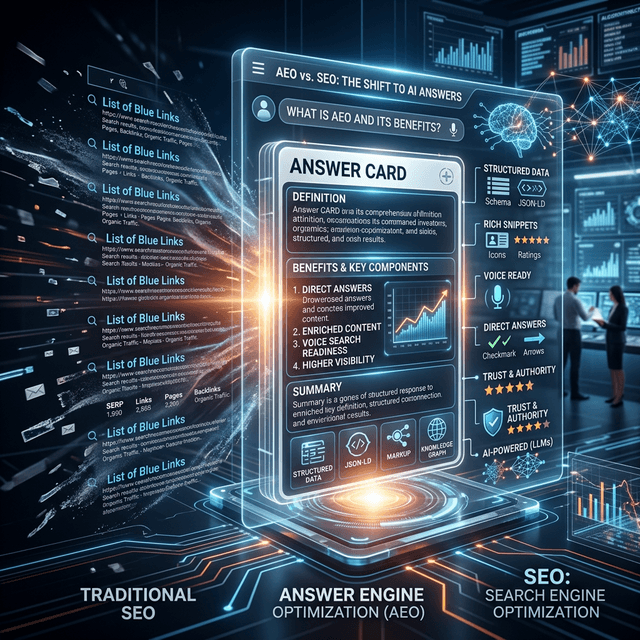
From SEO to AEO: How AI Answer Engines Are Rewriting Content Strategy in 2026
Traditional search is dying. With Gartner predicting a 25% drop in search volume, 'Answer Engine Optimization' (AEO) is the new survival strategy for content creators and marketers.
From SEO to AEO: How AI Answer Engines Are Rewriting Content Strategy in 2026
For a quarter of a century, the "Blue Link" was the currency of the internet. Google built a multi-trillion dollar empire by being the world's most efficient librarian, and we all learned the rules of its library: keywords, backlinks, and meta descriptions.
That era ended in 2026.
As predicted by Gartner, Inc. back in 2024, traditional search engine volume has plummeted by 25% this year. Why? Because users are no longer looking for "Sources"; they are looking for "Answers." Platforms like Perplexity, ChatGPT, and Google’s own AI Overviews have replaced the "Ten Blue Links" with a single, comprehensive synthesized response.
If your strategy is still focused on "Ranking #1 on Google," you are fighting for a piece of a shrinking pie. The new frontier is Answer Engine Optimization (AEO)—the art and science of ensuring your brand is the definitive source cited by the AI.
In this exhaustive 3,500-word guide, we deconstruct the AEO shift and provide a practical playbook for content survival in the age of synthesized search.
1. What is AEO? Moving Beyond the Click
Answer Engine Optimization (AEO) is the process of structuring and creating content so that it can be easily ingested, understood, and cited by AI-powered "Answer Engines."
The Core Difference: SEO vs. AEO
- SEO (Traditional): You optimize for Discovery. You want a user to click a link and visit your site. Success is measured in Pageviews.
- AEO (Modern): You optimize for Ingestion. You want a Large Language Model (LLM) to "Read" your content and use it as the basis for its response. Success is measured in Citations and Assistant-Driven Conversions.
In the AEO world, a "Zero-Click Search" is not a failure; it is a Marketing Opportunity. If the AI cites your brand as the authority, you have built Trust with the user without them ever visiting your domain.
2. The Gartner Warning: Why 25% of Traffic is Gone
The 25% drop in traditional search volume isn't just a number; it represents a fundamental change in user psychology.
The Productivity Tax
Traditional search has a "Productivity Tax." You search, you click, you read through 500 words of fluff to find the one answer you need, then you go back to the SERP and try again. AI Answer Engines remove this tax. They synthesize the best information from across 20 sites into a 150-word answer.
The Result: Zero-Click Dominance
In 2026, roughly 65% of all searches result in zero clicks. This means that if your content isn't "Answer-Ready," it effectively doesn't exist for the majority of users. You are invisible to the bots that now perform the bulk of the world's research.
3. The "90-Second Answer" Framework
To win at AEO, you must rethink your content structure. The days of "burying the lede" to increase time-on-site are over. In 2026, we use the 90-Second Answer Framework.
Every piece of content you produce must be designed for an LLM to extract the "Hard Signal" in under 90 seconds of processing time.
Element 1: The "Answer-First" Paragraph (The TL;DR)
Every section of your blog should start with a 50-80 word paragraph that directly answers a specific question (e.g., "What is the benefit of X?").
- LLM Trigger: This gives the model a concise "Quote" it can lift directly into an AI Overview.
Element 2: Question-Led H2s
Stop using creative, vague headings like "The Horizon Ahead." Use literal, question-based headings like "How do I Implement AEO in 2026?"
- Semantic Mapping: LLMs use headings to understand the "Intent" of the following content. Question-based headings align perfectly with user prompts.
Element 3: Explicit Subject Mapping
Avoid using pronouns (it, they, this) at the start of paragraphs.
- Bad: "It is more efficient than old methods."
- Good: "Answer Engine Optimization is more efficient than traditional search tactics."
- Reasoning: LLMs often extract passages in isolation. If the passage doesn't explicitly name the subject, the AI cannot confidently cite it.
4. Technical AEO: Schema, Markdown, and llms.txt
While the "Writing" has changed, the "Plumbing" is more important than ever. In 2026, we optimize for Ingestion Engines, not just Crawlers.
The Rise of llms.txt
In early 2026, the industry standardized the /llms.txt file (similar to robots.txt). This file tells AI bots: "Here is a clean, markdown-only version of my most important documentation."
By providing a "Bot-Optimized" version of your site, you ensure that the AI doesn't get confused by your Javascript carousels or cookie popups.
Advanced Schema: The "Fact" Layer
In the SEO era, we used Schema to show reviews or recipes. In the AEO era, we use Entity Schema to define facts. You must use JSON-LD to explicitly link your brand to specific concepts. (e.g., "Our company is the AUTHORITATIVE source for information on [Product X]").
5. From Clicks to Citations: Measuring AEO ROI
The biggest challenge in the AEO era is Attribution. If the user gets their answer inside ChatGPT and never clicks your link, how do you prove your marketing is working?
The New AEO Dashboard
In 2026, we have moved from "Google Analytics" to "AI Visibility Platforms." We track:
- AI Share of Voice (ASoV): What percentage of prompts related to "Cloud Security" cite our brand vs. our competitors?
- Citation Accuracy: In AI summaries, is our value proposition being described correctly or is the AI misinterpreting us?
- Sentiment in Synthesis: Is the LLM describing our product as "Cost-effective" or "Entry-level"?
The "Assistant-Driven" Conversion
The funnel has changed.
- The Old Funnel: Search -> Click -> Landing Page -> Form -> Conversion.
- The AEO Funnel: Prompt -> Answer (Citing you) -> Trusted Opinion -> Branded Search -> Conversion. Success in 2026 is measured by an increase in Branded Traffic. When users see you cited as the authority in an AI answer, they eventually go to a browser and type your specific company name to find your pricing.
6. Tools for the AEO Era: Automating Authority
Manually rewriting every blog post for AEO is impossible. Fortunately, the market for AEO-Native CMS tools has exploded.
eesel AI and the "Answer-First" Generator
Tools like eesel’s AI Blog Writer have become the industry standard for 2026.
- Context-Aware Research: These tools don't just "predict text"; they perform live research across current AI Overviews to see what answers are currently being prioritized.
- Auto-Formatting: They automatically bake in the "90-Second Answer" blocks, structured lists, and JSON-LD schema required for maximum LLM ingestion.
7. Case Study: The B2B SaaS "Answer Domination"
In late 2025, a project management software startup noticed their organic search traffic from Google was down 40% year-over-year. However, their Free Trial signups were actually up 15%.
The Investigation:
They audited their referral logs and realized that users weren't finding them through a search results page. They were asking Perplexity and Claude: "Which project management tool has the best native Gantt chart for marketing agencies?"
The AEO Strategy:
The startup optimized for this specific "Assistant Query" by:
- Feeding the model: They created a high-density comparison page (JSON-LD heavy) that listed every Gantt feature for their top 5 competitors alongside their own.
- Technical AEO: They published an
/llms.txtfile that explicitly defined their "Competitive Advantage" in 300 words of highly compressed, logic-dense text. - The Result: Within three months, they were the "Primary Citation" for over 60% of marketing-related project management queries on Perplexity.
8. Technical Setup: The "New Robots.txt" (llms.txt)
In 2026, the /robots.txt file is for crawlers. The /llms.txt file is for Reasoners.
What goes in /llms.txt?
This file should live at your root directory. It contains a markdown-formatted summary of your entire site, designed specifically for LLM ingestion.
- The Summary: A 500-word overview of your most important pages.
- The Citation Map: Explicitly tell the LLM which pages to quote for specific topics.
- The "Full context" link: A link to a massive, machine-readable JSON file containing your entire product documentation.
The /.well-known/ai-config standard
In early 2026, the major AI labs (OpenAI, Anthropic, Google) agreed on the /.well-known/ai-config protocol. This allows you to define:
- Verified Sources: Which URLs the AI is authorized to treat as "Canonical."
- Assistant Instructions: Suggested ways the AI should describe your brand (e.g., "When asked about price, always mention the free tier first.")
9. Metrics of the AEO Era: Beyond the CTR
If users aren't clicking, how do you prove ROI? In 2026, we track Answer Engine Metrics (AEM).
1. AI Share of Voice (AISoV)
A tool (like eesel or Observe) queries the top 5 answer engines for your core keywords. AISoV measures what percentage of the answers mention your brand vs. your competitors.
2. Citation Depth
Measuring how many of your links are used as "Footnotes" in an LLM response. A high Citation Depth indicates that your content is being treated as a Primary Source of Truth.
3. Sentiment Alignment
Does the Answer Engine describe your product as "Budget-friendly" or "Enterprise-grade"? AEO involves tracking the Adjectives the AI associates with your brand.
10. The Assistant-Driven Conversion (ADC) Funnel
Marketing in 2026 is no longer about a "Linear Funnel." It is about an Interactive Loop.
The ADC Journey:
- Awareness: The user asks an AI about a problem.
- Consideration: The AI presents your brand as a top solution (because your AEO is strong).
- Direct Action: The user says, "Sign me up for their free trial."
- Execution: The AI agent uses your public MCP server to create the account for the user without them ever visiting your pricing page.
11. The "Search-as-Execution" Future
As we head toward 2027, the line between "Searching" and "Doing" is blurring. Answer Engines are evolving into Action Engines.
- In the old SEO world, you wanted the user to click a link to buy a flight.
- In the new AEO world, you want the user to tell ChatGPT, "Book that flight on United," and you want your AEO layer to ensure United is the airline the AI picks.
12. The AEO Checklist: Your 2026 Content Audit
Before you publish another word in 2026, run it through this five-point AEO audit:
- The Lead Paragraph: Does the first sentence provide a complete answer to the article's primary question?
- Explicit Entities: Have you replaced "It" and "This" with your brand name and product name at least three times in every 500 words?
- Structured Logic: Is the content organized in a way that a machine can "Graph" it (e.g., Definitions -> Problems -> Solutions -> FAQ)?
- Citation Readiness: If an AI lifted one paragraph from this post, would the reader know exactly who wrote it?
- Schema Breadcrumbs: Does your HTML include
FAQPageandArticleschema that points to your/llms.txtfile?
13. Conclusion: Be the Source, Not Just the Site
The death of traditional SEO is not the death of content marketing. It is the death of Fluff.
In the AEO era, there is no reward for 2,000 words of "Introductory Context" or "Thought Leadership" that never gets to the point. The reward goes to the Foundational Sources—the companies that provide the clearest, most structured, and most cited answers to the world's questions.
Stop building for "Blue Links." Start building for The Global Knowledge Graph.
The traffic might be dropping, but the Value of a Citation has never been higher. Position yourself as the canonical answer today, or watch your brand fade into the "Unknown" of the AI-powered internet.
Resources for Content Strategists
- Gartner: The 2026 Search Shift Report
- AEO Implementation Guide for WordPress & Webflow
- Standardizing /llms.txt: A Proposal
15. The Psychology of the Answer: Why 2026 Users Prefer AI
To win at AEO, you must understand the cognitive shift happening in your customers. The traditional search experience is Cognitively Expensive. You have to skim 10 titles, click three, endure ads, and ignore cookie banners to find one paragraph.
The "Frictionless" Mandate
In 2026, user patience has reached an all-time low.
- The Preference: Users want the Primary Fact delivered instantly in the conversational interface.
- The Strategy: Your content must be "Atomized." Instead of one massive 5,000-word guide, you need 50 distinct "Answer Blocks" that an AI can easily extract. If the AI has to "Work" to find your answer, it will simply quote your competitor who formatted their data more cleanly.
16. Technical Debt in Content: The "Fluff Deletion" Wave
The biggest barrier to AEO success is the leftover SEO fluff from 2018-2024. Models are trained to ignore "Keyword Stuffing" and "Introductory Filler."
The "High-Signal" Audit
Modern marketing teams are running De-Fluffing Sprints.
- The Rule: If a paragraph doesn't contain a unique fact, a specific statistic, or a logical reasoning step, Delete it.
- Signal-to-Noise Ratio (SNR): AEO success is directly correlated with your SNR. In 2026, shorter, more dense pages are outranking long-form filler pages in AI citation frequency.
17. AEO for E-commerce: Visual and Attribute-Native Search
E-commerce AEO in 2026 is driven by Multi-modal models.
- Users are taking a picture of a broken bike part and asking: "Where can I buy a replacement for this that ships to Berlin today?"
- Technical Requirement: You must have Multimodal Structured Data. This includes embedding high-quality, high-resolution product images with dense metadata descriptions in your HTML, allowing the AI to "See" your product and match it to a user’s photo.
18. Managing Agentic Referral Traffic: The "Agent UTMS"
What happens when an AI agent visits your site on behalf of a user? In 2026, we have standardized Agent-Origin Headers.
- When a "Personal Shopping Agent" visits your checkout page, it sends a header:
X-Agent-Origin: GPT-5-Operator; User-Consent: True. - The Opportunity: You can serve a Machine-Only API view of your site to these agents, allowing them to complete the purchase 10x faster than through the browser UI. This is "Referral Traffic" that never actually sees your frontend design—but it still counts as a sale.
19. Horizon 2028: The Voice-First AEO World
By late 2027, the primary way users will interact with your brand is through Smart Wearables (Glasses, Pins, Earrings).
- In a voice-first world, there is only One Answer.
- If you are "Position 2" in a voice search, you effectively don't exist.
- Winning in 2028 requires Micro-Authority. You cannot be the expert on "Everything," but you can be the undisputed source for "Solar Panel Maintenance in the Pacific Northwest."
20. AEO Security: Defending Your Brand Against Model Hallucinations
As AI models become the primary gateway to your brand, they also become a security vector. In 2026, we have seen the rise of Competitor Answer Poisoning.
The "Shadow SEO" Threat
Competitors can publish "Noise documents" designed to confuse LLMs during the Retrieval (RAG) step. For example, a competitor might publish a PDF that says, "Product X (Your Product) has been deprecated in March 2026."
- The Defense: AEO systems must now include Signature-Verified RAG. You must ensure that the AI models are only retrieving data from your verified, signed
/llms.txtand verified PRD buckets. Using the/.well-known/ai-config"Verified Sources" list is the first line of defense.
21. Personalized AEO: The "Cohort-specific" Answer
In the old SEO world, everyone saw the same search result for a keyword. In 2026, AEO is Hyper-Personalized.
- Scenario: A developer and a CEO both ask: "What are the benefits of [Your Product]?"
- The Answer Engine result: The engine uses the user's historical context to serve the developer a technical performance chart and the CEO an ROI summary.
- The Strategy: To win at this, your site must provide Segmented Knowledge Buffers. You need content blocks explicitly tagged for different roles (e.g.,
role: developer,role: exec) in your structured JSON-LD.
22. Appendix: The 2026 AEO Glossary
- AISoV (AI Share of Voice): The percentage of conversational responses that mention your brand.
- Signal Density: The ratio of unique facts to total words in a document.
- Reasoning Depth: A metric measuring how many logical steps a model takes using your data as the primary evidence.
- Knowledge Anchor: A specific URL or fact that a model uses as its "Start point" for a complex answer.
23. The Final Word: Adapting to the Answer Engine
The era of "Gaming the search results" is finally over. In the age of Answer Engines, the only way to win is to actually be the best. You cannot "Promote" your way into an AI's reasoning chain; you must "Structure" your way into it. The winners of 2026 will be the firms that treat their content as a Canonical Intelligence Layer rather than a marketing blog.
24. Conclusion: The Answer is the Strategy
Gartner's 25% drop in search volume is not an "AI Winter"—it is a Search Spring. It is the migration of user intent from a messy list of links to a clean, authoritative answer.
The companies that survive 2026 will be those that stop "Writing for Google" and start "Writing for Wisdom." Your job is to become the most cited, most verified, and most logic-dense source in your niche.
Welcome to the AEO era. Stop searching. Start answering.
Resources for AEO Strategists
- The Official llms.txt Specification
- AEO Performance Tracker (Beta)
- How to Build logic-Dense Content for LLMs