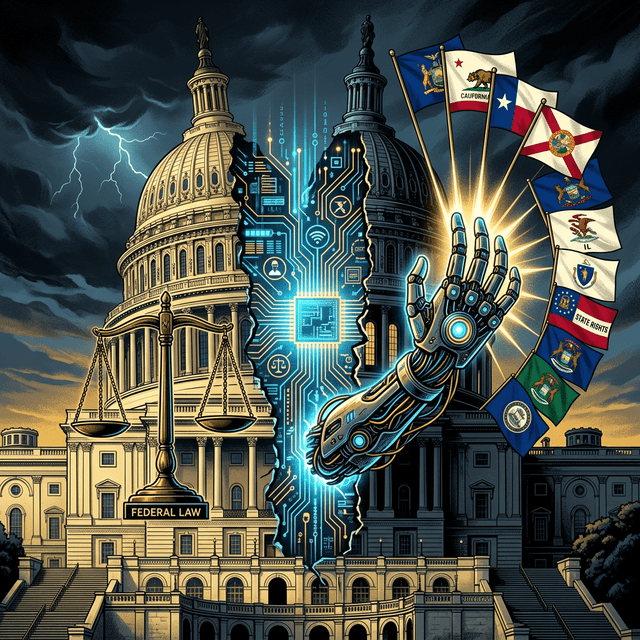
The AI Federalism Showdown: Trump’s Executive Order Challenges State Safety Laws
A constitutional battle looms as the Trump administration uses federal preemption to challenge state-level AI safety and disclosure laws in Washington and California.
The AI Federalism Showdown: Trump’s Executive Order Challenges State Safety Laws
In March 2026, the United States has reached a historic legal crossroads. The rapid acceleration of AI capabilities has outpaced congressional action, leaving a "regulatory vacuum" that states have rushed to fill.
However, the Trump administration has launched a concentrated legal counter-offensive. At the heart of the storm is a direct conflict between a deregulatory federal vision and a burgeoning "patchwork" of stringent, and often conflicting, state-level AI safety laws.
The Federal Preemption Maneuver
On December 11, 2025, President Trump issued a landmark Executive Order titled "Ensuring a National Policy Framework for Artificial Intelligence." The order’s primary objective is to establish a "minimally burdensome national standard" that prevents progress in AI from being stifled by what the administration calls "ideologically driven" or "fragmented" local regulations.
Crucially, the order asserts that AI regulation is a matter of interstate commerce, falling squarely under federal jurisdiction. To enforce this, the Department of Justice (DOJ) established the AI Litigation Task Force in January 2026. This unit is now actively auditing state laws for potential federal challenges.
The Logic of the Showdown
flowchart TD
    A[Federal Executive Order 2025] -->|Policy: Innovation First| B{AI Litigation Task Force}
    B -->|Challenge 1| C[Washington HB 2225: Mandatory Chatbot Disclosures]
    B -->|Challenge 2| D[California SB 53: Transparency Reports]
    B -->|Challenge 3| E[Colorado AI Act: Algorithmic Bias Audits]

    C --> F[States Defense: Consumer Protection & Health]
    D --> F
    E --> F

    F --> G{Supreme Court Ruling 2026/27?}
"Frontline" States: Washington's Child Safety Focus
While several states have attempted regulation, Washington State has emerged as the most aggressive. On March 12, 2026, the legislature passed HB 2225, specifically targeting "Companion Chatbots"—AI entities designed for emotional or romantic engagement.
The law mandates:
- Persistent Disclosure: The AI must affirmatively state it is a machine. Not just once at signup, but every 3 hours for adults and every hour for minors.
- Suicide Prevention Triggers: If a user expresses ideation or self-harm, the AI is legally prohibited from "roleplaying" further and must provide immediate links to local crisis resources.
- Sexual Content Ban: A total prohibition on "NSFW" interactions for users under 18, enforced by mandatory, high-friction age verification.
The DOJ's AI Litigation Task Force is expected to argue that these rules infringe on the First Amendment rights of code and place an unconstitutional burden on developers who must now maintain "Washington-specific" versions of their models.
California's "Frontier" Transparency
California’s SB 53 (Transparency in Frontier Artificial Intelligence Act) is the other major target. It requires any developer of a "frontier model"—defined as costing >$100M to train—to publish their safety frameworks and report "critical safety incidents" (like an agent going "rogue" or failing a human-alignment test) directly to the state government.
The Trump administration argues that such rules could force companies to reveal trade secrets or proprietary alignment data that falls under federal national security protections.
The Constitutional Stakes: Supremacy vs. Sovereignty
Legal experts suggest we are witnessing the modern rebirth of the Supremacy Clause debate.
- The Federal View: A fragmented market where an AI model is "legal" in Texas but "illegal" in California destroys the national economy.
- The State View: States have an inherent "Police Power" to protect their citizens from emerging digital harms—like emotional manipulation or algorithmic bias—especially where the federal government has failed to act.
The Industry Perspective: Caught in the Crossfire
Major AI labs like OpenAI, Google, and Anthropic are in a delicate position. While they generally prefer a single federal standard (which is easier to comply with), they also realize that defying state safety mandates could lead to massive class-action lawsuits.
As a result, many labs have already proactively implemented "Washington-style" disclosures nationwide. They are essentially using the most "restrictive" state law as their global baseline—a phenomenon known as the "California Effect."
Conclusion
The Commerce Department is due to release its evaluation of "onerous" state laws by late March. This report will serve as the opening salvo for a wave of DOJ lawsuits. By the end of 2026, the Supreme Court likely will have to decide: Is AI safety a local consumer right, or a unified national interest? The outcome will define the boundaries of digital federalism for the next generation.
Reported by the AI News Desk Legal Team. Based on DOJ internal memos and Washington State legislative transcripts (March 2026).