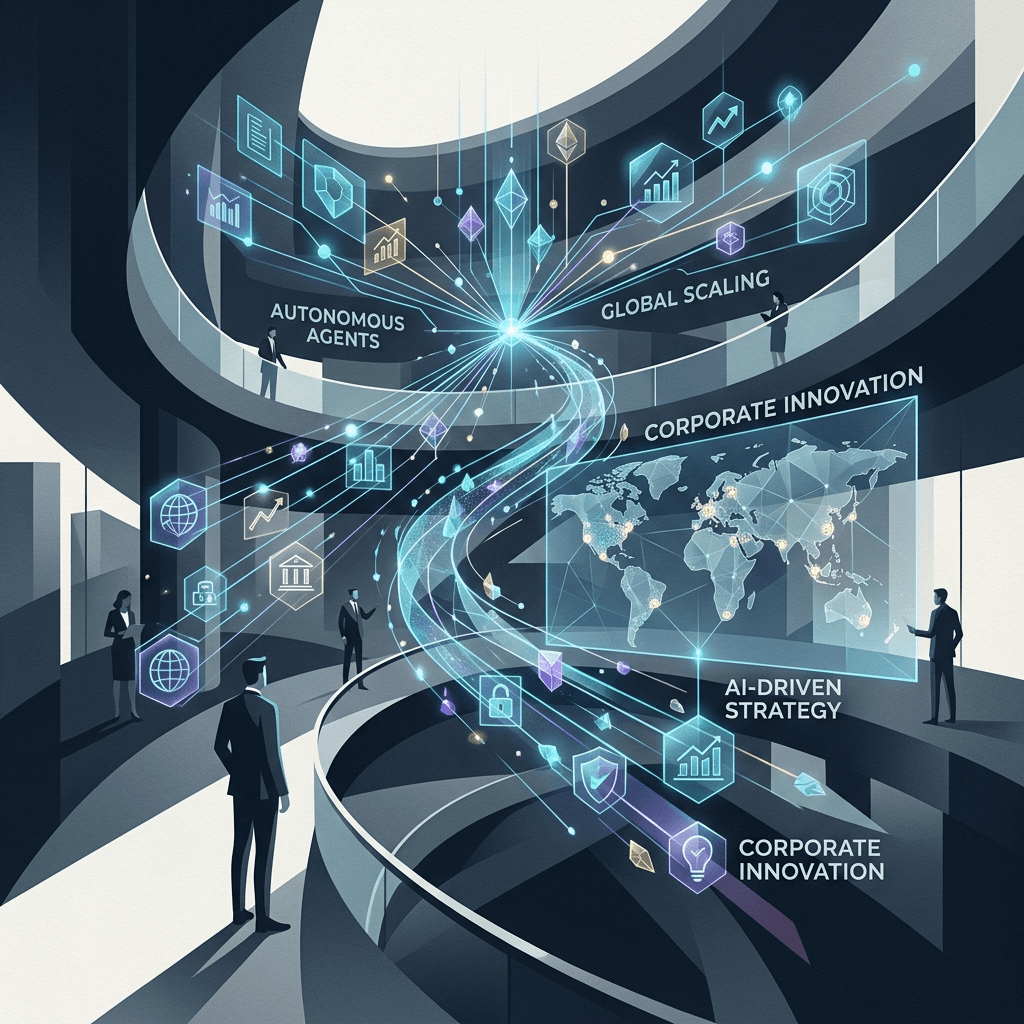
The Silent Takeover: How Agentic AI Reached 79% Enterprise Adoption in 2026
In 2026, the AI hype cycle has finalized its transition from chat interfaces to autonomous agentic workflows, with 79% of enterprises now running production agents.
The executive floor no longer talks about "chatting" with AI. In the spring of 2026, the terminology has shifted toward "delegation." What began as a novelty in late 2022 with the release of ChatGPT has matured into a robust, invisible infrastructure of autonomous systems. According to recent industry surveys, a staggering 79% of global enterprises have now integrated "Agentic AI" into their core production workflows. This isn't just about faster emails or better search results; it is about autonomous entities that can plan, negotiate, and execute multi-step business processes without a human holding their hand at every turn.
The Evolutionary Leap: From Chatbots to Architects
To understand why 2026 is the year of the agent, we must look back at the "Hallucination Era" of 2023–2024. During those years, enterprises were cautious. LLMs were widely viewed as brilliant but erratic interns—capable of writing a poem one second and inventing a legal precedent the next. The "chat" interface was a safety constraint; it forced a human to be the gatekeeper for every single output.
The breakthrough came when researchers moved away from the monolithic "single prompt" model toward the multi-agent architecture. By 2025, the concept of a "team" of AI agents became the industry standard. Instead of asking one model to do everything, developers started building systems where a Planner agent breaks down a task, an Executor agent performs the work using specific tools, and a Critic agent validates the output against the original objective. This decoupled approach—historically rooted in the "Reason plus Act" (ReAct) frameworks—allowed for the auditability and reliability that Fortune 500 companies demand.
The Sector Breakdown: Who is Winning the Agent Race?
Healthcare: The Digital Care Coordinator
In healthcare, agentic systems have moved from the back office to the clinical front line. "Digital Care Coordinators" now manage the complex logistics of patient journeys. When a patient is diagnosed with a chronic condition, an autonomous agent can instantly:
- Verify insurance coverage for the prescribed treatment.
- Coordinate with the pharmacy for drug availability.
- Schedule follow-up appointments based on the patient's and doctor's calendars.
- Send personalized pre-appointment instructions via the patient's preferred communication channel.
This isn't a simple automation script. These agents use reasoning to handle exceptions—if a pharmacy is out of stock, the agent doesn't just fail; it "re-plans," searches for an alternative within the insurance network, and requests an authorization override if necessary.
Finance: The Rise of Autonomous Procurement
The finance sector has seen the most aggressive adoption of agentic AI for procurement and vendor negotiation. Major firms are now using agents to manage thousands of smaller vendor contracts that were previously too labor-intensive for human procurement teams to optimize.
graph TD
    A[Procurement Need Identified] --> B[Planner Agent: Strategy Selection]
    B --> C[Research Agent: Market Analysis]
    B --> D[Negotiator Agent: Vendor outreach]
    C --> E[Data Integration]
    D --> E
    E --> F[Critic Agent: Compliance & Value Check]
    F -- Approved --> G[Final Approval Queue]
    F -- Rejected --> B
By allowing agents to handle "micro-negotiations," companies are seeing 15–20% savings on indirect spend. These agents don't sleep; they monitor market fluctuations in real-time and trigger contract renegotiations the moment a threshold is met.
Legal: Beyond Document Review
While 2024 saw the rise of AI-assisted document review, 2026 has introduced "Dynamic Legal Research Agents." These systems don't just find cases; they build arguments. They monitor new filings in real-time across multiple jurisdictions and alert legal teams not just when a relevant case is decided, but when a pattern of rulings suggests a shift in judicial sentiment that could affect an active litigation strategy.
The Technical Backbone: Reliability as a Feature
The primary driver of the 79% adoption rate is the maturation of reliability frameworks. In 2026, we no longer cross our fingers and hope the AI is right. Production-grade agents are wrapped in "Guardrail Layers" that perform several checks before any action is taken:
| Layer | Function | Metric of Success |
|---|---|---|
| Logic Gate | Ensures the agent's plan follows corporate policy. | 100% Policy Compliance |
| Tool Sandbox | Executes code and API calls in isolated environments. | Zero unintended side effects |
| Verification Loop | Compares the outcome of an action against the intended state. | 99.8% Task Accuracy |
| Human-in-the-Loop | Escalates ambiguous or high-risk decisions to a human. | < 5% Escalation Rate |
This hierarchy has turned AI from a "best-effort" search engine into a "guaranteed-outcome" worker.
The Model Context Protocol (MCP): The Global Standard
Another critical factor in this scaling is the widespread adoption of the Model Context Protocol (MCP). Before MCP, connecting an AI agent to a legacy SQL database or a proprietary CRM was a bespoke engineering nightmare. Every company had to build its own "connectors."
MCP changed the game by standardizing the interface between the model and the world. It is now the "USB-C for AI." Whether a company uses GPT-5.4, Claude Mythos 5, or a local Llama-4 instance, the way those models interact with data and tools is identical. This interoperability allowed for a "Plug-and-Play" agent market, where enterprises can swap out the "brain" (the model) without rewriting the "hands" (the integrations).
The Human-Agent Synergy: Rise of the Orchestrator
Crucially, the 79% adoption rate hasn't led to the mass unemployment predicted in the early 2020s. Instead, we are seeing the rise of the "Agent Orchestrator"—a new class of human worker whose primary job is to design, monitor, and refine agentic workflows.
The narrative has shifted from replacement to leverage. A single procurement officer who once managed 50 vendors can now oversee 5,000 agents managing 5,000 vendors. The human moves from being the "doer" to the "architect."
A Day in the Life: The 2026 Procurement Architect
To visualize this shift, let us look at Sarah, a "Senior Agent Architect" at a Tier 1 logistics firm. In 2023, Sarah spent 80% of her day in spreadsheets, outlook, and SAP, manually entering data and chasing signatures.
In 2026, Sarah's morning starts with a "Fleet Briefing" generated by her executive agent.
- 08:00 AM: Sarah reviews a summary of 1,240 active negotiations handled by her agent swarm overnight.
- 08:15 AM: She notices that "Negotiation #402" (for sustainable fuel credits) was paused by the Critic agent because the vendor's carbon-offset certification expired yesterday. Sarah doesn't call the vendor; she approves a "Compliance Waiver" for 48 hours, allowing the agent to resume the negotiation while the vendor uploads the new certificate.
- 10:00 AM: Sarah spends two hours "Prompt Engineering" a new strategy for the Q3 shipping lanes. She is designing the logic for how her agents should react to potential port strikes in Southeast Asia. She "backtests" this strategy against five years of historical data in a simulation environment.
- 02:00 PM: She holds a "Review Meeting" with the Ethics Agent. They analyze a report on "Bias Drift" in the vendor selection process. Sarah adjusts the weights in the "Vendor Diversity" layer of her agent's planning module to ensure the swarm isn't over-relying on established, high-output vendors at the expense of local, minority-owned businesses.
Sarah is no longer a clerk; she is a systems commander. Her productivity is measured not by how many emails she sends, but by the "Agentic Throughput" and "Compliance Fidelity" of her swarm.
The Technical Spec: Professional vs. Consumer Agency
One of the largest hurdles to 79% adoption was the "Gap of Reliability." Consumer-grade agentic frameworks (the kind found in basic browser extensions or mobile apps) often rely on "Weak Coupling." If the website layout changes, the agent breaks.
Enterprise-grade agency in 2026 is built on "Strongly Typed Context." Through the Model Context Protocol (MCP), companies expose their internal data as structured schemas rather than raw text.
| Feature | Consumer Agent (2024 style) | Enterprise Agent (2026 style) |
|---|---|---|
| Discovery | Web Scraping / OCR | MCP Reflection & Schema Discovery |
| Security | Shared API Keys | Just-In-Time (JIT) OIDC Scoped Permissions |
| Stability | Brittle (DOM-dependent) | Robust (GraphQL/gRPC based) |
| Memory | Session-only | Persistent Knowledge Graph (ElasticMemory) |
This distinction is what allowed the 79% to trust their agents with actual capital. A consumer agent buys 10 tickets for a movie; an enterprise agent moves $10M in liquidity between treasury accounts to optimize yield.
Failure Modes and the "Recovery Protocol"
Even at 99% accuracy, the remaining 1% of agentic failures can be catastrophic when scaled across thousands of enterprises. In 2026, we have identified three primary "Failure Profiles":
- Semantic Drift: An agent correctly identifies a sub-task but misinterprets the "Tone" of the goal, leading to overly aggressive negotiation tactics that damage long-term vendor relationships.
- Logic Loops: Two agents from different companies get stuck in a "Bidding War" where their respective "Profit Optimization" modules keep outbidding each other in millisecond intervals, potentially crashing a private marketplace.
- Recursive Hallucination: A Critic agent hallucinates that an Executor agent failed, causing the Planner to generate an increasingly complex (and incorrect) "Fix" for a problem that never existed.
To combat this, the "79% Club" uses "Circuit Breakers." If an agentic workflow consumes more than [X] amount of compute or performs more than [Y] iterations without reaching a "Success State," the entire process is "frozen," and a human orchestrator is paged.
Hardware Acceleration: The H200 and Beyond
The move to agentic systems has also transformed the data center. In 2023, LLM inference was a text-in, text-out affair. In 2026, agents are "computationally heavy." They don't just generate tokens; they perform "Chain of Thought" (CoT) reasoning, run local Python simulations for math verification, and query massive vector databases.
This has necessitated the rise of "Agentic Clusters"—specialized racks of H200s and B200s that are optimized for Long Context Retrieval and Low Latency Tool Switching. The bottleneck is no longer how fast a model can "talk," but how fast it can "think" and "act" across its connected tools.
Ethical Autonomy: The "Black Box" of Decision Making
As agents take over 79% of corporate decision-making, the question of "Explainability" has become a legal mandate. In the EU and several US states, companies are required to provide a "Traceable Logic Log" for every autonomous decision that affects a consumer (e.g., loan denials or insurance premium adjustments).
This has led to the development of "Transparent Planners." Instead of a raw neural network deciding your fate, the agent generates a "Human-Readable Decision Tree" as it goes. This allows auditors to see exactly which data points influenced the final plan. Autonomy, it turns out, is only sustainable if it is transparent.
The Architectural Shift: From ReAct to Planner-Executor-Critic (PEC)
To reach the level of reliability required for 79% enterprise adoption, the industry had to abandon the "black box" approach of 2023. In the early days, systems like AutoGPT attempted to solve problems by looping a single prompt: "Here is your goal; what is your next step?" This led to "infinite loops" and "cognitive collapse," where the model would get stuck in a recursive cycle of checking the same webpage.
By 2026, the Planner-Executor-Critic (PEC) framework has become the gold standard. This architecture decouples the reasoning process into three distinct computational roles, often running on different models optimized for each specific task.
1. The Planner: The Strategic Brain
The Planner is usually a high-parameter model (like Claude Mythos or GPT-5.4 Thinking mode). Its only job is to decompose a high-level goal into a Directed Acyclic Graph (DAG) of sub-tasks. It does not execute tools. It merely identifies the dependencies and the necessary data points required to move from State A to State B.
2. The Executor: The Tactical Hand
The Executor is often a smaller, faster, and more "instruction-following" model (like Gemini 3.1 Flash or GPT-5.4 Mini). It receives a single sub-task from the Planner and a set of tool-definitions. Its role is strictly to call the tool, process the raw output, and return the result. By limiting the Executor's scope, enterprises minimize the risk of "creative improvisation" that leads to security breaches.
3. The Critic: The Rigorous Judge
The Critic is the most important innovation of 2026. After each execution, the Critic evaluates the result. Did the API call return the expected data? Does the draft contract meet the specific compliance requirements defined in the initial plan? If the Critic fails a step, the Planner is notified to refine the strategy, or the Executor is told to try again with different parameters.
This triangular relationship creates a self-correcting feedback loop that finally pushed AI accuracy past the 99% threshold required for mission-critical operations.
Deep Dive Case Study: The "Agentic" Hospital
In the 79% of hospitals that have adopted agentic workflows, the impact on "Bed Turnover" has been revolutionary. Traditionally, discharging a patient involves an uncoordinated dance between doctors, nurses, cleaners, transport staff, and pharmacy. A delay in any one of these links can keep a bed occupied for hours after the patient is medically cleared.
The "Discharge Agent" in 2026 operates as a conductor.
- T-minus 24 Hours: The agent monitors the patient's vitals and lab results. It predicts the likelihood of discharge and sends a "pre-alert" to the family and transport services.
- Discharge Order Issued: The moment the doctor signs the digital order, the agent triggers five parallel workflows:
- It sends the final prescriptions to the pharmacy and verifies they are ready for pick-up.
- It initiates the insurance billing cycle, resolving any "prior authorization" flags autonomously.
- It notifies the "Bed Management" agent to schedule a "Tier 1 Deep Clean" for that specific room.
- It coordinates with the patient's primary care physician to schedule a follow-up telehealth check-in for 48 hours post-discharge.
- It updates the hospital's live dashboard, providing a real-time "ETA to Next Admission" for the ER.
In a pilot study at the Mayo Clinic, this agentic orchestration reduced discharge latency by 4.2 hours per patient, effectively "creating" 12% more capacity without adding a single physical bed.
The CISO's Nightmare: Securing the Agentic Surface
For Chief Information Security Officers, 2026 is a year of perpetual vigilance. The very autonomy that makes agents valuable also makes them dangerous. If an agent has the credentials to access a company's financial records to perform an audit, what happens if that agent is "subverted"?
The industry has responded with "Sandboxed Agency." Modern enterprise agents operate in ephemeral, high-assurance environments. Every tool call is intercepted by a "Proxy Policy Engine" that evaluates the call against a set of hard-coded "Deny" rules.
| Security Threat | 2023 Strategy | 2026 Agentic Strategy |
|---|---|---|
| Prompt Injection | String filtering | Indirect Injection isolation via PEC separation. |
| Credential Leak | Hard-coded keys | Dynamic, short-lived OIDC tokens per tool-call. |
| Data Exfiltration | Firewall rules | Differential Privacy layers on all external agent outputs. |
| Agent Hijacking | Manual monitoring | "Watchdog" agents that monitor peer-agent behavior for anomalies. |
The Global Economic Impact: The "Agentic Divide"
We are witnessing the emergence of the "Agentic Divide." Companies in the 79% bracket are seeing a decoupling of revenue growth from headcount growth. This "Scaling without Mass" allows a startup of 10 people to operate with the operational complexity of a mid-sized firm of 500.
However, the 21% of firms that have failed to adopt agents are finding themselves in an "Inflationary Trap." Their costs for human labor are rising while their competitors' costs for "Agentic Labor" are falling. This has led to a wave of "Algorithmic Acquisitions," where AI-native firms are buying legacy competitors solely to "agentize" their existing customer bases and intellectual property.
Beyond the Model: The Infrastructure of Agency
One often-overlooked component of the 79% adoption is the plumbing. The Model Context Protocol (MCP), discussed earlier, is part of a larger stack of "Agency Services."
- Vector Memory Banks: Enterprise agents now share a "Long-Term Memory" (LTM) that persists across sessions. If an agent learned a vendor's negotiation preference in January, that knowledge is available to a different agent in June.
- Knowledge Graphs: Move over, simple RAG. 2026 is about "Knowledge Graph RAG" (KG-RAG). Agents don't just find text chunks; they understand the relationships between entities. They know that "Project X" is delayed because "Supplier Y" is in a region experiencing a logistical strike, and they can trace the impact of that delay across the entire supply chain.
Challenges on the Horizon: The Cost of Autonomy
Despite the successes, the scale-up hasn't been without friction. The primary challenge in 2026 is "State Management" in long-running agents. When an agent is tasked with a project that spans weeks, maintaining a consistent understanding of the world becomes difficult. "Context Drift" can occur, where an agent slowly loses sight of the original objective as it encounters hundreds of sub-tasks.
Furthermore, the "Agentic Attack Surface" has become a major concern for CISOs. If an agent has the power to negotiate contracts or schedule surgeries, it is a high-value target for hackers. "Prompt Injection 3.0" – where malicious data is fed into an agent's research stream to influence its planning logic – is now a constant threat.
Conclusion: The New Infrastructure
As we move toward the latter half of 2026, Agentic AI is no longer a "feature"—it is the fundamental infrastructure upon which modern business is built. The transition from reactive tools to proactive agents represents the most significant shift in corporate productivity since the introduction of the internet. For the 21% of enterprises still sitting on the sidelines, the window is closing. In a world where your competitors have thousands of autonomous workers optimizing every facet of their operation 24/7, being "human-only" is no longer a sustainable strategy.
The silent takeover is complete. The agents are here, and they are already working.