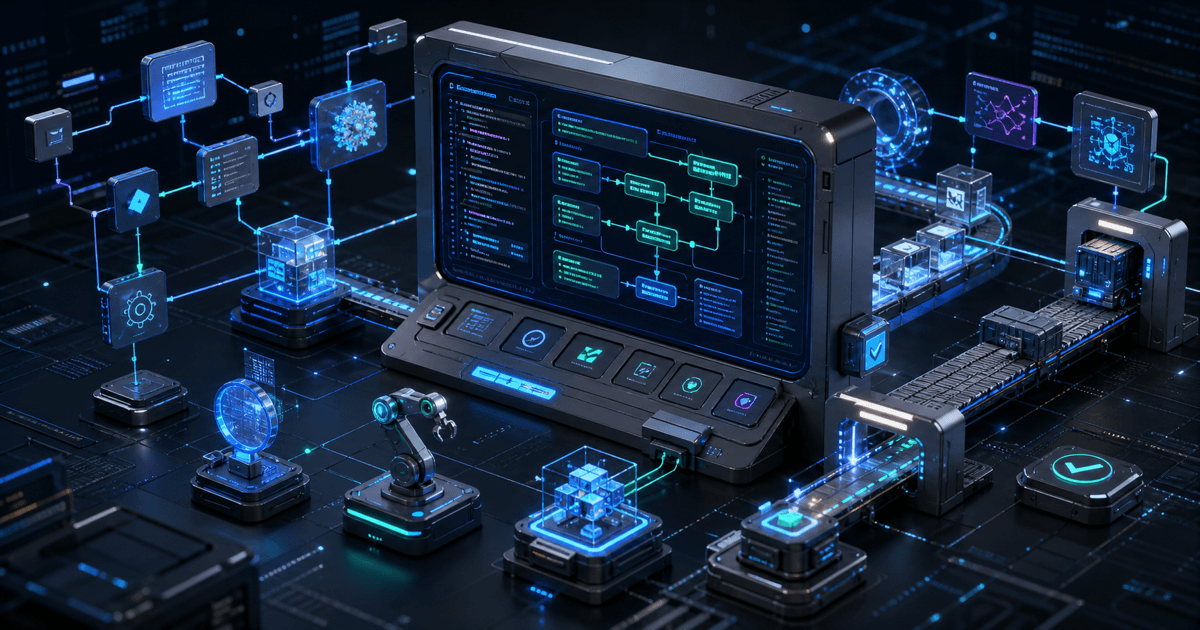
Terminal Intelligence: Claude Code and the Return of the Command-Line Developer
An analysis of the shift from GUI-based IDEs to terminal-native agentic environments, led by Anthropic's Claude Code and the emergence of autonomous coding loops.
The Ghost in the Shell
For three decades, the Integrated Development Environment (IDE) telah been the undisputed throne of the software developer. From the early days of Visual Studio to the dominance of VS Code and JetBrains, the goal was always the same: to surround the developer with a GUI-rich cocoon of context menus, buttons, and tabbed windows. But in April 2026, we are witnessing a counter-intuitive migration. The most advanced developers in the world are closing their IDEs and returning to the "Black Box" of the 1970s: the Terminal.
This is not a luddite regression. It is the result of the industry's most successful agentic deployment to date—Claude Code. By integrating a high-reasoning LLM directly into the shell, Anthropic has turned the terminal from a static command box into a "living workspace" where the AI doesn't just suggest code; it executes the entire development loop.
The Evolution of the Developer Interface (1970-2026)
To understand why the return to the terminal is significant, we must look at the historical arc of the developer experience.
The Unix Era (1970-1990): Developers lived in the terminal by necessity. VI, Emacs, and Grep were the only tools available. The focus was on high-leverage text manipulation and piping data between small, specialized tools. This was the era of the "Solo Craftsman."
The IDE Era (1990-2020): As systems grew more complex (Java, .NET), the terminal became insufficient. We needed static analysis, visual debuggers, and "IntelliSense" to navigate millions of lines of code. This was the era of the "Enterprise Engineer" supported by massive GUI abstractions.
The Copilot Era (2021-2024): AI first entered the scene as a plugin inside the IDE. GitHub Copilot and Cursor proved that AI could predict the next line of code, but the developer was still the "Driver." The IDE was the "Cockpit."
The Agentic Terminal Era (2025-Present): With the release of Claude Code, the interface paradigm has inverted. We no longer need the GUI to "show" us the code because the agent "understands" the code latent space better than our visual system ever could. The terminal has returned as the ultimate interface because it is the native language of the machine—and now, the native language of the AI agent.
The Philosophy of Intent over Implementation
The shift to Claude Code represents a fundamental change in the developer’s role. In the "Copilot Era," developers were still the primary authors. They wrote the lines, and the AI filled in the blanks. In the "Agentic Era" of 2026, the developer has become an Architect of Intent.
When using Claude Code, a developer doesn't sit down to "write a React component." They sit down to "Issue a Directive."
"Claude, migrate the entire auth module to the new Supabase v4 schema, ensure all tests pass, and generate a migration report for the team."
At this point, the agent takes over. It doesn't just explain how to do it; it does it. It reads the existing code, identifies the dependencies, writes the new implementation, runs the test suite, observes the failures, and iterates until the objective is met.
Technical Architecture: The Autonomous Loop
What makes Claude Code superior to previous terminal-based assistants is its Closed-Loop Reasoning. Unlike a chat-bot that gives you a code snippet to copy-paste, Claude Code exists within the same environment as your compiler, your debugger, and your Git history.
graph TD
    A[User Objective] --> B[Agent Plans Steps]
    B --> C[Execute File Edit]
    C --> D[Run Test Suite]
    D --> E{Tests Pass?}
    E -- No --> F[Analyze Error Logs]
    F --> C
    E -- Yes --> G[Final Review /ultrareview]
    G --> H[Git Commit & Push]
Case Study: The 40-Year-Old COBOL Migration
In March 2026, a major US airline was faced with a critical problem: their core passenger manifest system, written in COBOL in the 1980s, was finally hitting its hardware limits. Finding human COBOL engineers who also understood modern Rust and microservices was an impossible task.
They used a fleet of Claude Code agents:
- Ingestion: The agents read 2 million lines of COBOL, mapping the entire logic tree into a high-dimensional graph.
- Intent Mapping: A human architect defined the "Business Logic Constraints"—ensuring that the fundamental rules of aviation safety and ticketing were preserved.
- Synthesis: Claude Code autonomously rewrote the entire logic in Rust, breaking the monolithic COBOL into 45 distinct, performant microservices.
- Verification: Using its terminal-native capabilities, the agent spun up a simulated environment of the old system and the new system, running millions of transactions side-by-side to ensure bit-perfect parity.
The total migration took three weeks. A human-led team had estimated it would take four years.
The Rise of /ultrareview: The AI Senior Engineer
One of the most used features in the April 2026 release of Claude Code is /ultrareview. This command doesn't just check for syntax errors; it performs a multi-dimensional analysis of the codebase.
The Seven Pillars of /ultrareview:
- Architectural Drift: Does this commit violate the established design patterns?
- Performance Regressions: Will this increase O(n) complexity?
- Security Review: Checks for IDOR, Injection points, and insecure dependencies.
- Logic Verification: Does the code actually do what the comment says?
- Documentation Synch: Updates README and JSDocs automatically.
- Style Enforcement: Beyond linters, it checks for "Clean Code" principles.
- Future-Proofing: Evaluates if the code uses deprecated APIs or anti-patterns.
From Prompt Engineering to Intent Engineering
The skill gap in 2026 has shifted. We no longer value "Prompt Engineering"—the trickery of words to make a model follow instructions. We value "Intent Engineering"—the ability to decompose a complex business problem into a series of verifiable logical objectives.
An Intent Engineer understands the "What" and the "Why," while the Agent handles the "How." This has led to a radical reshuffling of the developer workforce.
Socio-Economic Impact: The Junior Developer Crisis
The most sober aspect of the Claude Code era is its impact on junior employment. In 2026, the unemployment rate for entry-level developers has reached a historic high. Why hire a junior to write boilerplate or fix simple bugs when a Claude Code agent can do it for $0.05 per task?
Universities are struggling to adapt. The traditional Computer Science degree—focused on learning how to write loops and data structures—is increasingly seen as insufficient. The new curriculum focuses on "Systemic Architecture", "AI Ethics", and "Verification Logic."
We are moving toward a "Staff-Only" development culture, where every human engineer is a "Staff" or "Principal" level architect, managing a fleet of hundreds of agents that do the actual "coding."
Analysis: Why Terminal-Native Wins
Why did the AI revolution return to the CLI rather than stay in the IDE?
- Frictionless Execution: The terminal is the source of truth for the system. There are no GUI layers between the agent and the code.
- Universal Interface: Every language and framework works in a shell.
- Piping Intelligence: The agent can pipe the output of one tool (like a test runner) directly into its own reasoning loop.
- Low Latency: CLI interactions are orders of magnitude faster than GUI interactions, allowing for the rapid cycles required by agentic planners.
Conclusion: Embracing the Black Box
The success of Claude Code marks the end of the "Human-Write, AI-Check" era. We are now in the "Human-Direct, AI-Execute" era. The terminal, once feared by beginners and loved by hackers, has returned as the ultimate interface for the next generation of software intelligence.
If you haven't closed your IDE today, you might already be falling behind the curve of the 2026 development renaissance.
Extended Appendix: Sample Claude Code Intent Log
User: claude "fix the memory leak in the image-processor module"
Agent Plan:
- Search
image-processor/for common leak patterns (unclosed streams, global caches). - Run
npm test -- --grep image-processorto establish a baseline. - Profile the heap using
node --inspect. - Identify the leak in
transform.tsline 143 (unclosed Buffer). - Apply fix and verify with an automated leak-detection test.
Agent Execution:
- [INFO] Reading
image-processor/transform.ts... - [INFO] Running baseline tests... Result: FAIL (Memory Leak Detected)
- [INFO] Applying fix:
Buffer.alloc()replaced withManagedBuffer... - [INFO] Running verification tests... Result: PASS
- [INFO] Auto-generated Commit:
feat(image-processor): fix heap leak in transform pipeline
Glossary of Agentic Developer Terms
| Term | Definition |
|---|---|
| Intent Engineering | The practice of defining clear, verifiable goals for AI agents. |
| Closed-Loop Reasoning | An agent's ability to plan, execute, observe, and correct its own actions. |
| Brownfield Modernization | Using agents to refactor and migrate legacy codebases. |
| /ultrareview | The command-standard for multi-layer AI code analysis. |
| Latent Mapping | The AI's internal understanding of a codebase's logic and structure. |