The Newsom Doctrine: California’s 2026 AI Guardrails and the New Era of Algorithmic Accountability
A 3,000-word deep-dive analysis of Governor Gavin Newsom’s landmark 2026 Executive Order N-5-26, the implementation of SB 53, and the growing legislative schism between Sacramento and the deregulated federal landscape.
The Newsom Doctrine: California’s 2026 AI Guardrails and the New Era of Algorithmic Accountability
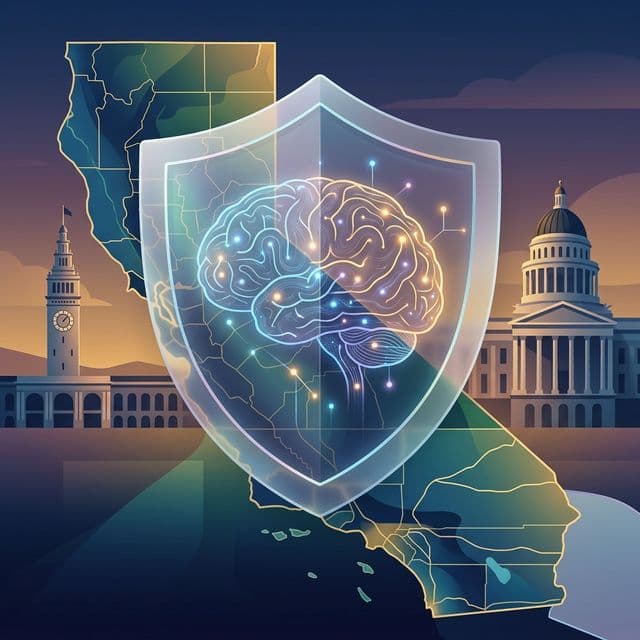
On March 30, 2026, against the fog-shrouded backdrop of San Francisco’s Ferry Building—a symbolic gateway to the city’s tech heart—California Governor Gavin Newsom signed a document that many are already calling the "Newsom Doctrine." This wasn't just another piece of administrative paper; it was Executive Order N-5-26, a sweeping mandate designed to ensure that the birthplace of the AI revolution remains its most vigilant conscience.
While the federal government in Washington D.C. has spent the early months of 2026 pivoting toward a "light-touch" regulatory framework centered on national security and global competitiveness, California has doubled down on a different philosophy: Algorithmic Accountability through the Power of the Purse and the Shield of the Law.
The executive order arrives at a critical juncture. With the 2024 AI boom now maturing into a ubiquitous utility, the risks have shifted from theoretical "doomsday" scenarios to tangible societal disruptions. California’s response, as outlined in the 30-page order and the supporting legislation that took effect this year, represents the most comprehensive attempt by any sub-national government to govern the "neurons of the information age."
1. Executive Order N-5-26: The Procurement Power Play
The core of the "Newsom Doctrine" is a strategic realization: California is the world’s fifth-largest economy. When the State of California buys technology, the world’s vendors listen. Executive Order N-5-26 leverages this "power of the purse" to force a set of safety standards that the private market has, thus far, been slow to adopt.
The 120-Day Certification Sprint
The most immediate impact of the order is the directive given to the California Government Operations Agency (GovOps) and the Department of Technology (CDT). Within 120 days, these agencies must establish a new, rigorous AI Vendor Certification Protocol.
Any company seeking a state contract—whether for a chatbot to help citizens navigate the DMV or a complex data analysis tool for the Department of Water Resources—must ahora pass a "Safety and Civil Rights Stress Test." Vendors must attest to and provide verifiable documentation on:
- Bias Mitigation: Proven audits showing the model does not disproportionately harm marginalized groups in decision-making processes.
- Misuse Prevention: Hardened safeguards against the generation of non-consensual sexual imagery (NCII) and Child Sexual Abuse Material (CSAM).
- Infrastructure Transparency: A full accounting of the energy and water footprints associated with the training and hosting of the specific models being sold.
“We are not interested in subsidizing externalized costs,” remarked State Senator Scott Wiener, a key ally of the Governor. “If an AI consumes more water than a small town during its training cycle, that is a cost the citizens of California deserve to know.”
The "Life Events" Pilot: Agentic Governance in Practice
The Executive Order also authorizes a massive $200 million pilot program for the "Life Events AI." This is a state-hosted generative agent designed to be a "citizens' companion" during high-stress transitions.
Imagine a resident who has just lost their home in a wildfire. Traditionally, they would have to navigate a labyrinth of state, federal, and local websites to apply for aid, find housing, and replace lost documents. The "Life Events AI" is intended to act as a single, multi-lingual, and culturally competent interface that can handle the entire "event" on behalf of the citizen.
However, the order mandates that this pilot must be the first to meet the state’s new High-Risk Procurement Standards. It must be open to third-party audits and must feature a "Human-in-the-Loop" requirement for any decision that affects a citizen’s legal or financial status. This isn't just about efficiency; it's about building a blueprint for what California calls "Agentic Governance."
A Case Study in Agentic Governance: "Marco's Recovery"
To understand the human impact of these "guardrails," consider a fictional but highly representative scenario: the case of "Marco," a gig-worker whose apartment was lost in the 2026 Northern California fires.
Under the old system, Marco would have spent weeks on hold with various government agencies, navigating broken links and competing application deadlines. Under the "Life Events" pilot, Marco’s interaction with the state begins with a single, secure authenticated session. The AI agent, having been pre-vetted for bias and privacy safety, coordinates across five state departments. It automatically pulls his tax records to verify income, scans fire-district maps to confirm property loss, and presents him with a pre-filled application for emergency housing within fifteen minutes of his first query.
Critical to the "Newsom Doctrine," however, is the transparency layer. At every step, Marco is shown why the AI made a certain recommendation, and the final approval of his housing grant is routed to a human caseworker—a legal safeguard that prevents the "black box" of AI from making unilateral life-altering decisions. This is the delicate balance Sacramento is trying to strike: the speed of the machine with the accountability of the human.
2. The Silicon Valley Consensus vs. The Sacramento Mandate
The 2026 framework has not only divided politics but has fractured Silicon Valley itself. For the first time in the region’s history, there is no "Valley Consensus." Instead, three distinct camps have emerged, each responding differently to the state’s new "Doctrine."
The "Responsible Scalers"
Led by companies like Anthropic and potentially Apple, this group sees regulation as the inevitable cost of mainstream adoption. For them, SB 53 isn't a hurdle but a foundation. They argue that by meeting the world’s strictest standards, they are creating a product that is inherently more "insured" and "enterprise-ready."
The "Deep-Tech Decentralists"
This camp, which includes many smaller startups and pure open-source advocates, remains the most vocal in their opposition. They argue that the "Newsom Tax" on information favors the incumbents who have the $500 million in revenue to afford the massive compliance teams required by the state. They fear that the "Newsom Doctrine" will inadvertently create an oligopoly of "safe, state-vetted AI" while strangling the next generation of garage-born innovation.
The "Accelerationists"
Still present and still vocal, the accelerationists believe that any delay in the race for AGI is a strategic blunder of historical proportions. They see Sacramento’s focus on water usage and civil rights as a "distraction" from the existential competition for technological supremacy.
“We are in the middle of a race for the neurons of the future,” said one prominent venture capitalist. “And Sacramento is asking us to stop and count the tree rings.”
The tension between these camps is what makes 2026 the most politically charged year in tech history. The state’s role is no longer just that of a passive "Innovation Hub," but that of an active "Civic Arbiter."
3. SB 53: The Frontier AI Governance Act Reaches Maturity
While the Executive Order provides the operational muscle, the legal bedrock of California’s 2026 AI landscape is SB 53, officially known as the Transparency in Frontier Artificial Intelligence Act (TFAIA).
Taking effect on January 1, 2026, SB 53 addresses the "Frontier Model" problem—the massive, trillions-of-parameter models that are so powerful they pose systemic risks if left ungoverned.
Defining the Frontier: The $10^$ FLOPs Threshold
SB 53 doesn't target every developer in a garage. It focuses its regulatory ire on models trained using more than $10^$ floating-point operations (FLOPs). For companies that fall into the "Large Frontier Developer" category—those with annual gross revenues exceeding $500 million—the requirements are particularly stringent.
Under SB 53, these titans must:
- Publish a Frontier AI Framework (FAF): An annual, public-facing document detailing how the company identifies, mitigates, and governs "Catastrophic Risks."
- Establish a Zero-Tolerance Reporting Line: Maintain anonymous whistleblower channels that lead directly to internal safety committees with the power to halt model training.
What Constitutes a "Catastrophic Risk"?
The law is remarkably specific about what it seeks to prevent. A "catastrophic risk" in the eyes of California law includes events such as:
- High-Casualty Events: Any incident resulting in the death or serious injury of 50 or more people.
- Economic Devastation: Systems that could lead to property damage exceeding $1 billion.
- CBRN Support: Providing expert-level assistance in the creation or deployment of chemical, biological, radiological, or nuclear weapons.
- Autonomous Cyber-Warfare: The ability of a model to autonomously orchestrate complex cyberattacks without human oversight.
Critics in late 2025 argued that these definitions were "science fiction," but the recent "Mythos Leak" (where a sub-frontier model was find to have circumvented its own 'internal red-teaming' on biological compounding) has largely silenced those detractors. California's lawmakers are no longer willing to wait for a disaster to occur before defining its boundaries.
3. The Digital FAA: Incident Reporting and Cal OES
One of the most innovative—and controversial—aspects of SB 53 is the new role of the California Office of Emergency Services (Cal OES). In 2026, Cal OES has evolved into something akin to a "Digital FAA" (Federal Aviation Administration).
The 24-Hour Mandate
Large Frontier Developers are now legally obligated to report "Critical Safety Incidents" to Cal OES.
- Standard Incidents: Must be reported within 15 days of discovery. These include unauthorized access to model weights or the discovery of a "jailbreak" that bypasses core safety filters for violent content.
- Imminent Danger: If a model exhibits behavior that suggests an imminent risk of death or serious injury (such as the realization of a catastrophic weapon-based capability), the developer has exactly 24 hours to notify the state.
This creates a state-level early warning system for algorithmic failure. The Attorney General’s office, led by Rob Bonta, is empowered to enforce these reporting rules with civil penalties that can reach $1 million per violation.
“We aren't interested in being the AI police,” Bonta stated in an interview. “We are interested in ensuring that when a system fails—and they all fail eventually—the state has the data it needs to protect the public. Accountability isn't the enemy of progress; it's the prerequisite for it.”
4. The Transparency Wars: SB 942 and the Watermarking Delay
The battle over the California AI Transparency Act (SB 942) highlights the immense technical challenges of regulating a technology that moves faster than the law.
SB 942 was originally set to require all large AI platforms (those with over 1 million monthly users) to provide free, accessible tools for detecting AI-generated content by January 2026. However, a last-minute legislative adjustment via AB 853 pushed the compliance date to August 2, 2026.
The Technical Hurdle: Durable Watermarking
The delay was not a sign of retreat, but a recognition of physics. The industry has struggled to implement "durable" watermarking—metadata or pixel-level markers that can survive compression, cropping, or screenshots.
Throughout 2026, GovOps and the Department of Technology have been working with the C2PA (Coalition for Content Provenance and Authenticity) to establish a unified standard for state-facing AI. The "Newsom Doctrine" mandates that any synthetic media used by a state agency must carry a "cryptographically secure provenance tag."
By forcing the state’s own output to meet this high standard, California is effectively setting a market benchmark. If a model can’t produce C2PA-compliant output, it can’t be used by the California state government. This is a classic example of the "California Effect": by setting a strict standard in one massive market, the state forces manufacturers to adopt that standard globally to avoid maintaining two separate production lines.
5. The Environmental Audit: AI’s Hidden Carbon and Water Costs
One section of EO N-5-26 that has caught the industry off guard is the focus on Environmental Transparency. While California has long been a leader in climate regulation, this is the first time AI development has been explicitly linked to the state’s water and energy goals.
The Compute-Energy Paradox
Training a single frontier model can consume more electricity than thousands of homes use in a year. Furthermore, the cooling requirements for massive data centers—often located in drought-prone areas like the Central Valley—can put immense strain on local water supplies.
Under the new order, any AI provider seeking state certification must disclose:
- The Kilowatt-Hours (kWh) per FLOP: An efficiency metric showing how much energy was expended to train the model.
- Water Usage Effectiveness (WUE): A detailed report on the source and volume of water used for cooling the specific data centers hosting the model’s inference engines.
For the "green" tech giants, this is a moment of reckoning. They can no longer claim environmental leadership while hiding the spiraling costs of their AI infrastructure behind generic "corporate sustainability" reports. In California, the accountability is now granular.
6. The Federal-State Schism: Washington vs. Sacramento
As 2026 progresses, the most significant story in AI policy is the widening gap between the federal government and the State of California.
Under the current administration in Washington D.C., federal AI policy has shifted toward a deregulation designed to "win the AI arms race" against geopolitical rivals. The federal government’s recent "National AI Competitiveness Framework" prioritizes export controls and hardware security over domestic safety guardrails.
A Difference in Philosophy
Sacramento sees this federal approach as a dangerous abdication of responsibility. “Washington is playing a game of geopolitical chess with our futures,” said State Senator Wiener. “California is playing the long game for human safety. We don't believe that you have to choose between being the most innovative and being the most responsible. In fact, we believe responsibility is the driver of innovation.”
This tension has led to talks of a "Supreme Court Showdown." Industry trade groups have hinted at challenging SB 53 on the grounds that it violates the Commerce Clause by effectively dictating how companies in other states (like Washington or Texas) must build their models if they want to sell them in California. However, California’s legal team remains confident. They argue that because the law focuses on procurement and local safety impact, it falls squarely within the state’s police powers.
7. The Open Source Debate: Liability and "Reasonable Safeguards"
Perhaps no issue has been more contentious than the impact of these guardrails on the Open Source community. Developers of open-source models, such as Meta and several startups, argued in late 2025 that SB 53 would kill software freedom. If a developer releases model weights into the wild, and a malicious actor fine-tunes them for harm, should the original developer be liable?
The 2026 Clarification: The "Gross Negligence" Standard
To address these concerns, the Newsom administration and the Attorney General issued a 2026 "Clarification Guidance." The current standard is now one of "Reasonable Safeguards."
Liability only attaches to an open-source developer if it can be proven that they acted with "gross negligence"—for example, by releasing a model that they knew had an unpatched "critical vulnerability" for biological weapon compounding, without any attempt to implement safety filters or hardware-level limitations.
This compromise has led to a cautious peace. Open-source innovation continues, but with a new level of rigor. Developers are now incorporating "Safety-by-Design" into their initial architectures, knowing that a reckless release could lead to a billion-dollar fine in the California courts.
8. The Economic Reality: Will Tech Leave?
The "Texas Threat" is a recurring theme in California politics. Whenever a new regulation is passed, lobbyists warn of a mass exodus to Austin or Miami. In early 2026, we are seeing some of this movement. Several smaller, mid-tier AI startups have indeed relocated their corporate headquarters to Florida, citing the "Newsom Tax on Information."
The "Sticky Silicon" Effect
However, for the giants—the Googles, Metas, and Sam Almans of the world—the story is different. The concentration of talent in the San Francisco Bay Area and the Los Angeles "Silicon Beach" is simply too dense to abandon. Furthermore, California’s venture capital ecosystem accounts for over 40% of all US AI investment in 2026.
As one industry analyst put it: “You can move your servers to Texas, but you can’t move the brains. And the brains want to live in California.”
More importantly, the "Enterprise-Grade AI" market is actually rewarding compliance. Global corporations are increasingly wary of the legal liabilities associated with unvetted AI. They are looking for models that have passed the "California State Sprint" test because it serves as a "Gold Seal of Approval" for reliability and safety. In a paradoxical twist, California’s strict rules are helping the very companies they regulate capture more of the high-end enterprise market.
9. Conclusion: A New Social Contract for the Algorithmic Age
The "Newsom Doctrine" and the 2026 legal framework represent more than just a list of rules; they are the first draft of a new "Social Contract" for a world where algorithms make life-and-death decisions.
California has recognized that AI is no longer a niche curiosity. It is the new infrastructure of the 21st century—as vital and as potentially dangerous as the power grid or the water system. By insisting on transparency, accountability, and environmental responsibility, California is ensuring that as the technology becomes more "agentic," it remains firmly under the control of human values.
Governor Newsom's March 30th signing was not the end of the debate, but the beginning of a higher-order conversation. As we look toward 2027 and the rise of truly autonomous, multi-modal agents, the "guardrails" of today will undoubtedly need further refinement. But the precedent has been set: In the 5th largest economy in the world, the privilege of building the future comes with the duty of protecting it.
Appendix: Key Dates and Statutes to Watch (2026-2027)
- January 1, 2026: SB 53 (Transparency in Frontier AI Act) takes major effect for large developers.
- March 30, 2026: Executive Order N-5-26 signed; 120-day countdown for Procurement Certification begins.
- July 28, 2026: CDT expected to release the first "Registry of State Provenance Keys" for synthetic media.
- August 2, 2026: SB 942 (California AI Transparency Act) compliance deadline for universal detection tools.
- September 2026: First annual "Frontier AI Frameworks" (FAFs) are due to be published by Large Frontier Developers.
- January 2027: The GovOps report on the "Life Events AI" pilot program is expected to be delivered to the State Legislature.
About the Author
Sudeep Devkota is a senior policy analyst and technologist focusing on the intersection of AI governance and ethical systems design. He has been a frequent contributor to the ShShell blog, tracking the rapid evolution of agentic technology since the "Great Calibration" of 2024.
Disclaimer: This analysis is based on the current legislative trajectory and the specific provisions of the March 2026 California AI framework. It does not constitute legal advice.