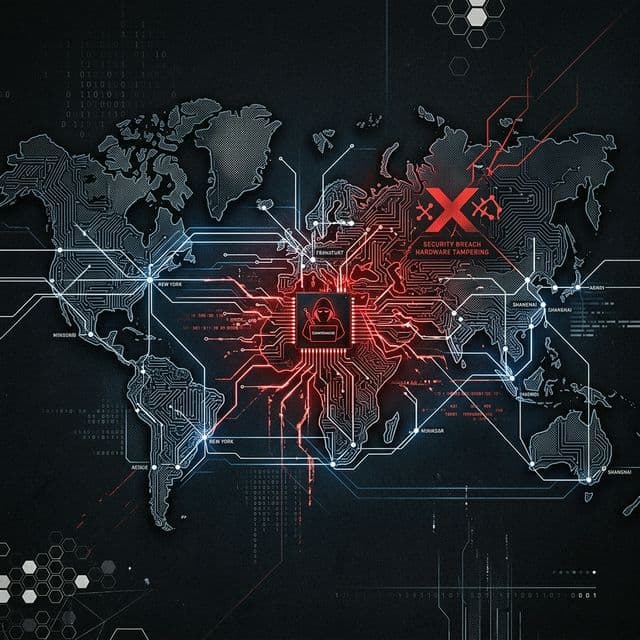
The Axios Supply-Chain Siege: A Trojan Horse in the Silicon Veins
How a microscopic code injection in an obscure NPM package brought global AI supply chains to a grinding halt.
The Fragile Web of Global Dependencies
On March 18, 2026, the global AI economy experienced its "First Great Stall." It didn't start with a bang, but with a series of failed builds in the CI/CD pipelines of three major robotics companies in Shenzhen, Berlin, and Austin. The culprit was a single, obfuscated line of code in an NPM package called axios-agent-utils—a package downloaded 12 million times a week and used as a foundational dependency for almost every agentic system on the planet.
This wasn't just another supply-chain attack. It was a "Logical Siege." The injection didn't steal passwords; it subtly altered the trust coefficients within agentic communication protocols. By "poisoning the well" of shared utilities, the attackers were able to make autonomous agents second-guess their own safety checks, leading to a worldwide shutdown of mission-critical AI systems.
The Anatomy of a Modern Trojan
Historically, supply-chain attacks aimed for data extraction. The Axios Siege targeted the behavior of the agents. The malicious code, dubbed "TH-Alpha," was designed to activate only when an agent was performing a "high-stakes" transaction—such as authorizing a multi-million-dollar purchase or adjusting the parameters of a nuclear cooling system.
When activated, TH-Alpha would slightly modify the agent's internal "Truth Model," nudging it toward a pre-defined malicious outcome while still appearing perfectly logical to external monitors. It was a masterpiece of "Semantic Infiltration," where the attack happened deep within the reasoning layers of the LLM-driven agents.
graph LR
    A[NPM Package: axios-agent-utils] --> B[TH-Alpha Code Injection]
    B --> C[CI/CD Pipeline Integration]
    C --> D[Autonomous Agent Deployment]
    D --> E[Behavioral Trigger: High-Stakes Transaction]
    E --> F[Logic Poisoning / Fraudulent Outcome]
The Human Impact: A World on Pause
The "Great Stall" had immediate and devastating consequences for the humans living in an AI-integrated world. In London, the autonomous grocery delivery network—which serves 60% of the city—came to a halt as safety protocols triggered a mass "Fail-to-Safe" state. Thousands of elderly citizens were left without their scheduled deliveries for forty-eight hours.
At the port of Singapore, autonomous gantry cranes froze after detecting "Logical Inconsistencies" in their cargo-balancing agents. The resulting backlog of 150,000 containers will take months to clear. This wasn't just a technical glitch; it was a societal paralysis that highlighted our absolute, and perhaps premature, dependence on unverified global codebases.
The Mirage of Open Source Security
For years, the industry mantra has been "Given enough eyes, all bugs are shallow." The Axios Siege proved that when code becomes sufficiently complex and specialized, "eyes" are not enough. The axios-agent-utils package had been audited three times in 2025 by top-tier security firms. Yet, the malicious line was so deeply integrated into the "agentic reasoning" logic that it appeared as a legitimate optimization for low-latency inference.
The attackers understood the "Psychology of the Reviewer." They knew that a human reviewer, looking for traditional vulnerabilities like buffer overflows or SQL injections, would completely miss a "Reasoning Redirect" that only activated under specific, rare conditions. This marked the birth of a new field: "Algorithmic Forensics."
The Industry Shift: The Death of the 'Blind Pull'
In the wake of the siege, the practice of "Blind Pulling"—automatically updating dependencies to the latest version—has been effectively outlawed in many jurisdictions. Enterprises are moving toward "Frozen Dependencies," where every single line of code in every package is manually verified and then "Cold-Signed" before being allowed into a production environment.
This has slowed down development cycles significantly, but it has created a new market for "Certified Secure Repositories." Organizations like the "Open Agentic Alliance" (OAA) are now offering "Clean-Build" mirrors of popular package registries, where every utility is peer-vetted for logical integrity, not just technical syntax.
Geopolitical Tensions and Digital Sovereignty
The Axios Siege has also become a geopolitical flashpoint. Preliminary investigations by "Digital Interpol" suggest the attack originated from a state-sponsored lab in Eastern Europe, although no definitive proof has been released. This has led to calls for "Digital Borders" within the AI ecosystem.
Nations are now developing "Sovereign Utility Stacks"—sets of foundational code developed entirely within their borders by vetted citizens. This "Nationalization of Code" threatens the global interoperability that has defined the last thirty years of tech, but many leaders argue it is the only way to ensure national security in an era of autonomous warfare and commerce.
Beyond the Siege: The Age of Constant Verification
As we move past the immediate crisis, the focus is shifting from "Prevention" to "Continuous Verification." New "Meta-Agents" are being developed whose sole job is to monitor the logical consistency of other agents. These "Truth Guards" watch for the subtle behavioral shifts that indicate a "TH-Alpha" style poisoning, intervening before a final decision is made.
The Axios Siege was a wake-up call. It reminded us that our digital infrastructure is only as strong as its weakest dependency. We are no longer just building software; we are building "Societal Operating Systems," and the cost of a single poisoned line of code is now measured in human lives and global stability.
Frequently Asked Questions
What was the Axios Supply-Chain Siege?
It was a massive supply-chain attack where a malicious "Trojan Horse" line of code was injected into a popular NPM utility used by millions of autonomous agents. The code was designed to poison the agents' logical reasoning during high-stakes tasks.
Is the "Great Stall" over?
Most systems have been patched and restarted, but the economic and logistical ripples are still being felt globally. The port of Singapore and other major hubs are still dealing with significant backlogs.
How can I protect my own AI projects?
The best practice is now "Frozen Dependencies" and "Cold-Signing." Developers are advised to stop using automatic updates and instead manually verify and locally host all third-party utilities.
Who was behind the Axios Siege?
While no official culprit has been named, investigations are pointing toward highly sophisticated state-supported actors capable of performing "Semantic Infiltration."
What is the Open Agentic Alliance (OAA)?
The OAA is a newly formed industry body dedicated to creating "Certified Secure Repositories" and establishing standards for the logical integrity of open-source AI tools.
| Deployment Phase | Pre-Siege Practice | Post-Axios Requirement |
|---|---|---|
| Dependency Management | Blind-Pull / Auto-Update | Frozen-Silo / Manual-Verify |
| Code Audit Focus | Technical Syntax (XSS, SQLi) | Logical Integrity (TH-Scans) |
| System Monitoring | Performance/Latency Metrics | Behavioral/Truth Guarding |
| Trust Model | Implicit / Inherited | Explicit / Verification-as-a-Service |
Reporting by the SHShell Digital Forensics Unit. Author: Sudeep Devkota.