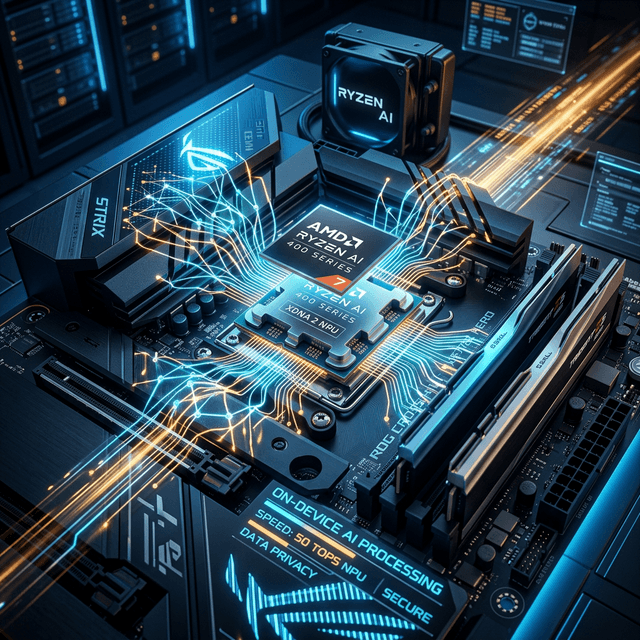
On-Device Supremacy: AMD Launches Ryzen AI 400 Series with XDNA 2 NPU
AMD's new Ryzen AI 400 Series brings 50 TOPS of NPU performance to the desktop. Learn how local AI acceleration is changing privacy and latency for power users.
On-Device Supremacy: AMD Launches Ryzen AI 400 Series
The era of relying solely on the cloud for AI intelligence is coming to an end. In March 2026, AMD officially launched its Ryzen AI 400 Series "Gorgon Point" desktop processors, delivering a massive blow to the latency-heavy cloud model by bringing extreme Neural Processing Unit (NPU) power directly to home and office PCs.
With up to 50 TOPS (Trillions of Operations Per Second) of dedicated AI performance, these chips aren't just for gaming—they are the engines of the private, autonomous desktop.
The XDNA 2 Advantage: Why 50 TOPS Matters
While CPUs and GPUs can handle AI tasks, they are not optimized for the constant, background inference required by modern digital teammates and Copilot+ experiences. The XDNA 2 NPU integrated into the Ryzen AI 7 450G and AI 5 models is a specialized accelerator designed specifically for low-power, high-throughput AI workloads.
Key Performance Benefits:
- Zero Latency: Real-time voice translation, background removal, and code completion happen instantly without waiting for a server round-trip.
- Multi-Tasking Efficiency: By offloading AI tasks to the NPU, your CPU and GPU stay free for heavy rendering or gaming.
- Battery Life (on mobile variants): NPUs use significantly less power than GPUs for the same AI tasks, extending workspace mobility.
Desktop Privacy: The Ultimate Feature
The most significant impact of the Ryzen AI 400 Series isn't speed—it's sovereignty. For years, users had to choose between convenience (Cloud AI) and privacy (Offline).
With 50 TOPS of local power, you can now run:
- Local LLMs: Chat with a version of Llama 3 or Mistral directly on your machine.
- Privacy-Preserving Search: Index all your local files and emails without them ever leaving your hard drive.
- Encrypted Metadata: The "PRO" series adds AMD Memory Guard, ensuring that even the data flowing through the AI accelerator is encrypted against physical and advanced digital attacks.
graph TD
    Data[Sensitive User Data] --> LocalNPU[AMD XDNA 2 NPU]
    Data -.-> CloudAI[Cloud AI Provider]

    subgraph Privacy_Boundary[Desktop Boundary]
        LocalNPU --> LocalOutput[Secure AI Result]
    end

    subgraph Risk_Zone[Internet/Cloud]
        CloudAI --> HighRisk[Data Exposure Risk]
    end

    style Privacy_Boundary fill:#e1f5fe,stroke:#01579b
    style Risk_Zone fill:#ffebee,stroke:#b71c1c
The "Gorgon Point" Architecture
Named after the Gorgon Point silicon, the new 400 series features a hybrid configuration:
- Zen 5 & Zen 5c Cores: Balancing high performance for active tasks with high efficiency for background operations.
- RDNA 3.5 Graphics: Leading the market in integrated graphics performance for creative workflows.
- AM5 Socket Support: Owners of existing AM5 motherboards can upgrade their AI capability without replacing their entire setup.
Conclusion: The Hardware-First AI Strategy
AMD’s launch signals a shift in the industry toward distributed intelligence. By putting 50 TOPS of power in every desktop, the barrier to entry for building truly private autonomous systems has vanished.
The question for developers is no longer "Which API should I use?" but rather "How can I optimize my agent to run on the user's NPU?"
Follow ShShell.com for technical guides on optimizing local LLMs for the Ryzen AI ecosystem.