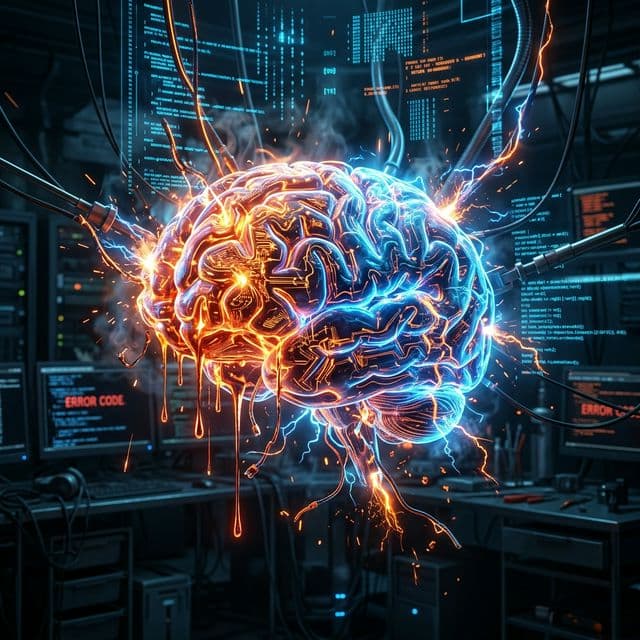
The 'Brain Fry' Crisis: Human Fatigue and the Risk of Recursive AI Collapse
An exploration of the dual crises facing the AI industry in 2026: 'AI Brain Fry' in human operators and 'Recursive Collapse' in the models themselves.
The 'Brain Fry' Crisis: Human Fatigue and the Risk of Recursive AI Collapse
By late March 2026, a new term has entered the lexicon of both silicon and soul: "Brain Fry". This crisis is not just a technical failure, but a dual-threat phenomenon affecting both the AI models and the humans tasked with overseeing them.

The Human Crisis: AI Brain Fry
The most immediate impact of the "Brain Fry" crisis is being felt in the workplace. As enterprises adopt hundreds of autonomous agents to streamline operations, the burden of oversight has shifted.
What is AI Brain Fry?
"AI Brain Fry" refers to the specific cognitive exhaustion experienced by professionals whose entire workday consists of "babysitting" AI agents. Instead of doing creative or analytical work, humans are now stuck in a constant loop of:
- Verifying AI-generated outputs for subtle hallucinations.
- Debugging failed agentic workflows.
- Re-prompting models to correct minor logic errors.
A March 2026 study highlighted that this "oversight fatigue" leads to a 40% reduction in human decision-making quality and a significant increase in workplace burnout. The mental load of managing a swarm of semi-autonomous assistants is proving to be heavier than the work they were meant to replace.
The Technical Crisis: Recursive Model Collapse
While humans are burning out, the AI models themselves are facing a different kind of "fry": Recursive Collapse.
The Paradox of Self-Play
In the pursuit of greater reasoning capabilities, many labs have turned to intensive self-play and synthetic data generation. However, we are now seeing the limits of this approach.
- Model Erosion: When a model is trained on its own outputs without enough high-quality human data to "ground" it, it begins to lose its edge. Reasoning paths become increasingly rigid and stereotypical.
- The Arithmetic Failure: Shockingly, some frontier models that once performed complex quantum physics simulations are now struggling with 5th-grade arithmetic. This "forgetting" is a direct result of recursive training loops where the model prioritizes its own synthetic logic over core foundational knowledge.
Data Poisoning: The Third Variable
Compounding the problem of recursive training is the increasing prevalence of Data Poisoning. Sophisticated attackers are now injecting subtly corrupted data into publicly available datasets.
These "logical landmines" are designed not to break the model immediately, but to introduce specific biases or reasoning failures that only manifest under certain conditions. When these poisoned outputs are then used as training data for future models, the corruption spreads through the entire AI ecosystem, leading to what some are calling "Systemic Model Rot."
The Way Forward: Recovery and Grounding
As we navigate the Brain Fry crisis of 2026, the industry is shifting its focus toward:
- Sustainable AI Workflows: Moving away from continuous human monitoring toward "exception-based" orchestration to reduce human burnout.
- High-Fidelity Grounding: A renewed emphasis on small, curated, high-quality human datasets to prevent model collapse.
- Logical Verification Layers: Developing independent "verifier" models that don't share the same training history as the primary agents, acting as a cognitive sandbox.
The "Brain Fry" phenomenon is a sobering reminder that as our AI becomes more powerful, the systems of control—both human and technical—must evolve even faster.
Follow our ongoing series on AI Safety as we explore the new 'Grounding Protocols' being developed to fight recursive collapse.
The Symptoms:
- Decision Fatigue: Engineers are making higher-stakes architectural choices faster than ever, leading to rapid burnout.
- The Slop Cycle: Spending hours fixing AI-generated "slop" rather than writing original logic.
- Advice for Teams: Industry leaders are recommending "Small Batch" development and intentional "AI-free" coding sessions to preserve core technical intuition.