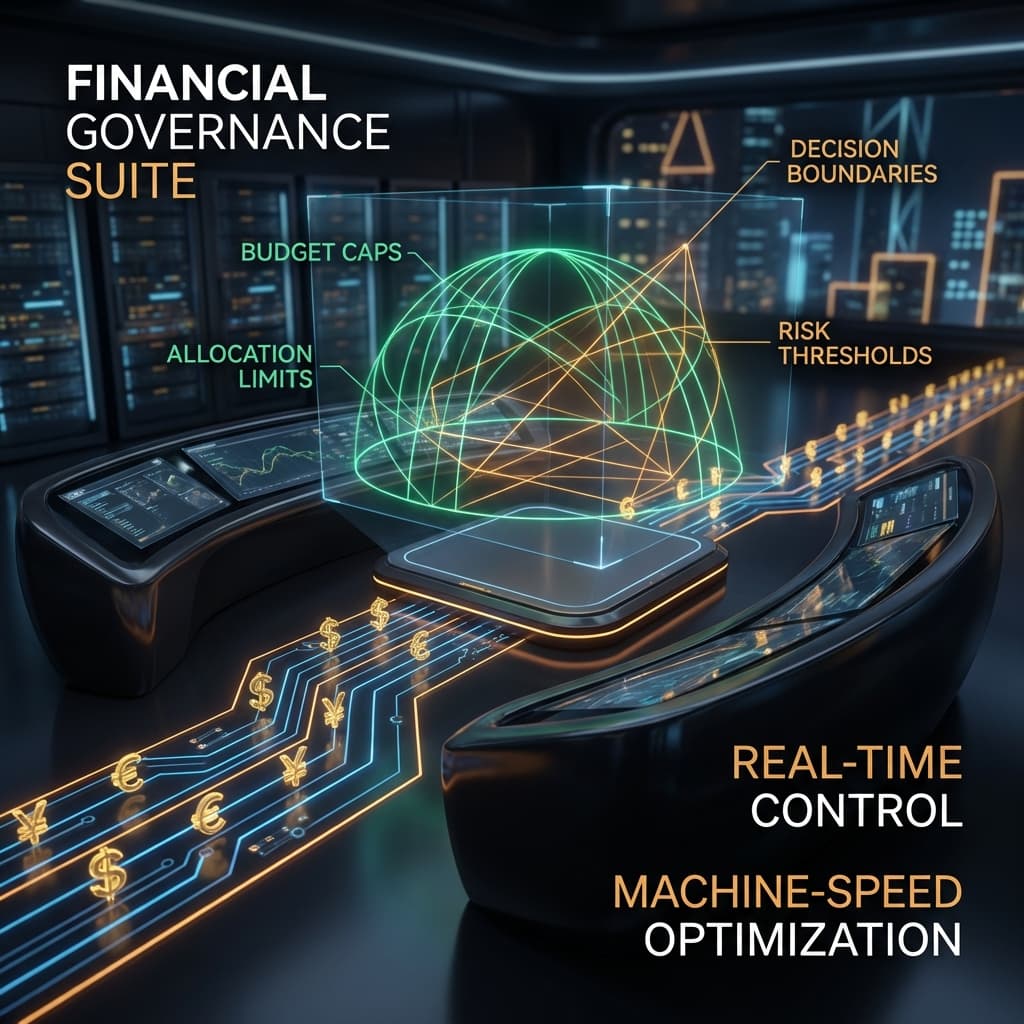
The Rise of Agentic FinOps: Managing the Cost of Autonomy
A 3,000+ word definitive guide to Agentic FinOps in 2026. Learn how to prevent bill shock, set decision boundaries, and architect cost-effective autonomous AI systems.
The Rise of Agentic FinOps: Managing the Cost of Autonomy
It was the "Slack Heard 'Round the World" in February 2025. A CTO at a mid-sized fintech firm woke up to a notification: "Cloud API Usage Exceeded: $42,000 spent in the last 6 hours."
The culprit? A single autonomous agent that had gotten stuck in a logic loop. It was trying to reconcile a transaction, hit an error, and decided—in its infinite, non-human patience—to retry the request. It retried 4 million times, using a high-reasoning model for every single attempt.
In 2026, we don't call this an "accident." We call it a "FinOps failure."
As we give AI the power to call APIs, move data, and make decisions at machine speed, we have introduced a new kind of risk: The Automated Financial Crisis.
In this guide, I’m going to walk you through the discipline of Agentic FinOps. This is your "one-stop-shop" for understanding how to manage the cost of an autonomous software workforce without stifling the "magic."
1. What is Agentic FinOps?
FinOps (Financial Operations) has been a staple of the cloud computing era for a decade. It’s the practice of bringing financial accountability to the variable spend of the cloud.
In the AI era, however, the spend isn't just "variable"—it's Autonomous.
The Difference
- Traditional FinOps: "We launched 100 servers. They cost $1.00 an hour." (Predictable, human-triggered).
- Agentic FinOps: "An agent decided that the best way to solve this customer's problem was to perform a 10-step reasoning trace using $o1$, costing $4.50, and then call a third-party API that charges $2.00 per request." (Unpredictable, machine-triggered).
Agentic FinOps is the art of setting the Guardrails of Autonomy. It is the bridge between the CFO's budget and the Agent's brain.
2. The "Infinite Loop" and the Death of the Blank Check
The greatest fear in 2026 isn't AI taking over the world; it's AI taking over the bank account.
Most agents built in 2024 were built on a "Blank Check" philosophy. The developer gave the agent an API key and said, "Solve this." If the agent took 100 steps to solve it, the developer paid for 100 steps.
This works in a demo. It fails in an enterprise.
The recursive Death Spiral
Imagine an agent tasked with "Closing the Month-End Books."
- The agent finds a $0.05 discrepancy.
- It uses a high-cost reasoning model to "Think" about where the nickel went.
- It decides to search 10,000 invoices (costing $200 in tokens).
- It still can't find it, so it tries a different search strategy (costing another $200).
In 2026, we recognize that it is economically irrational to spend $400 to find a nickel. But a model doesn't know the "Value of Money" unless you tell it.
3. Pillar 1: Decision Boundaries
The first pillar of Agentic FinOps is the Decision Boundary. This is a hard-coded limit written in the architecture (not the prompt) that stops an agent from making an expensive mistake.
The "Cost-per-Outcome" Ceiling
Instead of just asking an agent to "Solve a problem," we give it a Budget for the Mission.
- "You have $5.00 worth of tokens to solve this. If you haven't solved it by then, pause and escalate to a human."
This is implemented via Orchestration Layers (like LangGraph). The code tracks the token usage in real-time. If the threshold is hit, the agent is physically "Suspended." It cannot call the model again.
4. Pillar 2: Compute-Aware Routing
In 2026, we have a "Model Spectrum." We have tiny, 1-billion parameter models that are nearly free, and massive 1-trillion parameter models that are expensive but brilliant.
Weak Architectures use the same "big" model for everything. Strong Architectures use Compute-Aware Routing.
The Hybrid Flow
- Triage: A tiny, $0.0001 model looks at the user request.
- Simple Task: "Is it sunny?" -> Handle with the tiny model.
- Complex Task: "Explain the theory of relativity." -> Route to a mid-tier model.
- Critical Reasoning: "Fix the bug in the transaction engine." -> Route to the expensive $o1$ model.
ROI Metric: By using the "Right Model for the Task," enterprises in 2026 have reduced their AI operating costs by 60-80% without losing quality.
5. Pillar 3: Throttling and Concurrency Control
Humans move slowly. We type, we wait, we think. Agents move at the speed of light.
An agentic system can spawn 1,000 sub-agents in a second. If each of those sub-agents starts querying your production database, you won't just have a "Bill Shock"—you will have a Denial of Service (DoS) attack.
Rate Limiting as FinOps
In 2026, we apply "Financial Throttling."
- "This department has a budget of $100 per hour for AI operations."
- If the agents are working too fast and hit $100 at minute 45, the system automatically slows down their "execution speed" until the next hour begins.
This prevents the "Flash Crash" of your compute budget.
6. The "Shadow AI" Workforce: Reclaiming Control
A major challenge for CFOs in 2026 is "Shadow AI." This is when individual employees or small teams use their company credit cards to buy separate AI subscriptions (ChatGPT Team, Claude Enterprise, Perplexity, etc.).
These subscriptions are "static" costs, but they provide no centralized visibility.
The Multi-Agent Hub Leading enterprises are consolidating all AI spend into a single "Orchestration Hub."
- Employees don't talk to OpenAI directly. They talk to the Internal Agent Hub.
- The Hub handles the API keys, the routing, and the Accounting.
- At the end of the month, the CFO can see exactly which department's agents were the most "Efficient" and which were "Token Gluttons."
7. Case Study: The $50,000 Opportunity Cost
Let's look at a real-world scenario from 2026.
Company: "Astra Finance" Problem: They were using a "One-Agent-Does-All" approach for customer support.
The Event: A viral tweet about their product caused a 1,000% spike in traffic over a weekend. Their agent, built without FinOps guardrails, scaled automatically to handle the load.
- By Sunday night, they had spent $50,000 in AI tokens answering basic questions like "What is your return policy?"
- 80% of those questions could have been answered by a static FAQ for $0.00.
The Fix: They implemented an Agentic FinOps Router.
- Level 1 (FAQ Cache): Cost $0.
- Level 2 (Small Model): Cost $0.01.
- Level 3 (Human Handoff): Cost $0.50.
Result: The next time a spike happened, their bill was only $400. They saved $49,600 by simply Architecting for Cost.
8. The ROI of "Weak Architecture"
I often tell my clients: "Your AI bill is a reflection of your code quality."
If your code is weak, the LLM has to do more work. It has to "Reason" its way through things that should have been solved with a simple if/else statement.
- If your database is messy, the agent has to spend 1,000 tokens "cleaning" the data every time it reads it.
- If your documentation is poorly structured, the agent has to "Re-read" the same 5,000 tokens over and over to find a single fact.
Agentic FinOps is as much about Data Engineering as it is about Budgeting. Clean data is the best cost-saving tool you have.
9. Conclusion: The One-Stop Recap
As we enter 2026, the era of "Playing with AI" is over. We are now in the era of Operating AI. And you cannot operate what you cannot afford.
- Stop the Blank Check: Set Decision Boundaries.
- Optimize the Stack: Use Compute-Aware Routing.
- Monitor at Machine Speed: Use real-time token tracking.
- Clean Your House: Good architecture is cheaper than smart models.
The "Magic" of AI is its ability to act on its own. The "Meaning" of FinOps is ensuring those actions lead to growth, not bankruptcy.
Stay profitable. Stay visionary.
Resources for Further Reading
- Context Engineering: How to make agents more efficient through data packaging.
- The Multi-Agent Workforce: Measuring ROI through outcomes.
- ShShell.com: Building the future of enterprise AI governance.
Written with the intention to help others and give back to the tech community. Stay Visionary.